In the Name of Allah, the Most Gracious, the Most Merciful.
Swearing by the Sanctity of Makkah and Other Things that Man was created in Hardship
Here Allah has sworn by Makkah, the Mother of the Towns, addressing its resident (during the non-sacred months,) free in this city in order to draw his attention to the significance of its sanctity when its people are in the state of sanctity. Khusayf reported from Mujahid;
لاَ أُقْسِمُ بِهَـذَا الْبَلَدِ
(Nay! I swear by this city;) "The word "La" (Nay) refers to the refutation against them (Quraish). I swear by this city." Shabib bin Bishr narrated from `Ikrimah, from Ibn `Abbas that he said,
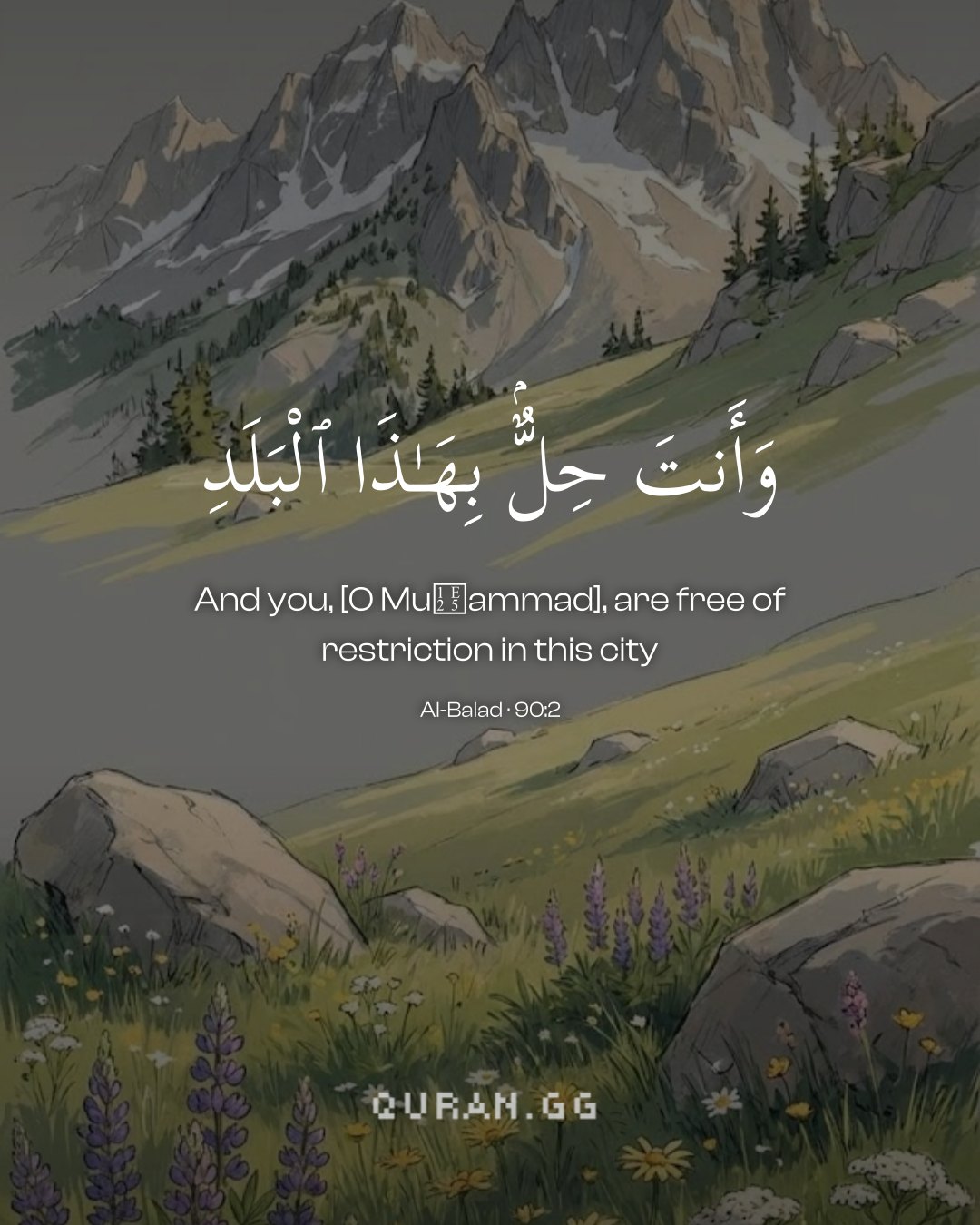
وَأَنتَ حِلٌّ بِهَـٰذَا الْبَلَدِ (and [ 0 Holy Prophet,] you are going to be allowed to fight in this city....90:2). The word hillun bears two possibilities: [ 1] It could be derived from hulul which signifies to reside in or to descend on some place. In this sense, hillun signifies 'a dweller or resident' and the verse purports to say that the city of Makkah itself is sacred, and since Holy Prophet Muhammad ﷺ is the inhabitant of this city, it adds to the sanctity, honour and glory of the place. Thus, on account of the Holy Prophet's ﷺ residing in that city its honour and sanctity has been enhanced and augmented. The second possibility is that it is derived from hillatun which means 'the thing the doing of which is lawful'. From this point of view, hillun could signify one of two things: One that the pagans of Makkah consider it lawful to do the Holy Prophet ﷺ any harm, even to kill him, in this City of Makkah which is so sacred that the doing of harm to a living creature in its precincts, not to say of killing it or hunting it, is strictly forbidden even according to their own belief system. Secondly, this may be a prophecy that the city of Makkah is going to be made lawful for the Holy Prophet in the sense that fighting in it will be allowed for him for a specified time, and He will alight in this City of Makkah, as it happened on the occasion of the Conquest of Makkah. On this occasion, all the injunctions and ordinances of the حرم Haram were suspended for one day, and it was made lawful to kill the disbelievers. Mazhari cites three possible meanings, and says that all three of them are equally possible.
Uthmani text of the Madinah mushaf (King Fahd Complex). Translation: Saheeh International. Tafsir via Quran.com.