Surah Al-Baqarah Ayah 10 (2:10) — Meaning & Tafsir | Quran.GG

Surah Al-Baqarah, Ayah 10

2:10 · Meaning and tafsir

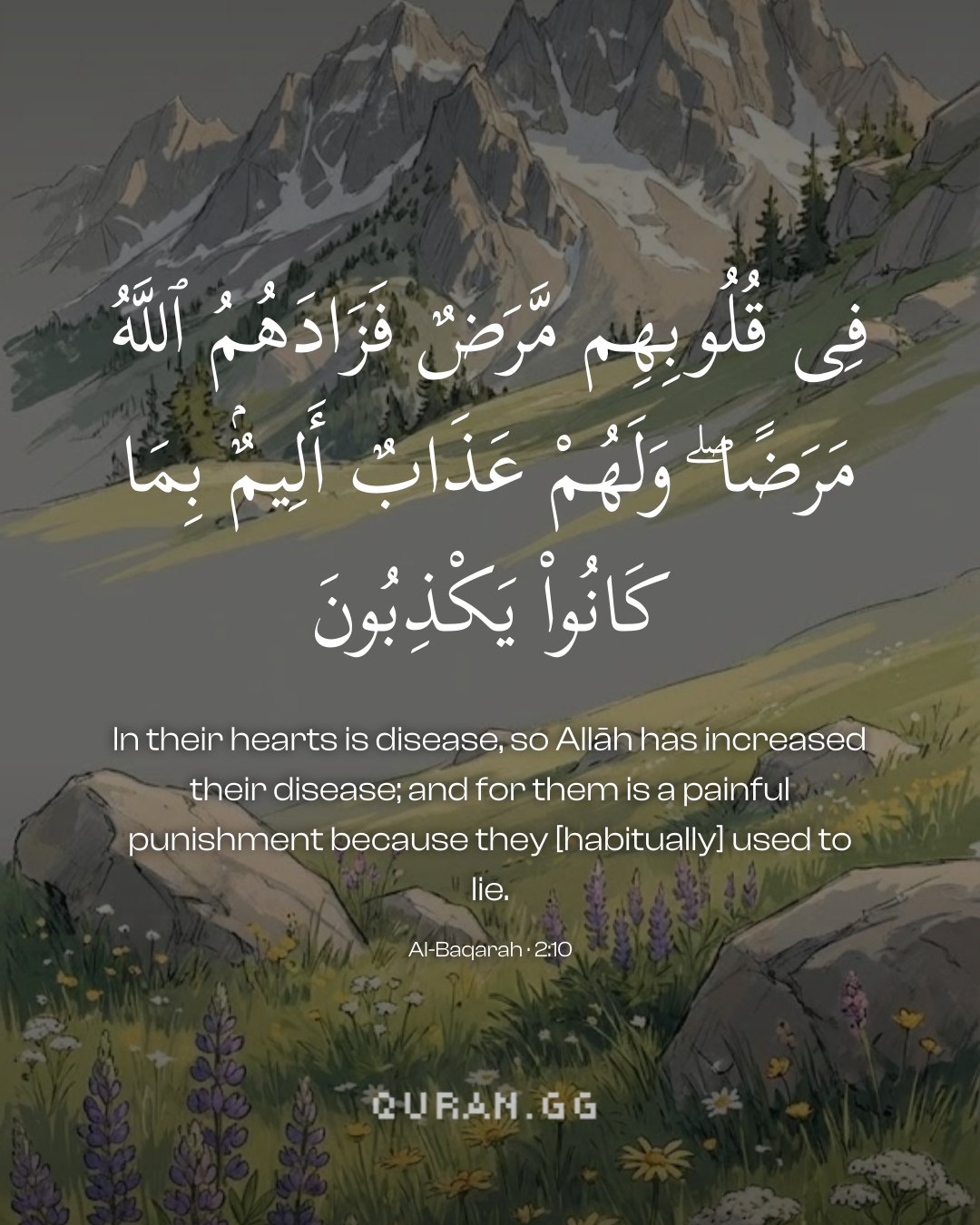
فِى قُلُوبِهِم مَّرَضٌ فَزَادَهُمُ ٱللَّهُ مَرَضًا ۖ وَلَهُمْ عَذَابٌ أَلِيمٌۢ بِمَا كَانُوا۟ يَكْذِبُونَ ١٠

In their hearts is disease, so Allāh has increased their disease; and for them is a painful punishment because they [habitually] used to lie.

Surah Al-Baqarah 2:10 in Arabic with its translation: “In their hearts is disease, so Allāh has increased their disease; and for them is a painful punishment…”

Make something with this ayah

Turn it into a video for Stories, Reels or TikTok, recited by the reciter you pick, or an image on a background you choose. Free, in your browser.

Download this image

Tafsir Ibn Kathir (abridged)

The Meaning of `Disease' in this Ayah

As-Suddi narrated from Abu Malik and (also) from Abu Salih, from Ibn `Abbas, and (also) Murrah Al-Hamdani from Ibn Mas`ud and other Companions that this Ayah,

فِى قُلُوبِهِمْ مَّرَضٌ

(In their hearts is a disease) means, `doubt', and,

فَزَادَهُمُ اللَّهُ مَرَضًا

(And Allah has increased their disease) also means `doubt'. Mujahid, `Ikrimah, Al-Hasan Al-Basri, Abu Al-`Aliyah, Ar-Rabi` bin Anas and Qatadah also said similarly. `Abdur-Rahman bin Zayd bin Aslam commented on,

فِى قُلُوبِهِمْ مَّرَضٌ

(In their hearts is a disease), "A disease in the religion, not a physical disease. They are the hypocrites and the disease is the doubt that they brought to Islam.

فَزَادَهُمُ اللَّهُ مَرَضًا

(And Allah has increased their disease) meaning, increased them in shameful behavior." He also recited,

فَأَمَّا الَّذِينَ ءامَنُواْ فَزَادَتْهُمْ إِيمَـناً وَهُمْ يَسْتَبْشِرُونَوَأَمَّا الَّذِينَ فِى قُلُوبِهِم مَّرَضٌ فَزَادَتْهُمْ رِجْسًا إِلَى رِجْسِهِمْ

(As for those who believe, it has increased their faith, and they rejoice. But as for those in whose hearts is a disease, it will add disgrace to their disgrace.) (9:124-125) and commented, "Evil to their evil and deviation to their deviation." This statement by `Abdur-Rahman is true, and it constitutes a punishment that is compatible to the sin, just as the earlier scholars stated. Similarly, Allah said,

وَالَّذِينَ اهْتَدَوْاْ زَادَهُمْ هُدًى وَءَاتَـهُمْ تَقُوَاهُمْ

(While as for those who accept guidance, He increases their guidance and grants them their piety) (47:17).

Allah said next,

بِمَا كَانُواْ يَكْذِبُونَ

(Because they used to tell lies). The hypocrites have two characteristics, they lie and they deny the Unseen.

The scholars who stated that the Prophet ﷺ knew the hypocrites of his time have only the Hadith of Hudhayfah bin Al-Yaman as evidence. In it the Prophet ﷺ gave him the names of fourteen hypocrites during the battle of Tabuk. These hypocrites plotted to assassinate the Prophet ﷺ during the night on a hill in that area. They planned to excite the Prophet's ﷺ camel, so that she would throw him down the hill. Allah informed the Prophet ﷺ about their plot, and the Prophet ﷺ told Hudhayfah their names.

As for the other hypocrites, Allah said about them,

وَمِمَّنْ حَوْلَكُم مِّنَ الاٌّعْرَابِ مُنَـفِقُونَ وَمِنْ أَهْلِ الْمَدِينَةِ مَرَدُواْ عَلَى النَّفَاقِ لاَ تَعْلَمُهُمْ نَحْنُ نَعْلَمُهُمْ

(And among the bedouins around you, some are hypocrites, and so are some among the people of Al-Madinah who persist in hypocrisy; you (O Muhammad ) know them not, We know them) (9:101), and,

لَّئِن لَّمْ يَنتَهِ الْمُنَـفِقُونَ وَالَّذِينَ فِى قُلُوبِهِمْ مَّرَضٌ وَالْمُرْجِفُونَ فِى الْمَدِينَةِ لَنُغْرِيَنَّكَ بِهِمْ ثُمَّ لاَ يُجَاوِرُونَكَ فِيهَآ إِلاَّ قَلِيلاً - مَّلْعُونِينَ أَيْنَمَا ثُقِفُواْ أُخِذُواْ وَقُتِّلُواْ تَقْتِيلاً

(If the hypocrites, and those in whose hearts is a disease, and those who spread false news among the people in Al-Madinah do not cease, We shall certainly let you overpower them, then they will not be able to stay in it as your neighbors but a little while. Accursed, they shall be seized wherever found, and killed with a (terrible) slaughter) (33:60-61).

These Ayat prove that the Prophet ﷺ was not informed about each and everyone among the hypocrites of his time. Rather, the Prophet ﷺ was only informed about their characteristics, and he used to assume that some people possessed these characteristics. Similarly, Allah said,

وَلَوْ نَشَآءُ لأَرَيْنَـكَهُمْ فَلَعَرَفْتَهُم بِسِيمَـهُمْ وَلَتَعْرِفَنَّهُمْ فِى لَحْنِ الْقَوْلِ

(Had We willed, We could have shown them to you, and you should have known them by their marks; but surely, you will know them by the tone of their speech!) (47:30).

The most notorious hypocrite at that time was `Abdullah bin Ubayy bin Salul; Zayd bin Arqam - the Companion - gave truthful testimony to that effect. In addition, `Umar bin Al-Khattab once mentioned the matter of Ibn Salul to the Prophet ﷺ, who said,

«إِنِّي أَكْرَهُ أَنْ تَتَحَدَّثَ الْعَرَبُ أَنَّ مُحَمَّدًا يَقْتُلُ أَصْحَابَه»

(I would not like the Arabs to say to each other that Muhammad is killing his Companions.)

Yet, when Ibn Salul died, the Prophet ﷺ performed the funeral prayer for him and attended his funeral just as he used to do with other Muslims. It was recorded in the Sahih that the Prophet ﷺ said,

«إِنِّي خُيِّرْتُ فَاخْتَرْت»

(I was given the choice (to pray for him or not), so I chose.)

In another narration, the Prophet ﷺ said,

«لَوْ أَعْلَمُ أَنِّي لَوْ زِدْتُ عَلَى السَّبْعِينَ يُغْفَرُ لَهُ لَزِدْت»

(If I knew that by asking (Allah to forgive Ibn Salul) more than seventy times that He would forgive him, then I would do that.)

Ma'arif al-Qur'an

The third verse indicates why the hypocrites behave so foolishly and why they fail to see the folly of their course:

فِي قُلُوبِهِم مَّرَ‌ضٌ فَزَادَهُمُ اللَّـهُ مَرَ‌ضًا

In their hearts there is a malady, so Allah has made them grow in their malady.

Now, illness or disease, in the general medical sense, is a state in which a man has lost the balanced proportion of the elements within him necessary to keep him healthy, so that his body can no longer function properly, which may finally lead to his total destruction. In the terminology of the Holy Qur'an and the Hadith, the word 'disease' is also applied to certain mental or psychic states (we are using the two terms in the original and more comprehensive sense) which hinder man from attaining any degree of spiritual perfection, for they gradually deprive him of the ability to perform good deeds, and even of ordinary human decency, till he meets with his spiritual death. The great spiritual master, Junaid of Baghdad, has said that just as the diseases of the body arise from an imbalance among the four humours, the diseases of the heart arise from a surrender to one's physical desires. According to the present verse, the disease hidden in their hearts is unbelief and rejection of the truth, which is as much a physical sickness as a spiritual one. It is all too obvious that being ungrateful to one's creator and nourisher and going against His commandments is to be spiritually sick. Moreover, to keep this disbelief concealed for the sake of petty worldly gains and not to have the courage to speak out one's mind is no less a disease of the soul. Hypocrisy is a physical disease too in so far as the hypocrite is always shuddering4for fear of being exposed. Jealousy being a necessary ingredient of hypocrisy, he cannot bear to see the Muslims growing stronger in the world, and yet the poor hypocrite cannot even have the satisfaction of unburdening his heart of the venom. No wonder that all this tension should express itself in physical ailment.

The curse of telling lies

(4) There is another subtle and very significant point here. According to these verses, the hypocrites would meet with a grievous punishment for having told lies. Now, their greatest crime was disbelief and hypocrisy in matters of faith, and they had been committing other crimes as well, like nursing envy and malice against Muslims in their hearts and actually conspiring against them. And yet here the grievous punishment has been connected with their habit of telling lies. This is an indication that basically this nefarious habit was their real crime, which gradually led them to hypocrisy and disbelief. In other words, although hypocrisy and disbelief are much greater crimes, yet they arise from the habit of telling lies. That is why the Holy Qur'an combines the sin of lying with the sin of idol worship in the same phrase:

فَاجْتَنِبُوا الرِّ‌جْسَ مِنَ الْأَوْثَانِ وَاجْتَنِبُوا قَوْلَ الزُّورِ‌

"Guard yourselves against the filth of idols and against telling lies" (22:30)

Tazkirul Quran

If one closes one’s eyes, one will not be able to see. If one blocks one’s ears, one will not be able to hear. However clear the call of truth may be, it can be understood and accepted only if one opens one’s mind to it. God’s inaudible call present in the universe, and the audible expression of that call by the preacher of God’s word, cannot touch those who have closed minds. The call of truth in its pure, unadulterated form is founded on reality; it is in accord with nature. When it is made, none can fail to recognize it. If one hears it with an open mind, one will know in one’s heart that it is nothing else but truth. However, where society is rigidly bound by age-old conventions, people are less concerned with opening their minds to divine realities than they are with supporting the vested interests of the existing system. As God’s emissary, the preacher is neither a representative nor a supporter of the conventional structures of society. His call, being new and unfamiliar, poses itself as a threat to material security. Much as people are urged by him to submit to the will of God, they baulk at doing so, because it would mean demolishing the world they have made for themselves. It is difficult also for him to convey his message to highly placed individuals who are afraid that, if they follow an ‘insignificant’ person, they will thereby suffer some diminution of their own personal glory. The two greatest obstacles then to the success of the preacher are people’s worldliness and arrogance. It is these mental states, which prevent people from accepting the truth; the Quran has called them ‘seals’ over people’s hearts. The minds of those who do not consider the call of truth seriously, who are proud and worldly in their attitude, are covered with an invisible veil which makes them impervious to the truth. When one is prejudiced against something, one cannot see its rationality, even if there are clear signs in support of it.

Continue reading the tafsir of ayahs 7–12

Uthmani text of the Madinah mushaf (King Fahd Complex). Translation: Saheeh International. Tafsir via Quran.com.