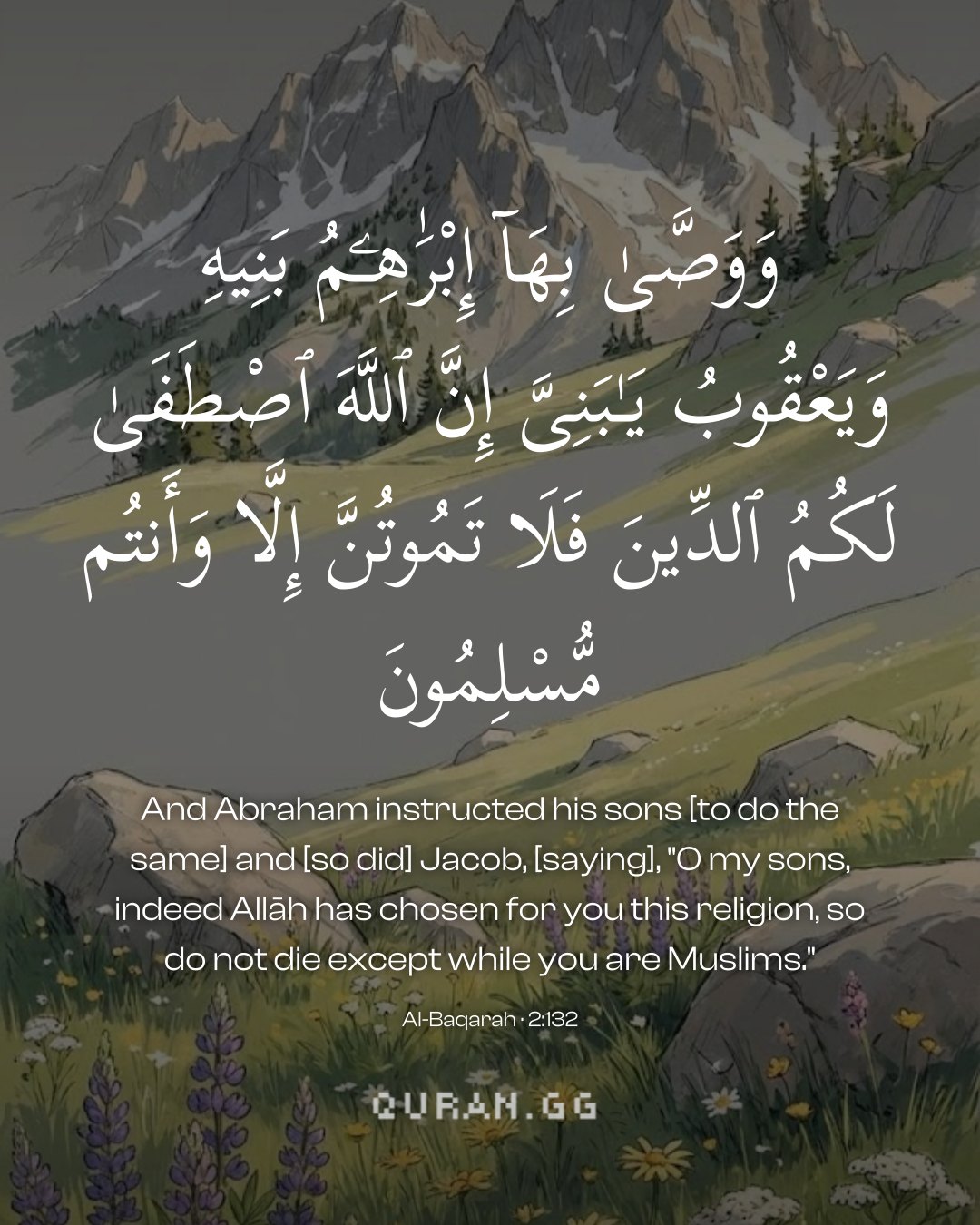
And Abraham instructed his sons [to do the same] and [so did] Jacob, [saying], "O my sons, indeed Allāh has chosen for you this religion, so do not die except while you are Muslims."
Allah refuted the disbelievers' innovations of associating others with Allah in defiance of the religion of Ibrahim, the leader of the upright. Ibrahim always singled out Allah in worship, with sincerity, and he did not call upon others besides Allah. He did not commit Shirk, even for an instant. He disowned every other deity that was being worshipped instead of Allah and defied all his people in this regard. Prophet Ibrahim said,
Verse 131 defines the basic principle of the religion of Sayyidna Ibrahim (علیہ السلام) . Allah asked him to submit himself, and he willingly and gladly agreed to submit himself to "the Lord of the worlds." Let us add that the word of command employed in this verse is Aslim اَسلِم ، which comes from the same root as the word Islam. It is difficult to find an exact English equivalent, for the word signifies "to obey, to submit oneself, to surrender one's will." Anyhow, we should notice that in reply to the divine command, he did not say, as one would have expected, اَسلَمتُ لَک : "I submit myself to you," but, more elaborately: اَسلَمتُ لِرَبِّ الْعَالَمِين : "I submit myself to the Lord of the worlds." This particular form of reply expresses the attitude of respect and awe proper to the occasion, and includes the praise of Allah which the moment of receiving the honour of divine address demanded. It also carries a recognition of the fact that in submitting himself to the Lord of the worlds he was only performing the essential duty of a servant towards the Master of All, and doing it for his own benefit. The reply makes it clear that the basic principle of the religion of Sayyidna Ibrahim (علیہ السلام) ، and its very essence is contained in one word, Islam, which signifies total obedience and willing submission of oneself to Allah. It was to show to the world his perfect adherence to this principle that he was made to pass through all the trials before attaining his exalted station. Islam اسلام ، or submission to Allah, is what the world has been created for; it is the end all the prophets and all the divine books have been sent to serve.
The message taught by the Prophet Muhammad was exactly the same as had been taught by Abraham. But those People of the Book, who prided themselves on being followers of Abraham, led the opposition against the Prophet. Why did they act in this manner? The reason was that the religion that the Prophet taught, and which Abraham had taught before him, was the religion of Islam. Now, Islam means total submission to God, and it was this religion that Abraham handed down to his offspring. But the religion that the People of the Book practised had nothing to do with total submission to God. Having lapsed into permissiveness and, unwilling to change this lifestyle, they had allowed their religion to degenerate into a series of hollow rituals, which they fondly believed would make it easy for them to enter paradise. In the religion that the Prophet Muhammad taught, however, one could gain salvation only by virtue of one’s actions. The People of the Book, for their part, thought that their affiliation to a nation of saints and prophets would be sufficient to earn them redemption. There was a world of difference then between Islam, the true religion of Abraham, and the religion that the People of the Book practised and attributed to him. True religion means acceptance of divine guidance, as revealed to man through the prophets, whereas the religion practised by the People of the Book was based on their own national legacy, a collection of national traditions, which had accumulated over generations.
Uthmani text of the Madinah mushaf (King Fahd Complex). Translation: Saheeh International. Tafsir via Quran.com.