Allah said, if they, the disbelievers among the People of the Book and other disbelievers, believe in all of Allah's Books and Messengers and do not differentiate between any of them,
فَقَدِ اهْتَدَواْ
(then they are rightly guided) meaning, they would acquire the truth and be directed to it.
وَإِن تَوَلَّوْاْ
(but if they turn away) from truth to falsehood after proof had been presented to them,
(then they are only in opposition. So Allah will suffice you against them) meaning, Allah will aid the believers against them,
وَهُوَ السَّمِيعُ الْعَلِيمُ
(And He is the Hearer, the Knower). Allah said,
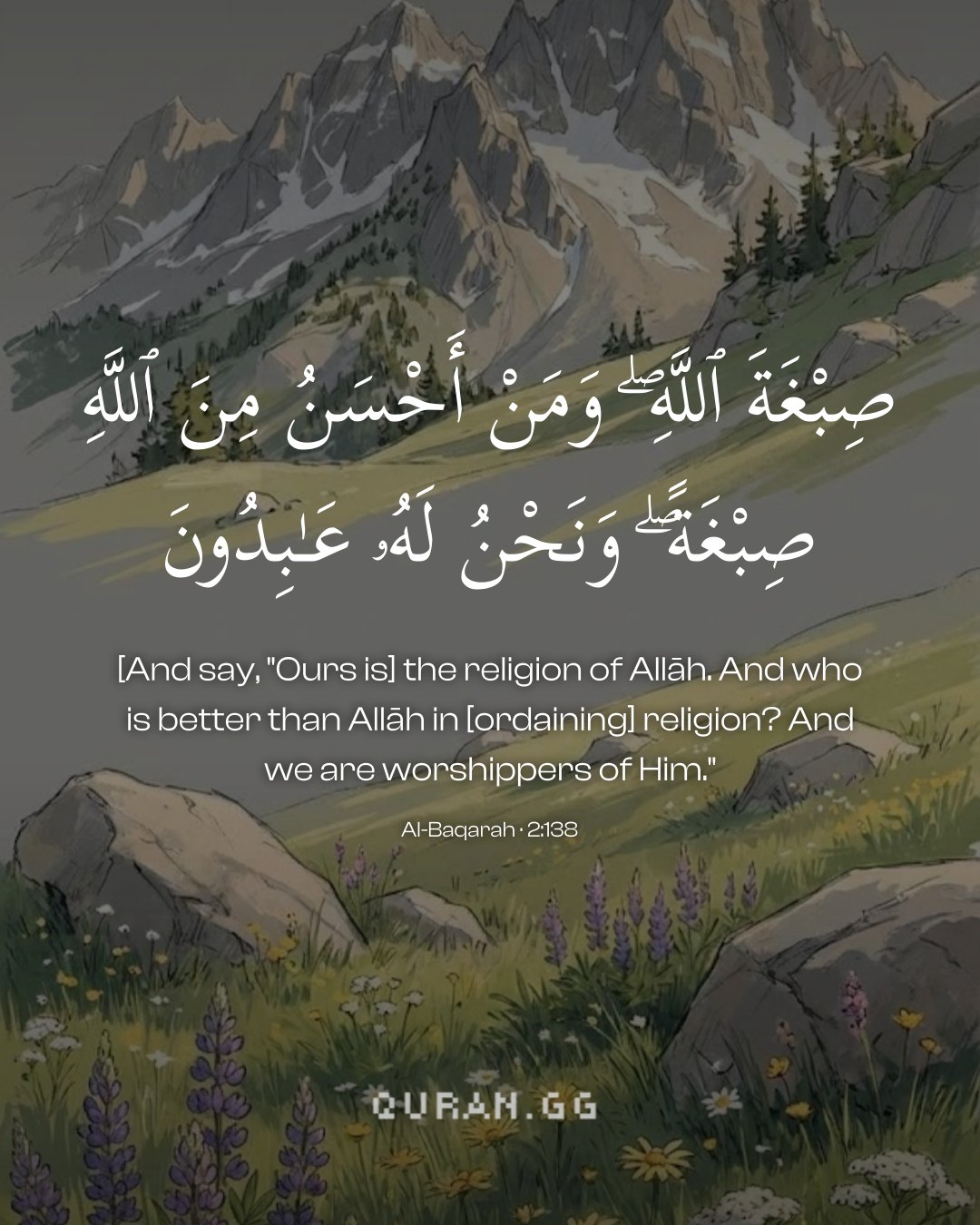
صِبْغَةَ اللَّهِ
(The Sibghah of Allah). Ad-Dahhak said that Ibn `Abbas commented, "The religion of Allah." This Tafsir was also reported of Mujahid, Abu Al-`Aliyah, `Ikrimah, Ibrahim, Al-Hasan, Qatadah, Ad-Dahhak, `Abdullah bin Kathir, `Atiyah Al-`Awfi, Ar-Rabi` bin Anas, As-Suddi and other scholars. The Ayah,
فِطْرَةَ اللَّهِ
(Allah's Fitrah (i.e. Allah's Islamic Monotheism)) (30:30) directs Muslims to, "Hold to it."
Ma'arif al-Qur'an
Mufti Muhammad Shafi
The Colour of Allah
Verse 138 delineates Islam as the "colouring of Allah", and explains this "colouring" as the unalloyed worship of Allah and total submission to Him. Verse 135 has identified Islam with "the religion of Ibrahim." If we put Verse 135 and 138 together, it becomes clear that essentially Islam - or any authentic religion, for that matter – is the religion of Allah, and that the association of a religion with the name of a prophet can only be symbolised.
Verse 138 presents religion as "colouring" صبغہ (Sibghah). The expression carries within itself several levels of meaning. But the immediate allusion is to a certain ceremony of the Christians. On the seventh day of its birth, they used to bathe an infant in coloured (probably yellow) water, which was supposed to be a substitute for circumcision, and a sufficient guarantee for the external and internal purification of the infant - the fast and indelible "colouring" of Christian faith, so to say. The verse suggests that this colour is wasted away with the water, without leaving a trace outside or inside, nor does this kind of baptism serve the purpose of circumcision and cleanse a man of physical impurity. And the verse declares that the only colouring worth the name is the colouring of a genuine and unabrogated religion - that is, Islam اسلام۔ the only colouring which can guarantee physical and spiritual purification, and the only one which shall remain. Then, the word Sibghah صِبْغَةَ or "colouring" has a deeper meaning too. Just as a certain colour is openly and clearly visible to the beholder, the signs of genuine and pure 'Iman ایمان should shine through the face, the movements, the habits and the behaviour of a Muslim. In this sense, the verse is a commandment, asking Muslims "to dye" themselves in the "colouring of Allah", outwardly and inwardly by offering unalloyed worship to Him alone, by submitting themselves totally to His commandments, and by gladly accepting His will.
Tazkirul Quran
Maulana Wahiduddin KhanOn ayahs 136–140
The religion that the Prophet Muhammad taught was the religion of the Prophet Abraham, the very religion to which the Jews and the Christians claimed allegiance. Why was it, then, that they turned away from the Prophet Muhammad? The reason for this was that the religion brought by the Prophet, taught people to take on the hue of God; to devote themselves to Him entirely. With the People of the Book, religion had a different meaning. For them religion was reduced to a symbol of national pride. The message brought by the Prophet hurt their pride, so they turned against him. Those who consider their own race superior to others cannot accept the truth when it manifests itself in some nation other than their own. They would believe in prophets who came from amongst their own people, but not in those who appeared among other people outside their own community. The only personalities that they acknowledged were those who belonged to their own race. Those who look at religion as worship of God, on the other hand, recognize the truth of every piece of wisdom that God sends down, no matter who teaches it. For the theologians to realize that the Prophet was God’s final messenger was not a matter of insuperable difficulty. There was nothing to prevent them from seeing the truth of his religion. They should have proclaimed what, deep down in their hearts, they knew to be true. But they did not accept him as the final prophet, as was enjoined by God, for the simple reason that they were more concerned about their own position and prestige. Just as the people of old received their just deserts as individuals, so will latter-day generations receive what they merit on their own account, for truth is an individual, not an ancestral matter. The mistake of the People of the Book was to think that contemporary and succeeding generations would be rewarded for the good deeds of their ancestors. The idea of original sin held by Christians implied that sins were handed down from one generation to the next. Such beliefs have no basis in truth. Everyone will be rewarded by God according to his or her own personal actions; no one can be held responsible for the deeds of others.