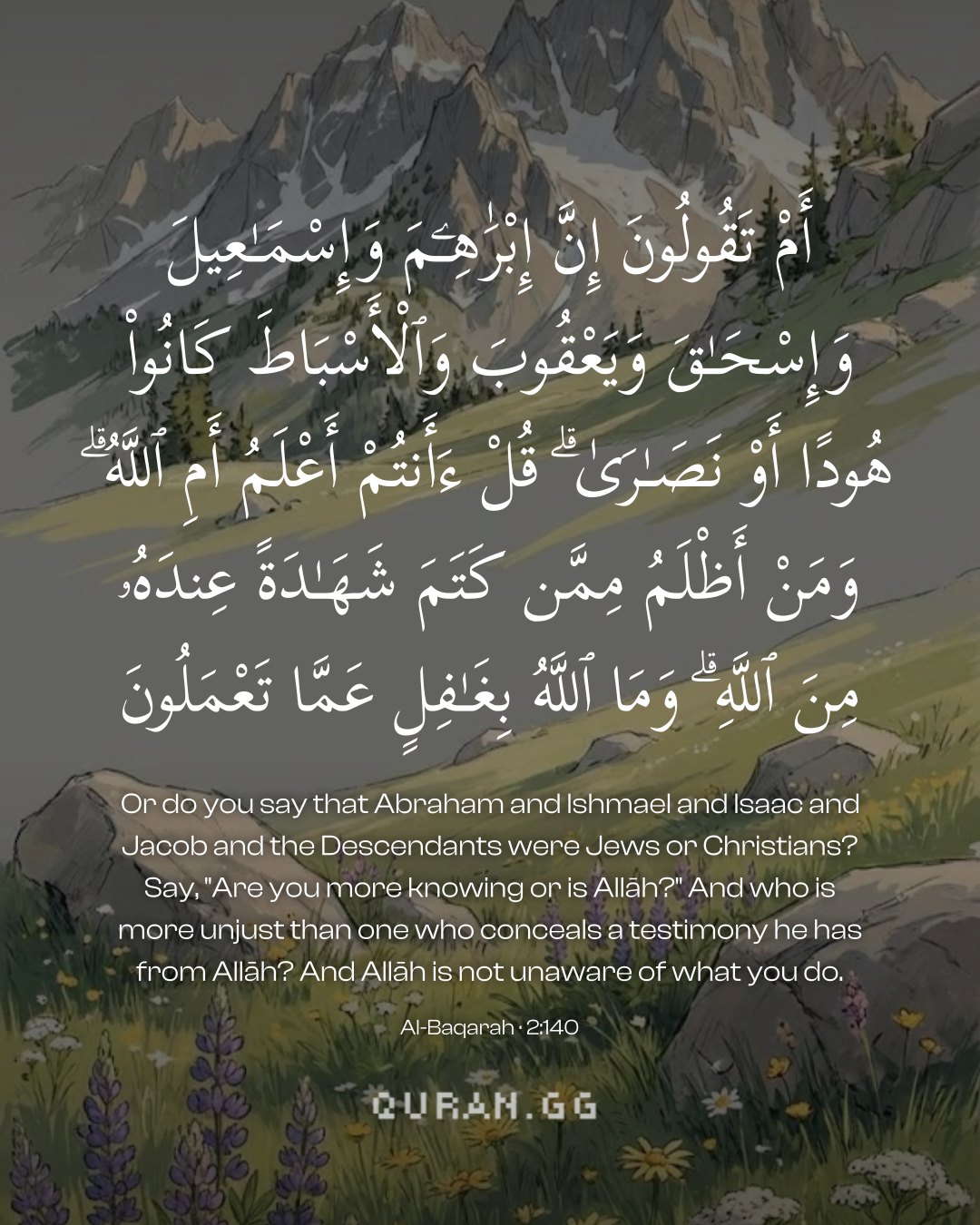
Or do you say that Abraham and Ishmael and Isaac and Jacob and the Descendants were Jews or Christians? Say, "Are you more knowing or is Allāh?" And who is more unjust than one who conceals a testimony he has from Allāh? And Allāh is not unaware of what you do.
Allah directed His Prophet to pre-empt the arguments with the idolators:
قُلْ أَتُحَآجُّونَنَا فِى اللَّهِ
(Say (O Muhammad to the Jews and Christians), "Dispute you with us about Allah) meaning, "Do you dispute with us regarding the Oneness of Allah, obedience and submission to Him and in avoiding His prohibitions,
وَهُوَ رَبُّنَا وَرَبُّكُمْ
(while He is our Lord and your Lord) meaning, He has full control over us and you, and deserves the worship alone without partners.
وَلَنَآ أَعْمَـلُنَا وَلَكُمْ أَعْمَـلُكُمْ
(And we are to be rewarded for our deeds and you for your deeds.) meaning, we disown you and what you worship, just as you disown us. Allah said in another Ayah,
These three verses bring to an end the section of the Surah in which certain claims of the Jews and the Christians have been refuted -- for example, their assertion that Sayyidna Ibrahim (علیہ السلام) (Abraham), Sayyidna Ismail (علیہ السلام) (Ishmael), Sayyidna Ishaq (علیہ السلام) (Isaac), Sayyidna Ya` qub (علیہ السلام) (Jacob) and the prophets (علیہم السلام) in his lineage were either Jews or Christians, and the claim that they were the chosen people and would have the exclusive privilege of being sent straight to Paradise which would be denied to Muslims. The earlier verses have established that the religion of all these prophets was Islam, in the general sense of the term, but that the earlier Shari` ahs have now been abrogated, and the title of "Islam" been specially given to the religion of Sayyidna Muhammad ﷺ . Should the Jews and the Christians still continue, in their stubbornness, to deny, Allah asks the Holy Prophet ﷺ and the Muslims to declare in plain and simple words that Allah, being the Lord of All, cannot show any special favour to any particular group of His creatures, and that on the Day of Judgment He will assess the Jews and the Christians as well as the Muslims according to what each has believed in and how each has been behaving - a principle which was accepted by the People of the Book too. The Muslims have also been asked to announce that they on their part recognize no other god but Allah, and have purified their religion of all traces of association (Shirk شرک ) - as against the Jews and the Christians who consider Sayyidna ` Uzayr (علیہ السلام) (Ezra) and Sayyidna ` Isa (علیہ السلام) (Jesus) respectively to be "the Son of God", and whose religions have, moreover, been abrogated. In this respect at least, Muslims have a superiority over them. If the People of the Book should, on account of their affiliation with the earlier prophets, still keep insisting on their own rectitude, the Muslims may ask them a basic question - who knows the truth better, Allah or the People of the Book? Allah has definitely and finally announced the truth in the Last Revelation, and the People of the Book themselves know that the religion of the earlier prophets was Islam. Yet they are trying to conceal the truth, and being unjust, in the gravest sense of the term. Allah knows what they have been doing, and will judge them according to their own deeds, and not according to the deeds of their ancestors. Thus, at the end of this section, Verse 141, which is a repetition of Verse 134, warns them against the consequences of their vanity and pretentiousness, and advises them to take care of themselves rather than relying on ancestral glory.
The religion that the Prophet Muhammad taught was the religion of the Prophet Abraham, the very religion to which the Jews and the Christians claimed allegiance. Why was it, then, that they turned away from the Prophet Muhammad? The reason for this was that the religion brought by the Prophet, taught people to take on the hue of God; to devote themselves to Him entirely. With the People of the Book, religion had a different meaning. For them religion was reduced to a symbol of national pride. The message brought by the Prophet hurt their pride, so they turned against him. Those who consider their own race superior to others cannot accept the truth when it manifests itself in some nation other than their own. They would believe in prophets who came from amongst their own people, but not in those who appeared among other people outside their own community. The only personalities that they acknowledged were those who belonged to their own race. Those who look at religion as worship of God, on the other hand, recognize the truth of every piece of wisdom that God sends down, no matter who teaches it. For the theologians to realize that the Prophet was God’s final messenger was not a matter of insuperable difficulty. There was nothing to prevent them from seeing the truth of his religion. They should have proclaimed what, deep down in their hearts, they knew to be true. But they did not accept him as the final prophet, as was enjoined by God, for the simple reason that they were more concerned about their own position and prestige. Just as the people of old received their just deserts as individuals, so will latter-day generations receive what they merit on their own account, for truth is an individual, not an ancestral matter. The mistake of the People of the Book was to think that contemporary and succeeding generations would be rewarded for the good deeds of their ancestors. The idea of original sin held by Christians implied that sins were handed down from one generation to the next. Such beliefs have no basis in truth. Everyone will be rewarded by God according to his or her own personal actions; no one can be held responsible for the deeds of others.