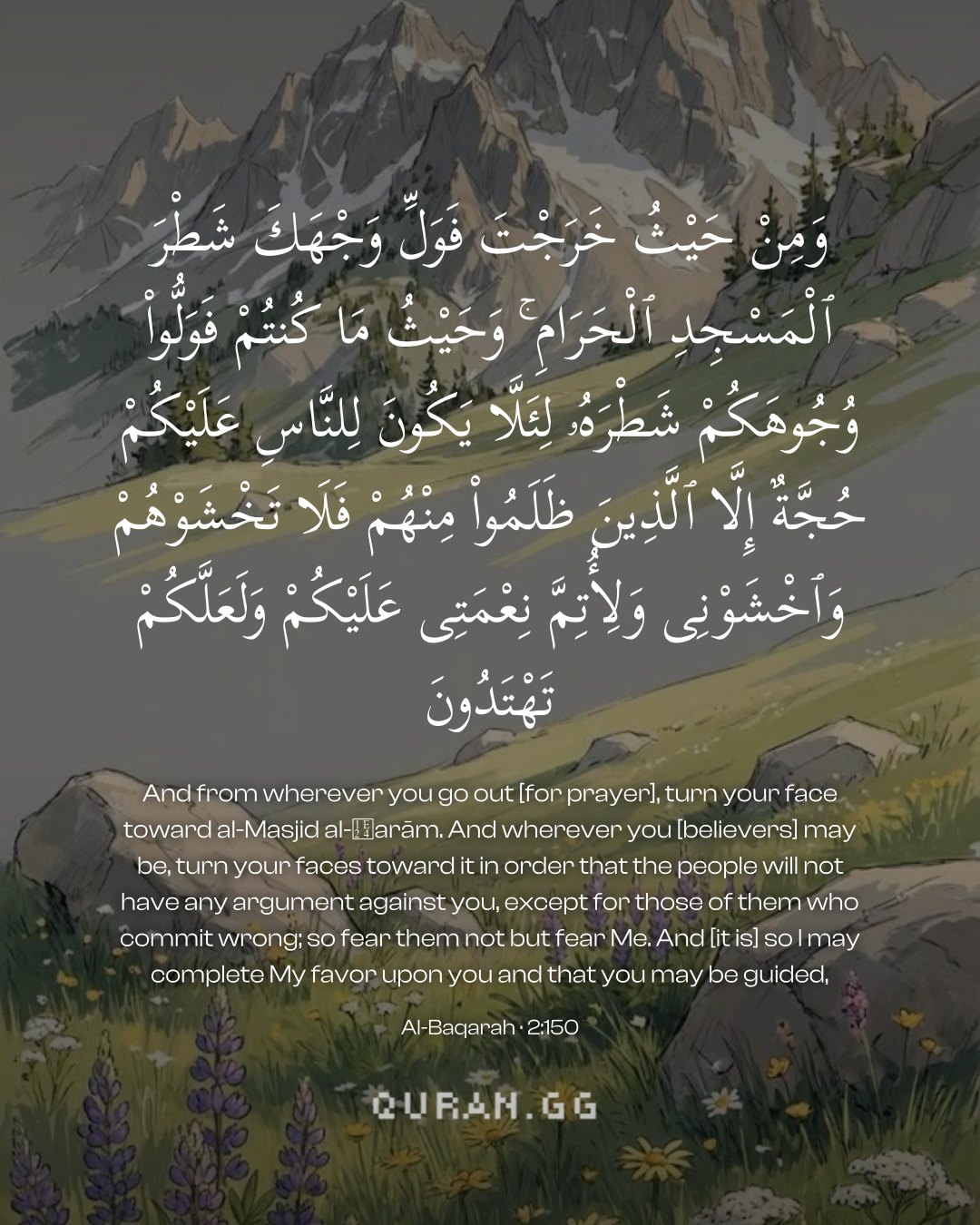
And from wherever you go out [for prayer], turn your face toward al-Masjid al-Ḥarām. And wherever you [believers] may be, turn your faces toward it in order that the people will not have any argument against you, except for those of them who commit wrong; so fear them not but fear Me. And [it is] so I may complete My favor upon you and that you may be guided,
This is a third command from Allah to face Al-Masjid Al-Haram (the Sacred Mosque) from every part of the world (during prayer). It was said that Allah mentioned this ruling again here because it is connected to whatever is before and whatever is after it. Hence, Allah first said:
(Verily, We have seen the turning of your (Muhammad's) face towards the heaven. Surely, We shall turn you to a Qiblah (prayer direction) that shall please you) (2:144), until:
The question of religious orientation being of the highest significance for an Ummah (or a traditional community), these verses continue and enlarge upon the theme of the Qiblah, and lay down further raisons d'etre for the change.
It is, the commentators point out, an observable fact that every traditional community has had a religious orientation of its own, whether appointed by Allah or chosen by itself. This being so, why should anyone object, or wonder that Allah has appointed for the Islamic Ummah a Qiblah قبلہ peculiar to it? After all, it is a regular and distinct Tradition in its own right - in fact, the last of all Traditions, which makes it all the more necessary that it must have a distinct Qiblah. Anyhow, once the divine commandment has been promulgated, the Muslims need not worry about the objections or the ridicule of others, but should, above all, concern themselves with the performance of good deeds (as defined by Allah and His Prophet ﷺ). They should, indeed, give up fruitless controversies and strive to excel in good deeds, for they have to appear before Allah on the Day of Judgment when they will be rewarded or punished according to their deeds. The raison d'etre laid down in this verse requires that the Muslims should, whether staying at home or travelling, turn their faces in the direction of Al-Masjid al-Harm المسجد الحرام ، for that undoubtedly is the Qiblah قبلہ appointed for them by divine commandment. It is obligatory for them to obey this as well as any other commandment, bearing in mind that Allah is not unaware of what men do.
When the Ka‘bah in Makkah was appointed as the prayer direction, or qiblah, the People of the Book started discussing whether the East was God’s direction or the West. They saw the matter as one of direction alone, but this was nothing other than sheer ignorance on their part. The selection of the House of God as the qiblah was not merely the specification of a certain direction for prayer; it was a sign that the time had come for God to reveal His greatest favour to man. It had been decided a long time ago, that, in answer to the prayer of Abraham and Ishmael (see 2:129), God would send a final Prophet to the world. The path to life everlasting was now being thrown open to all: God was showing His ultimate favour to mankind. The bringing of religion to its final stage of perfection in Islam does not mean that previous religions were incomplete. They too were complete in themselves, but none of them was preserved in its original and authentic form. God had revealed true religion time and time again, but on each occasion mankind had rebelled against it and either distorted it or allowed it to fall into oblivion. Now it was revealed in its ultimate and indelible form. Divine religion that had deteriorated into a set of mythological tales was now incorporated into history in the form of solid facts. Up till then, no pattern of true religion had been preserved for posterity; now, it was placed before mankind in a permanent, living and practical form. The change of qiblah, rather than denoting a change from one direction of worship to another, more sacred one, showed the completion of God’s guidance to mankind.
Uthmani text of the Madinah mushaf (King Fahd Complex). Translation: Saheeh International. Tafsir via Quran.com.