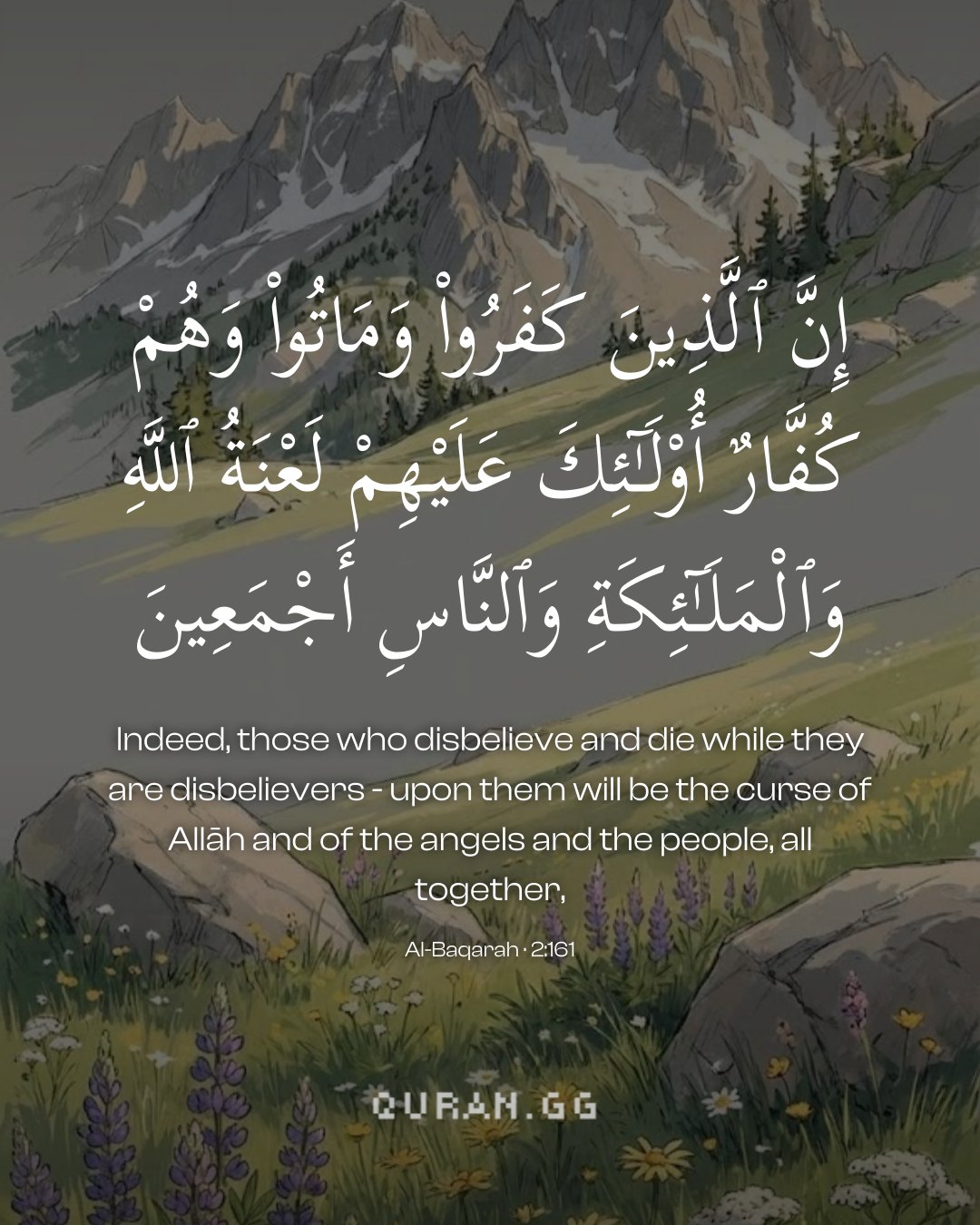
Indeed, those who disbelieve and die while they are disbelievers - upon them will be the curse of Allāh and of the angels and the people, all together,
The Eternal Curse for Those Who hide Religious Commandments
These Ayat sternly warn against those who hide the clear signs that the Messengers were sent with which guide to the correct path and beneficial guidance for the hearts, after Allah has made such aspects clear for His servants through the Books that He revealed to His Messengers. Abu Al-`Aliyah said that these Ayat, "were revealed about the People of the Scripture who hid the description of Muhammad ." Allah then states that everything curses such people for this evil act. Certainly, just as everything asks for forgiveness for the scholar, even the fish in the sea and the bird in the air, then those who hide knowledge are cursed by Allah and by the cursers. A Hadith in the Musnad, narrated through several chains of narrators, that strengthens the overall judgment of the Hadith, states that Abu Hurayrah narrated that Allah's Messenger ﷺ said:
From the words of the text :'and died while they were disbelievers', commentators al-Jassas, al-Qurtubi and some others have formulated the view that it is not permissible to curse an infidel about whom it is not certain that he is to die in a state of infidelity. Now that we have no way of finding out for sure that a person will die in a given state, we are bound to obey the ruling that it is not permissible to curse an infidel by name. That the Holy Prophet ﷺ has. Cursed some infidels by name is explained by the fact that their death in a state of infidelity was divinely revealed to him. As far as the infidels as a whole are concerned, including the tyrants and the unjust, it is technically correct, if cursed without any particularization.
From this we also find out that the act of cursing is so grave that it has been disallowed even if the target be an infidel about whom it is not certain that he is going to die as one. If so, how can this become permissible if the target is a Muslim or, even if it is directed at an animal? Common people in Muslim societies seem to neglect this aspect of standard Muslim behaviour, specially our Muslim sisters who are prone to use very hard language about those they do not like among the circle of their acquaintances. It should be clearly understood that the act of cursing becomes effective not only by using the word, 'curse' but all synonyms used are subject to the same ruling. The word 'La` nah لعنہ ' (curse) means: to remove away from the mercy of Allah Almighty'. Therefore, all damnatory swearing and cursing, whatever the shade, circumstance or language, falls under the purview of "la` nah" لعنہ or 'curse'.
Tazkirul Quran
Maulana Wahiduddin KhanOn ayahs 158–162
Prophet Abraham was a native of Iraq. Acting at God’s behest, he took his wife Hajar and his infant son Ishmael, and left them in the place now known as Makkah. There was no habitation there at that time and there was no water. Thirst forced Hajar to go far afield in search of water. Distressed, she ran back and forth between the hills of Safa and Marwah. After seven unsuccessful attempts, she returned to her dwelling. There she found a spring, now known as the spring of Zamzam, flowing from the ground. This was a symbolic event, showing us how Almighty God looks after His servants. If one persists in the service of God, finally reaching a stage where there is nothing but burning sand beneath one’s feet, then God in His mercy will cause a refreshing spring to gush forth from the dryness of the desert sands. When Muslims perform the pilgrimage to Makkah, they repeat Hajar’s historic quest between these hills, thus commemorating the profound relevance of the event to everyone who struggles in the path of God. God’s signs were displayed so clearly in the Prophet Muhammad’s life and teachings, that it was not difficult to see that he had been sent by God. Yet the Jewish intelligentsia denied him. They were prevented from believing in him by the fear that if they accepted an Arab prophet, their religious hegemony would come to an end. People would stop looking up to the Jews as their leaders. Old established religious traditions, and the interests, which had come to be associated with them, (the Jews being the main beneficiaries) would be destroyed. They deemed it wise to conceal the truth, for they thought that they would lose their worldly status were they to accept it; but it would have been much wiser for them to have proclaimed it. They forgot that God’s servants are required to put truth before their worldly interests. One who becomes destitute for the sake of the Lord gains succour from the inexhaustible treasures of divine grace. The doors of God’s mercy are always open to His servants. He will always forgive one who comes to his senses and mends his erring ways, proclaiming the truth as God wishes it to be proclaimed. Only those who persevere in their disbelief till the day they die will be deprived of His mercy.