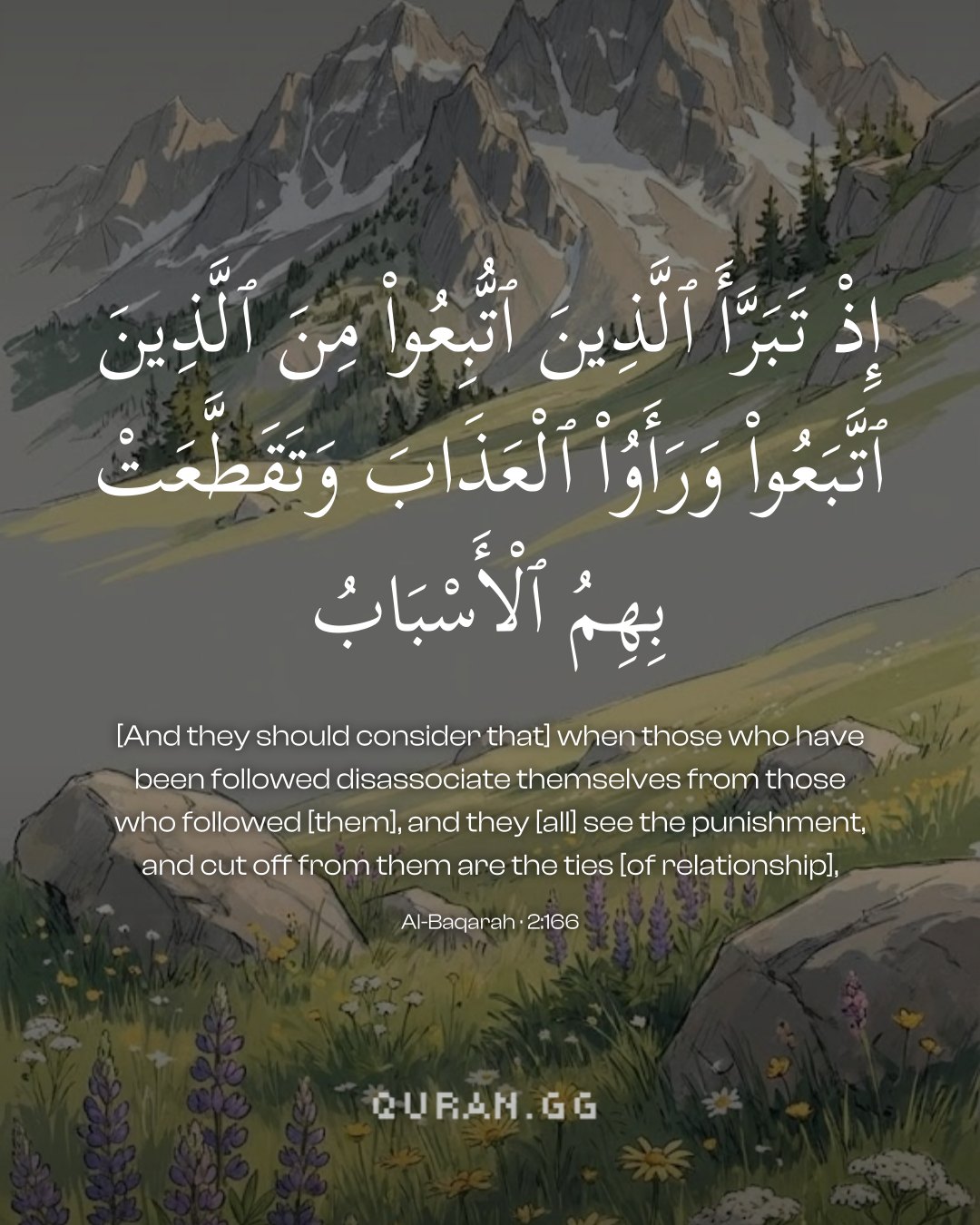
[And they should consider that] when those who have been followed disassociate themselves from those who followed [them], and they [all] see the punishment, and cut off from them are the ties [of relationship],
The Condition of the Polytheists in this Life and the Hereafter
In these Ayat, Allah mentions the condition of the polytheists in this life and their destination in the Hereafter. They appointed equals and rivals with Allah, worshipping them along with Allah and loving them, just as they love Allah. However, Allah is the only deity worthy of worship, Who has neither rival nor opponent nor partner. It is reported in the Sahihayn that `Abdullah bin Mas`ud said: I said, "O Messenger of Allah ﷺ! What is the greatest sin" He said:
«أَنْ تَجْعَلَ للهِ نِدًّا وَهُوَ خَلَقَك»
(To appoint a rival to Allah while He Alone has created you.)
Towards the end of the preceding verse it was said that the punishment of the Hereafter is severe. How severe it will be is now the subject of the present verse.
The severity of the punishment against which the polytheists have been warned will unfold itself when their leaders whom they followed will disown them as their votaries; and they both, the leaders and the led, will witness the punishment, and whatever bonds of leading and following may have existed between them would be snapped apart, very much like it happens in our mortal world when people share in the illegal but wriggle out when apprehended, so much so, that they would even go to the limit of refusing to recognize their accomplices!
When the so-called 'people' of their leaders will see this turnabout of theirs, they will fret and fume but will be unable to do anything about it except wishing that there be a return for them to the mortal world where they could, at least, square up with their greasy leaders - 'May be this time they come back to us seeking our allegiance which would be a perfect time to say no to them and to distance ourselves from them and to do to them what they did to us.'
But, what price are these dreams now? They are not going anywhere. They are stuck with 'their deeds which they see as remorse', and they all, the leaders and their followers, 'are not to come out from the Fire', since the punishment for shirk, the grave sin of associating partners with Allah, is to remain in the Fire for ever.
Tazkirul Quran
Maulana Wahiduddin KhanOn ayahs 165–169
By their nature and circumstances, human beings always look for an external support—a being, who may compensate for their feelings of helplessness, and may serve as a source of confidence and conviction. To make someone a part of one’s life in this capacity is akin to accepting that being as a deity. When a being (or an object) is taken as a deity, it is assumed to be someone or something worthy of being worshipped. It necessarily entails that all one’s feelings of love and devotion become exclusively reserved for that being or object. Their own nature compels human beings to have some focus for all their feelings of love, devotion and reverence. And whatever becomes the focus of these emotions is held to be God. (That is, that object has been accorded the status of divinity). Since God remains invisible in this present world, one who judges things by appearances tends to accord some visible being the status due only to the Almighty. Such beings are generally leaders who, because of certain marks of distinction, become the centre of public attention. This vacuum in human nature was in actual fact to be filled by God Almighty, but many people chose something or someone other than God for this purpose. This happens when ordinary human beings, seeing someone surrounded by visible pomp and splendour, are impressed by certain special talents or qualities; when they find certain individuals occupying ‘seats’ sanctified by centuries-old traditions; when at times they are impressed by the large following which certain people enjoy and when they see public figures surrounded with the halo of mysterious legends. Being ordinary mortals themselves, they come thus to regard certain persons as possessing extraordinary power and therefore superior to the common man. But the truth is that in this universe of God, no one save God possesses any power or greatness. Man may continue to receive the status of divinity only for so long as God remains invisible. But when God appears on Doomsday, the state of affairs will change so drastically that people will flee from one another. Today people take great pride in their association with and devotion to great men. They think that they are clinging to a firm rock which will surely help them in the Hereafter. Such association will prove meaningless on Doomsday—as if they had never existed at all. Man will look at his past life in despair, but he will be utterly helpless to rectify the situation. He will be able to do nothing but regret his past deeds.