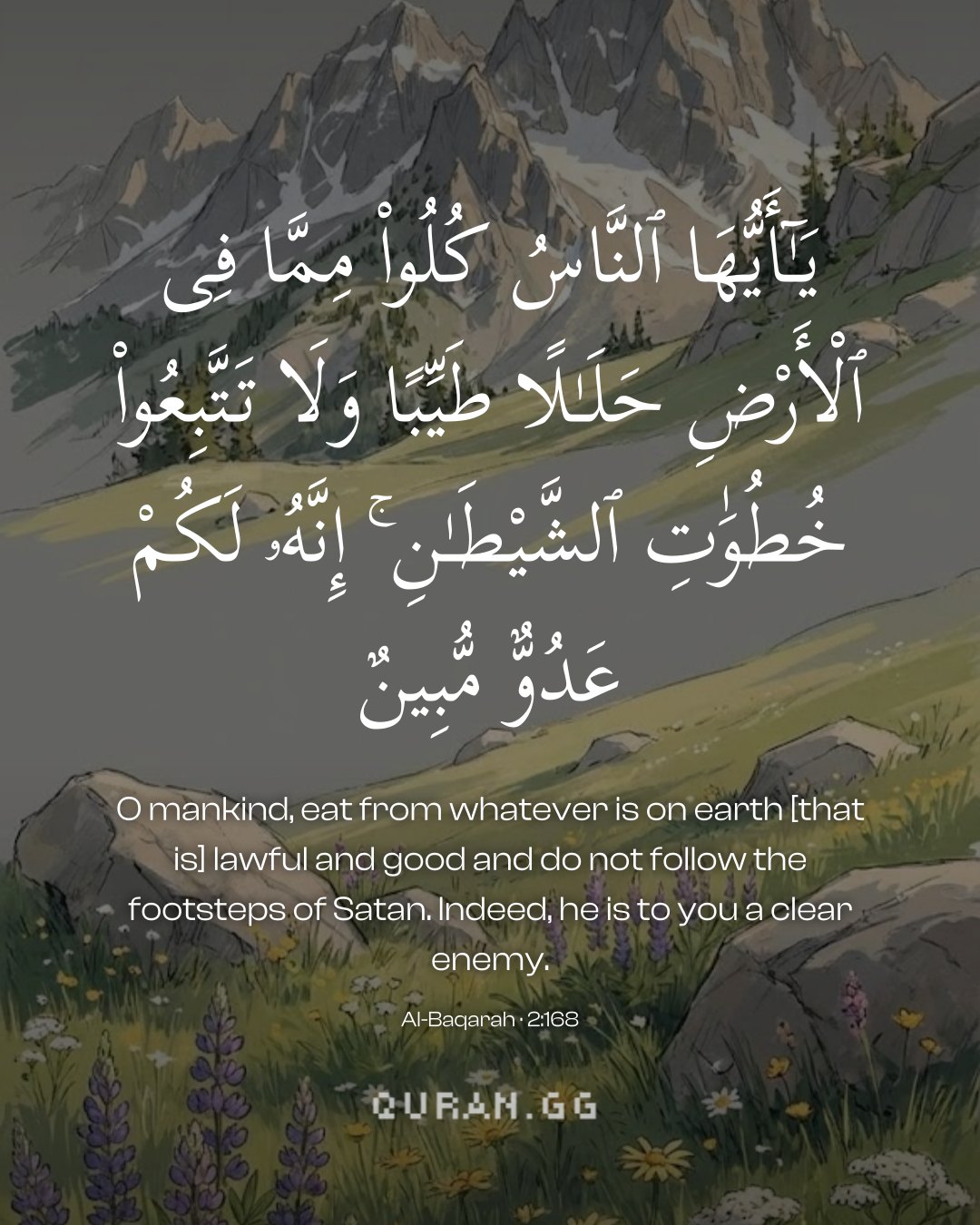
The Order to eat the Lawful Things, and the Prohibition of following the Footsteps of Shaytan
After Allah stated that there is no deity worthy of worship except Him and that He Alone created the creation, He stated that He is the Sustainer for all His creation, and He mentioned a favor that He granted them; He has allowed them to eat any of the pure lawful things on the earth that do not cause harm to the body or the mind. He also forbade them from following the footsteps of Shaytan, meaning his ways and methods with which he misguides his followers, like prohibiting the Bahirah (a she-camel whose milk was spared for the idols and nobody was allowed to milk it), or Sa'ibah (a she-camel let loose for free pasture for the idols and nothing was allowed to be carried on it), or a Wasilah (a she-camel set free for idols because it has given birth to a she-camel at its first delivery and then again gives birth to a she-camel at its second delivery), and all of the other things that Shaytan made attractive to them during the time of Jahiliyyah. Muslim recorded `Iyad bin Himar saying that Allah's Messenger ﷺ said that Allah the Exalted says,
يَقُولُ اللهُ تَعَالَى:إِنَّ كُلَّ مَالٍ مَنَحْتُهُ عِبَادِي فَهُوَ لَهُمْ حَلَالٌ، وَفِيهِ وَإِنِّي خَلَقْتُ عِبَادِي حُنَفَاءَ، فَجَاءَتْهُمُ الشَّيَاطِينُ فَاجْتَالَتْهُمْ عَنْ دِينِهِمْ، وَحَرَّمَتْ عَلَيْهِمْ مَا أَحْلَلْتُ لَهُم»
(`Every type of wealth I have endowed My servants is allowed for them...' (until), `I have created My servants Hunafa' (pure or upright), but the devils came to them and led them astray from their (true) religion and prohibited them from what I allowed for them. ')
Allah said:
إِنَّهُ لَكُمْ عَدُوٌّ مُّبِينٌ
(...he is to you an open enemy.)
warning against Satan. Allah said in another instance:
إِنَّ الشَّيْطَـنَ لَكُمْ عَدُوٌّ فَاتَّخِذُوهُ عَدُوّاً إِنَّمَا يَدْعُو حِزْبَهُ لِيَكُونُواْ مِنْ أَصْحَـبِ السَّعِيرِ
(Surely, Shaytan is an enemy to you, so take (treat) him as an enemy. He only invites his Hizb (followers) that they may become the dwellers of the blazing Fire.) (35:6), and:
أَفَتَتَّخِذُونَهُ وَذُرِّيَّتَهُ أَوْلِيَآءَ مِن دُونِى وَهُمْ لَكُمْ عَدُوٌّ بِئْسَ لِلظَّـلِمِينَ بَدَلاً
(Will you then take him (Iblis) and his offspring as protectors and helpers rather than Me while they are enemies to you What an evil is the exchange for the Zalimin (polytheists, and wrongdoers, etc).) (18:50)
Qatadah and As-Suddi commented on what Allah said:
وَلاَ تَتَّبِعُواْ خُطُوَتِ الشَّيْطَـنِ
(...and follow not the footsteps of Shaytan (Satan)):
Every act of disobedience to Allah is among the footsteps of Satan.
`Abd bin Humayd reported that Ibn `Abbas said: "Any vow or oath that one makes while angry, is among the footsteps of Shaytan and its expiation is that of the vow. " Allah's statement:
إِنَّمَا يَأْمُرُكُم بِالسُّوءِ وَالْفَحْشَآءِ وَأَن تَقُولُواْ عَلَى اللَّهِ مَا لاَ تَعْلَمُونَ
(He (Satan) commands you only what is evil and Fahsha (sinful), and that you should say about Allah what you know not.)
The verse means: `Your enemy, Satan, commands you to commit evil acts and what is worse than that, such as adultery and so forth. He commands you to commit what is even worse, that is, saying about Allah without knowledge.' So this includes every innovator and disbeliever.
Ma'arif al-Qur'an
Mufti Muhammad Shafi
The meaning of the words
The real meaning of the root word حلَّ (halla) in (halalan tayyiban:
حَلَاً طَیِّباً : permissible and good) is 'to open a knot'. In that sense, what has been made halal حلال means that a knot has been opened and the restriction has been removed. The blessed Companion Sahl ibn ` Abdullah ؓ has said: "Salvation depends on three things - eating halal حلال ، fulfilling (Divine) obligations and following the Sunnah of the Holy Prophet ﷺ ." The word طَیَّب (tayyib) means 'good' as inclusive of the clean and the pure and covers the twin aspects of being lawful, permissible or halal حلال and being naturally desirable.
The word حُطُوَات (khutuwat) is the plural form of خُطوہ (khutwah) which is the distance between the two feet when striding. Here the khutuwat of Shaytan means Satanic deeds.
Injunctions and Rulings
1. Polytheistic practices, such as releasing animals in the name of idols or dedicating them, whether big or small, to a saint or to anyone other than Allah has been declared unlawful in Verse 173 which follows. The present Verse (168) is not negating the unlawfulness of such an animal as wrongly conceived by some people. The objective of the verse is to stress that animals which Allah has made lawful should not be made unlawful by dedicating them to idols. Let them be what they are and use them for personal benefit. Why go about making things unlawful on your own which is a grave sin, and when it is dedicated to someone other than Allah it becomes impure and what is impure is unlawful.
2. If anyone dedicates an animal to anyone other than Allah out of ignorance or carelessness and wishes to make amends, he should resolve to retreat from his misdeed and repent on what he did, in which case, the meat of that animal will become lawful for him.
By their nature and circumstances, human beings always look for an external support—a being, who may compensate for their feelings of helplessness, and may serve as a source of confidence and conviction. To make someone a part of one’s life in this capacity is akin to accepting that being as a deity. When a being (or an object) is taken as a deity, it is assumed to be someone or something worthy of being worshipped. It necessarily entails that all one’s feelings of love and devotion become exclusively reserved for that being or object. Their own nature compels human beings to have some focus for all their feelings of love, devotion and reverence. And whatever becomes the focus of these emotions is held to be God. (That is, that object has been accorded the status of divinity). Since God remains invisible in this present world, one who judges things by appearances tends to accord some visible being the status due only to the Almighty. Such beings are generally leaders who, because of certain marks of distinction, become the centre of public attention. This vacuum in human nature was in actual fact to be filled by God Almighty, but many people chose something or someone other than God for this purpose. This happens when ordinary human beings, seeing someone surrounded by visible pomp and splendour, are impressed by certain special talents or qualities; when they find certain individuals occupying ‘seats’ sanctified by centuries-old traditions; when at times they are impressed by the large following which certain people enjoy and when they see public figures surrounded with the halo of mysterious legends. Being ordinary mortals themselves, they come thus to regard certain persons as possessing extraordinary power and therefore superior to the common man. But the truth is that in this universe of God, no one save God possesses any power or greatness. Man may continue to receive the status of divinity only for so long as God remains invisible. But when God appears on Doomsday, the state of affairs will change so drastically that people will flee from one another. Today people take great pride in their association with and devotion to great men. They think that they are clinging to a firm rock which will surely help them in the Hereafter. Such association will prove meaningless on Doomsday—as if they had never existed at all. Man will look at his past life in despair, but he will be utterly helpless to rectify the situation. He will be able to do nothing but regret his past deeds.
Continue reading the tafsir of ayahs 165–169 Uthmani text of the Madinah mushaf (King Fahd Complex). Translation: Saheeh International. Tafsir via Quran.com.