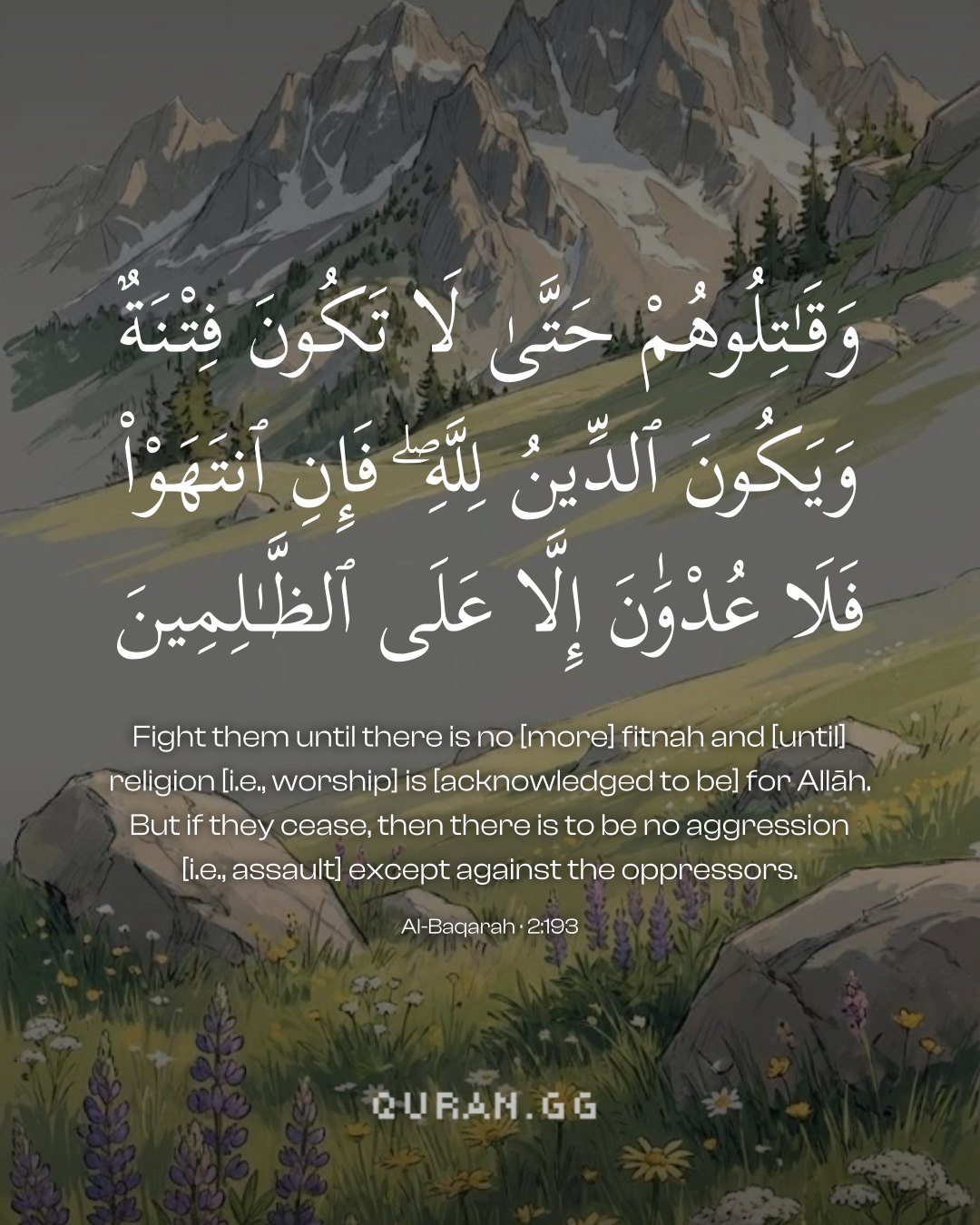
Fight them until there is no [more] fitnah and [until] religion [i.e., worship] is [acknowledged to be] for Allāh. But if they cease, then there is to be no aggression [i.e., assault] except against the oppressors.
(And fight in the way of Allah those who fight you,)
Abu Al-`Aliyah said, "This was the first Ayah about fighting that was revealed in Al-Madinah. Ever since it was revealed, Allah's Messenger ﷺ used to fight only those who fought him and avoid non-combatants. Later, Surat Bara'ah (chapter 9 in the Qur'an) was revealed." `Abdur-Rahman bin Zayd bin Aslam said similarly, then he said that this was later abrogated by the Ayah:
1. When the Holy Prophet decided to travel to Makkah in the year 7 A.H. to perform his qada"Umrah as envisaged in the peace treaty of Hudaybiyyah; his Companions ؓ who were to accompany him knew that disbelievers could not be trusted with treaties, or peace. It was quite possible that they may start fighting. Now, the blessed Companions had a problem before them. They thought if this fighting came, it would have to be within the sacred precincts of Makkah, which is not permissible in Islam. This doubt was answered in Verse 191 by stating that the sanctity of the sacred precincts of Makkah must certainly be observed by Muslims, but should the disbelievers start to fight within the sacred limits, then, it is permissible for them to fight back in defence.
2. The second problem that bothered the noble Companions was about the month, which was Dhul-Qa'dah ذوالقعدہ ، being one of the four known as the 'sacred months' wherein fighting anyone anywhere was not permissible. Now, the Muslims thought if the disbelievers of Makkah started fighting against them how could Muslims fight a defensive battle during a 'sacred month'? The verse under reference (194) was revealed to answer this doubt. The answer is that, the way a state of defence grants an exception to observing the sanctity of the Haram of Makkah, in the same manner, it allows an exception to observing the sanctity of the 'sacred months' also.
Tazkirul Quran
Maulana Wahiduddin Khan
The Quranic exhortation to do battle against religious persecution (fitnah) has been explained by ‘Abdullah ibn ‘Umar, a senior companion of the Prophet. He said that this verse referred to the coercive religious system that prevailed in the ancient world. (Fathul Bari, vol. 8, p. 60). Temporary in nature, the war against fitnah was thus one of limited duration, meant to be engaged in only until its specific purpose had been served. In the wake of the Islamic revolution, religious persecution was replaced by intellectual freedom. As ‘Abdullah ibn ‘Umar said, they had already put an end to fitnah, therefore, except in cases where self-defence had become inevitable, the Quran did not give permission for violence.
Uthmani text of the Madinah mushaf (King Fahd Complex). Translation: Saheeh International. Tafsir via Quran.com.