Tafsir Ibn Kathir (abridged)
Ismail ibn Kathir
Do not delay embracing the Faith
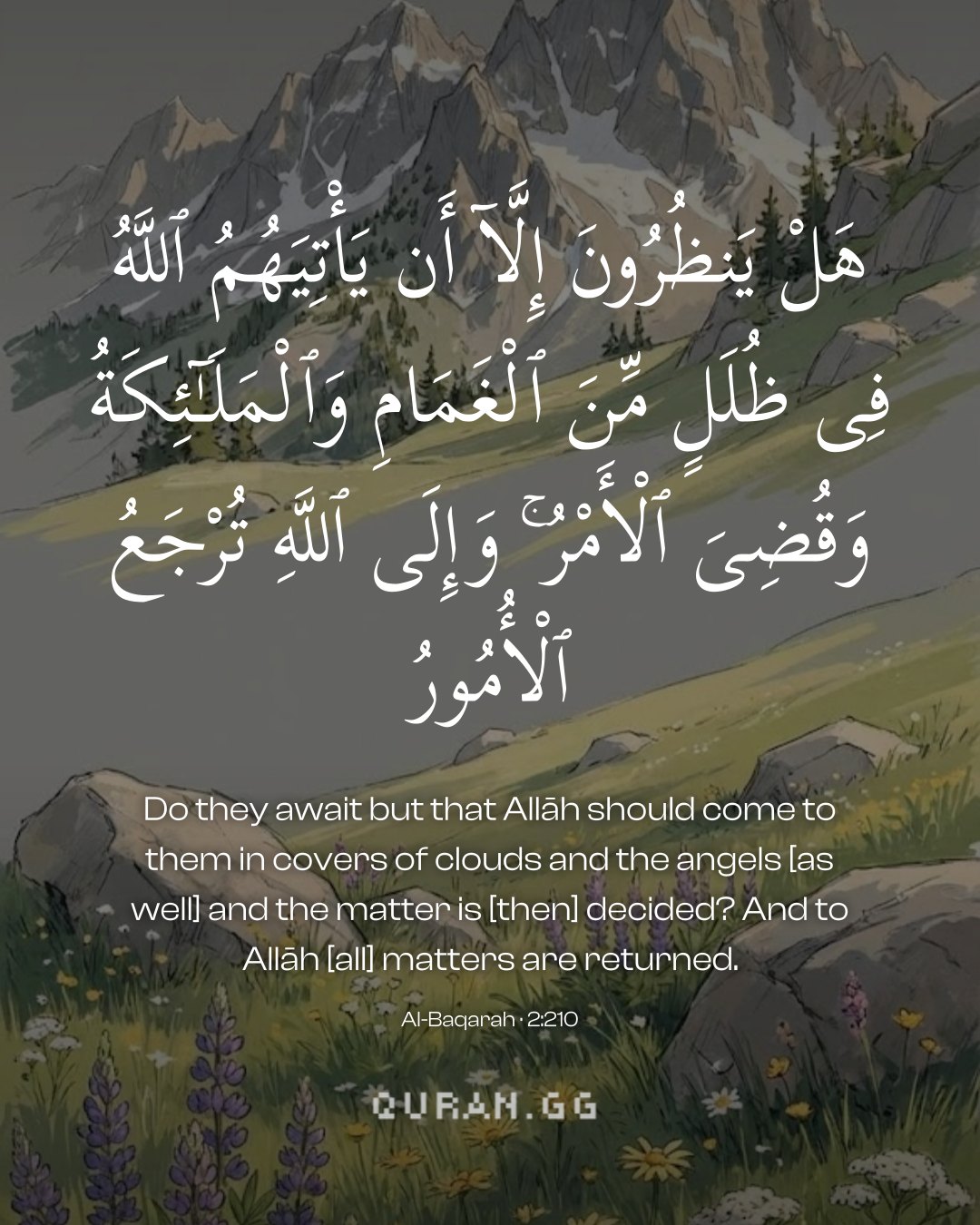
هَلْ يَنظُرُونَ إِلاَّ أَن يَأْتِيَهُمُ اللَّهُ فِي ظُلَلٍ مِّنَ الْغَمَامِ وَالْمَلَـئِكَةُ
(Do they then wait for anything other than that Allah should come to them over the shadows of the clouds and the angels) on the Day of Resurrection to judge the early and the latter creations. Allah shall then reward each according to his or her deeds; and whoever does good shall see it, and whoever does evil shall see it. This is why Allah said:
وَقُضِىَ الأَمْرُ وَإِلَى اللَّهِ تُرْجَعُ الأُمُورُ
((Then) the case would be already judged. And to Allah return all matters (for decision).)
Similarly, Allah said:
كَلاَّ إِذَا دُكَّتِ الاٌّرْضُ دَكّاً دَكّاً - وَجَآءَ رَبُّكَ وَالْمَلَكُ صَفّاً صَفّاً - وَجِىءَ يَوْمَئِذٍ بِجَهَنَّمَ يَوْمَئِذٍ يَتَذَكَّرُ الإِنسَـنُ وَأَنَّى لَهُ الذِّكْرَى
(Nay! When the earth is ground to powder. And your Lord comes with the angels in rows. And Hell will be brought near that Day. On that Day will man remember, but how will that remembrance (then) avail him) (89:21-23) and:
هَلْ يَنظُرُونَ إِلاَ أَن تَأْتِيهُمُ الْمَلَـئِكَةُ أَوْ يَأْتِىَ رَبُّكَ أَوْ يَأْتِىَ بَعْضُ ءَايَـتِ رَبِّكَ
(Do they then wait for anything other than that the angels should come to them, or that your Lord (Allah) should come, or that some of the signs of your Lord should come (i. e., portents of the Hour, e.g., rising of the sun from the west)!) (6:158)
Abu Ja`far Razi reported that Abu Al-`Aliyah narrated that:
هَلْ يَنظُرُونَ إِلاَّ أَن يَأْتِيَهُمُ اللَّهُ فِي ظُلَلٍ مِّنَ الْغَمَامِ وَالْمَلَـئِكَةُ
(Do they then wait for anything other than that Allah should come to them over the shadows of the clouds and the angels) means, the angels will descend on the shadows of clouds, while Allah comes as He wills. Some of the reciters read it,
هَلْ يَنظُرُونَ إِلاَّ أَن يَأْتِيَهُمُ اللَّهُوَالْمَلَـئِكَةُفِي ظُلَلٍ مِّنَ الْغَمَامِ
Do they then wait for anything other than that Allah should come to them and also the angels over the shadows of the clouds. This is similar to Allah's other statement:
وَيَوْمَ تَشَقَّقُ السَّمَآءُ بِالْغَمَـمِ وَنُزِّلَ الْمَلَـئِكَةُ تَنزِيلاً
(And (remember) the Day when the heaven shall be rent asunder with clouds, and the angels will be sent down, with a grand descending.) (25:25)
The previous verses ended with a word of praise for the sincere. As sincerity (ikhlas اخلاص) can sometimes touch the limits of excess inadvertently, that is, one does intend to come up with more obedience, but that obedience, when observed carefully, turns out to be exceeding the limits set by the Shari'ah and Sunnah. This is called bid'ah بدعت . This can be explained through the example of the blessed Companion ` Abdullah ibn Salam ؓ and others who were, previous to their Islam, known scholars among the Jews. Since Saturday was the sacred day of rest (the Sabbath اَسَّبت) in Judaism, and camel-meat was unlawful, they thought, once they were in Islam, to bring about some sort of a synthesis between the two faiths, through which they could continue to honour Sabbath سَبِّت as it was necessary under the law of Moses while Islam did not require dishonouring it; and similarly, they could simply avoid eating camel-meat in practice while believing that it was lawful, for it was unlawful in the law of Moses but Islam does not make it obligatory to eat it. Thus, they thought that they would stay in touch with the law of Moses and still not go against the Shari'ah of Muhammad ﷺ ، something that appealed to them as a stronger demonstration of obedience to divine laws and a closer approach to matters of faith. Allah Almighty corrects this thought in the present verse which aims to establish that Islam is an obligation in its totality. It is total and perfect only when what is not necessary in Islam is not considered to be a part of it. To take such thought or practice as part of the Faith is a Satanic slip which may bring far more severe a punishment than common sins would.
Continue reading the tafsir of ayahs 208–210 Those who have adopted opportunism as their religion are always able to impress people with words. Why? Because it is in their own selfish interest to do so. For them it is not right or wrong that matters; there is no set standard guiding them. They just go by what is calculated to make a favourable impression on the listener. They have no problem in painting a glowing picture on the outside, despite the fact that in their heart of hearts they are bereft of the warmth of true sincerity; they owe no loyalty to truth; they are loyal only to their own interests. Why is it that judged by his words a person appears to be a great reformer, while his actions result only in corruption in the land. It can all be traced to the contradiction in himself. He may have an array of words to demonstrate his love for truth, but in practice he belies his words, and acts out of self-interest. So there is bound to be a dichotomy between his words and his actions. He can convey a sense of idealism in speech, but when he gets down to actually doing things, he is drawn by the force of his self-interest to feather his own nest at the expense of others. The one who spoke of peace and reconciliation acts in a manner that leads to strife and conflict. He plays on people’s emotions, saying things which will make him popular, with no regard for the real situation. Such are they who have sold themselves for the world. Even when the truth is made plain to them, they do not follow it. They see no benefit for themselves, no furtherance of their own interests, in following truth. Only when there is sufficient gain to be had do they uphold the truth; otherwise they deny it. Behind an obsequious exterior they hide a proud ego. That is why they can never acknowledge truth if it comes from a preacher whom they consider inferior to them. There are others who sell their lives, not for themselves, but for God; it is to find favour with Him that they strive. They do no accept the demands of their own selves, but the commands of God. At any cost to themselves, they give what they have in the divine cause. It is God’s true faith that they seek, so they leave conventional, ancestral religion by the wayside; even though such a move will make them lose in popularity. Their guideline is truth, and they stick to it, despite the fury of the people which pours on them from all sides.
Continue reading the tafsir of ayahs 204–211 Uthmani text of the Madinah mushaf (King Fahd Complex). Translation: Saheeh International. Tafsir via Quran.com.