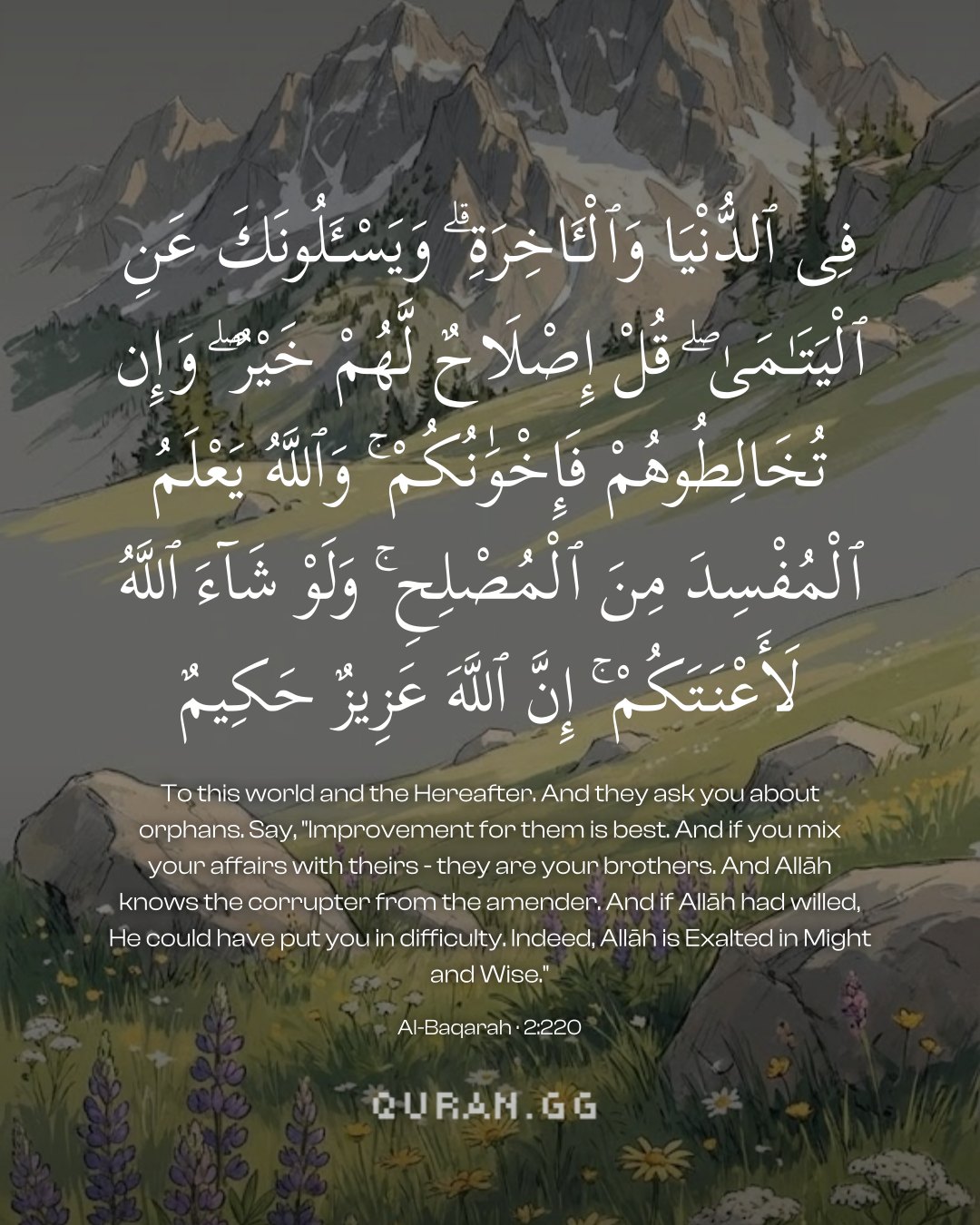
To this world and the Hereafter. And they ask you about orphans. Say, "Improvement for them is best. And if you mix your affairs with theirs - they are your brothers. And Allāh knows the corrupter from the amender. And if Allāh had willed, He could have put you in difficulty. Indeed, Allāh is Exalted in Might and Wise."
The Gradual Prohibition of Khamr (Alchoholic Drink)
Imam Ahmad recorded that Abu Maysarah said that `Umar once said, "O Allah! Give us a clear ruling regarding Al-Khamr!" Allah sent down the Ayah of Surat Al-Baqarah:
(They ask you (O Muhammad ) concerning alcoholic drink and gambling. Say: "In them is a great sin...)
`Umar was then summoned and the Ayah was recited to him. Yet, he still said, "O Allah! Give us a clear ruling regarding Al-Khamr." Then, this Ayah that is in Surat An-Nisa' was revealed:
Verse 220 features yet another question in a series of several posed by the noble Companions. This question relates to the combining of the cost of maintenance of orphans. Since there was general lack of carefulness about the rights of orphans in pagan Arabia, as elsewhere, warning was given that consuming what belongs to the orphans is like filling bellies with embers of Hell. Consequently, the recipients of this warning were so scared that they, out of preventive measure, started preparing and storing meals given to orphans separately. In case the child ate less, food was left over and, naturally so, got decomposed. The reason: It was not permissible for them to use food which belonged to the orphans, nor did they have the right to give what belonged to the orphans in charity. This was a matter of sheer discomfort and a source of loss to the orphans as well. Therefore, the situation was brought to the notice of the Holy Prophet ﷺ following which came the guidance given in this verse.
It is being said here that the purpose is not to compromise the welfare of the orphaned children. Since their welfare is served better through a joint expense system, there is nothing to worry about, for they are brothers-in-faith and brothers do share.
The above permission has been hemmed by a warning that Allah watches over the performance of guardians in this matter. He could have, by setting up a harder code of conduct, put them in trouble because He is All-Powerful. But, He has provided an easier code of conduct because He is All-Wise and does not obligate people with what they cannot do.
Tazkirul Quran
Maulana Wahiduddin Khan
Who can truly call himself a true believer? He who makes the next world his goal and who is constantly striving to find favour with his Lord. Such a man does not make worldly possessions his aim in life. This does not mean, however, that he renounces the world, for a certain number of material things are an obvious necessity. It simply means that when he makes a living and engages in worldly activities, he does so only in so far as such action is related to acquiring the bare necessities of life. His purpose in life is never to amass wealth. His purpose, on the contrary, is to gain the blessing of his Lord. So, out of whatever he has, he keeps only what he really needs for himself and spends the rest for the cause of God. If we were to attempt to state, in explicit, legal terms, how men should deal with their fellowmen and how they should conduct their business, this would be too complicated in the context of daily living. It is, therefore, more useful to lay down some, fundamental guidelines: to wish others well and to keep in mind not just our own interests, but also the interests of those with whom we have to deal, thinking of them as brothers. God will never take us to task if we act in a manner which is conducive to harmony and justice.
Uthmani text of the Madinah mushaf (King Fahd Complex). Translation: Saheeh International. Tafsir via Quran.com.