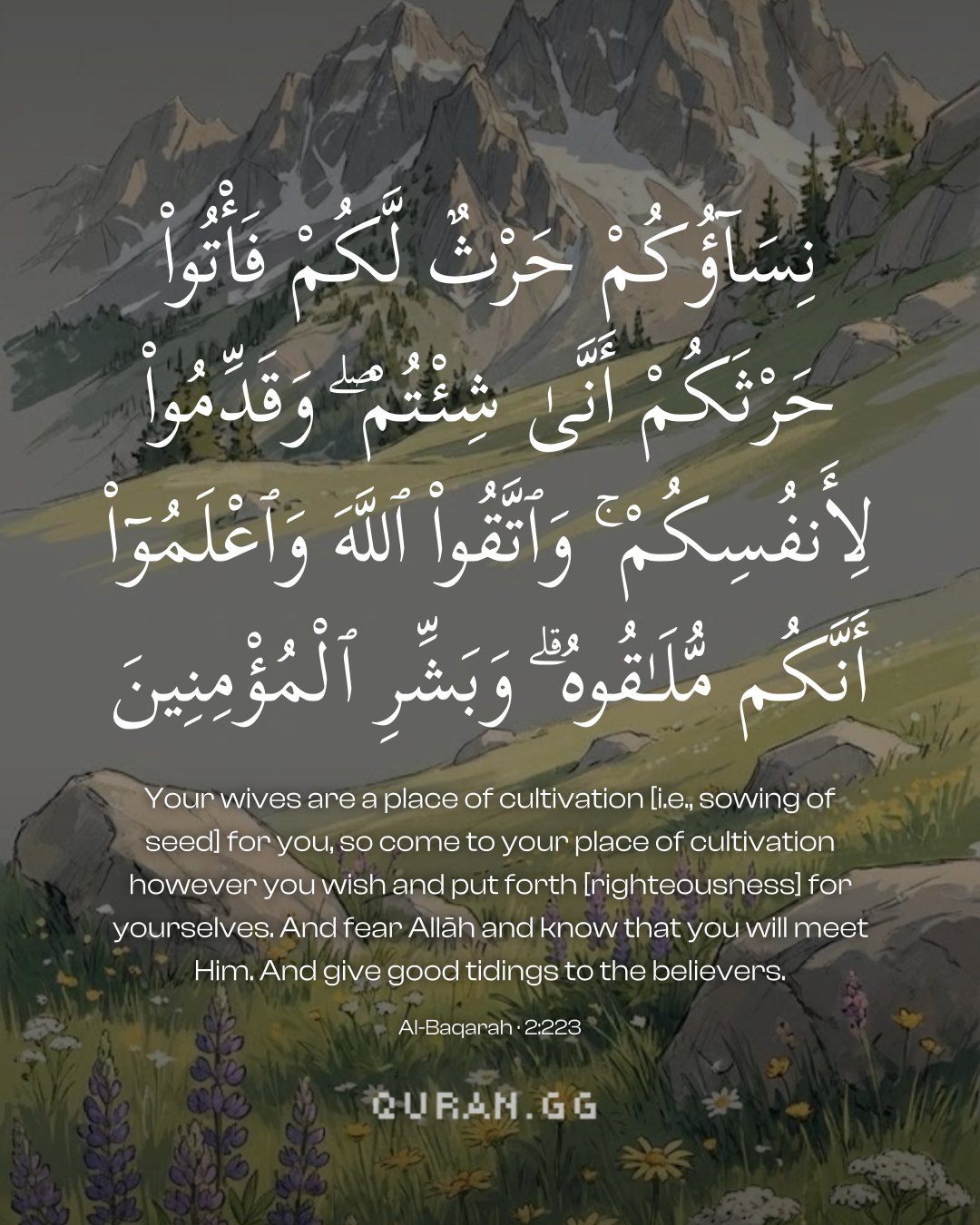
Your wives are a place of cultivation [i.e., sowing of seed] for you, so come to your place of cultivation however you wish and put forth [righteousness] for yourselves. And fear Allāh and know that you will meet Him. And give good tidings to the believers.
Sexual Intercourse with Menstruating Women is prohibited
Imam Ahmad recorded that Anas said that the Jews used to avoid their menstruating women, they would not eat, or even mingle with them in the house. The Companions of the Prophet asked about this matter and Allah revealed:
(They ask you concerning menstruation. Say: "That is an Adha, therefore, keep away from women during menses and go not in unto them till they are purified.)
Allah's Messenger ﷺ said:
«اصْنَعُوا كُلَّ شَيْءٍ إِلَّا النِّكَاح»
(`Do everything you wish, except having sexual intercourse.)
The basic purpose of these verses is to declare the prohibition of having sexual intercourse with a woman in a state of menstruation. If someone committed sexual intercourse in such a state either unknowingly or carelessly, he has to make Taubah (repentance). In this context it has been said in the verse 222 that "Allah loves those who are most repenting."
The verse 223 points out to the lawful ways of having sexual intercourse with one's woman. The permission of such intercourse has been subjected to two conditions. Firstly, it should take place at a time when the woman is pure from her menstruation. Secondly, carnal intercourse is not allowed at all. This verse begins with a comprehensive remark: "Your women are for you a soil to cultivate." Here the woman has been compared with a soil, while the husband has been compared with a cultivator. This is to indicate that the sexual intercourse has not been allowed for satisfying the sexual lust only, but also to make it a valid source for having children. By using this expression the Holy Qur'an has given a subtle indication to the prohibition of carnal intercourse, even with one's wife, because it can never be a productive act, and there is no question of 'cultivation' therein.
Doing good works means acting with the Hereafter in mind. In the knowledge that there is an eternal side to life, which is more important than the temporal side, it is for eternity that we should strive. Should our actions on earth profit us in this life, but be harmful to our everlasting life, we shall have lived our lives in vain. What we do on earth will be judged after death. We should take care to ensure that our deeds measure up well on God’s scale of justice, for if they fail to do so, there is no way we can avoid His punishment.
Uthmani text of the Madinah mushaf (King Fahd Complex). Translation: Saheeh International. Tafsir via Quran.com.