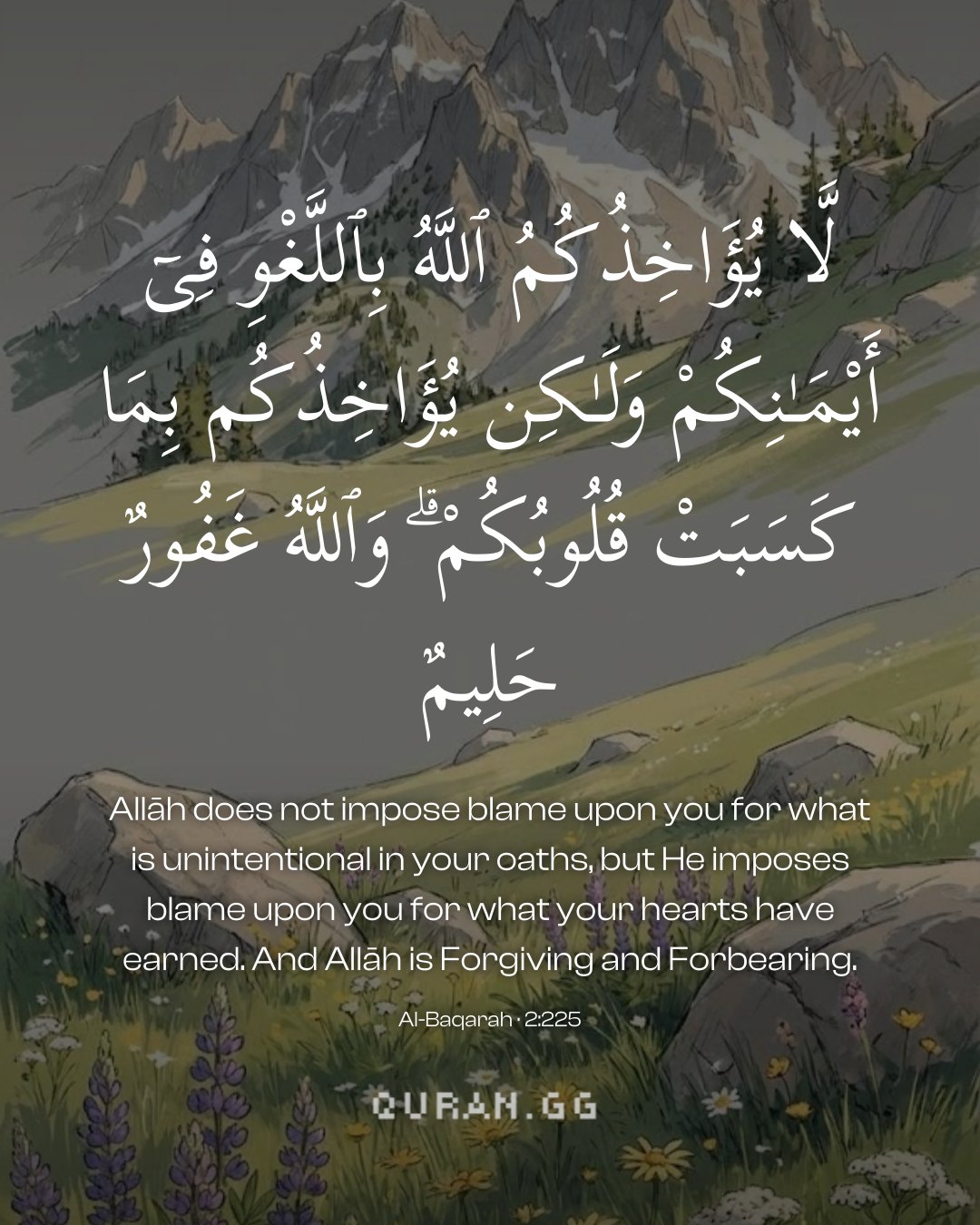
The Prohibition of swearing to abandon a Good Deed
Allah commands, `You should not implement your vows in Allah's Name to refrain from pious acts and severing the relations with the relatives, if you swear to abandon such causes.' Allah said in another Ayah:
وَلاَ يَأْتَلِ أُوْلُواْ الْفَضْلِ مِنكُمْ وَالسَّعَةِ أَن يُؤْتُواْ أُوْلِى الْقُرْبَى وَالْمَسَـكِينَ وَالْمُهَـجِرِينَ فِى سَبِيلِ اللَّهِ وَلْيَعْفُواْ وَلْيَصْفَحُواْ أَلاَ تُحِبُّونَ أَن يَغْفِرَ اللَّهُ لَكُمْ
(And let not those among you who are blessed with graces and wealth swear not to give (any sort of help) to their kinsmen, Al-Masakin (the poor), and those who left their homes for Allah's cause. Let them pardon and forgive. Do you not love that Allah should forgive you) (24:22)
Continue reading the tafsir of ayahs 224–225Ma'arif al-Qur'an
Mufti Muhammad Shafi
Note:
The laghw لغو or ineffectual oath has two meanings:
I. In the first case it means a false oath sworn without volition over something in the past, or it could have been sworn with volition while the oath-taker considers it to be true in his supposition. For ex-ample, guided by his information and supposition, one ends up declaring on oath that a certain person has arrived while that person had not arrived in reality. Similarly, if someone swears on oath for some-thing in future unintentionally, while he has been actually wanting to say something else, but the words of oath come out of his lips mistakenly, this type of oath also falls in this category. All these three types are not an act of sin and that is why they are called laghw لغو or ineffectual. This act will not be reprehensible in the Hereafter (Akhirah). As compared to this, the oath which has been declared reprehensible is the one that has been uttered intentionally knowing it to be false. This is known as ghamus (perjury), and is an act of sin, but according to the Hanafiyyah, it does not require kaffarah or expiation. Therefore, لغو laghw, in the sense explained earlier, involves no kaffarah more obviously, (because it is not a sinful act). The verse under discussion exclusively takes up these two categories that carry no کَفَّارہ kaffarah.
II. Laghw لغو also means that which has no kaffarah کَفَّارہ . It will be called as laghw because it does not entail the liability of Kaffarah کَفَّارہ in this world.
III. Given this meaning, the word, laghw لغو is inclusive of ghamus, which being an act of sin, however, does not require kaffarah کَفَّارہ .
As compared to this, the oath that requires kaffarah کَفَّارہ is called mun'aqidah منعقدہ (that which is established, confirmed: fait accompli). For instance, if someone intentionally declares on oath to the effect that he or she would or would not perform a certain act, then, acting contrarily requires kaffarah. (Bayan al-Qur'an)
Swayed by anger and obstinacy, sometimes an individual swears an oath that he will not do anything which would benefit a certain person. In ancient times, a variety of such oaths was very common among the Arabs. They swore oaths that they would refrain from such and such a good deed, so that when they were called upon to join in some good act, they would decline, saying that they had already taken an oath to the contrary. To refrain from good acts is in itself bad enough, but swearing to this in the name of God is much worse. For God is a being who is all merciful and all good. Then attaching the name of God to the non-performance of good works is sinful. Perversion at all events is bad. But if perverse acts are done in the name of God, there is a manifold increase in the evil perpetuated.
Uthmani text of the Madinah mushaf (King Fahd Complex). Translation: Saheeh International. Tafsir via Quran.com.