(And those of you who die and leave wives behind them) was abrogated by the other Ayah (2:234). Therefore, why did you collect it (meaning, in the Qur'an)" He said, "O my nephew! I shall not change any part of the Qur'an from its place."
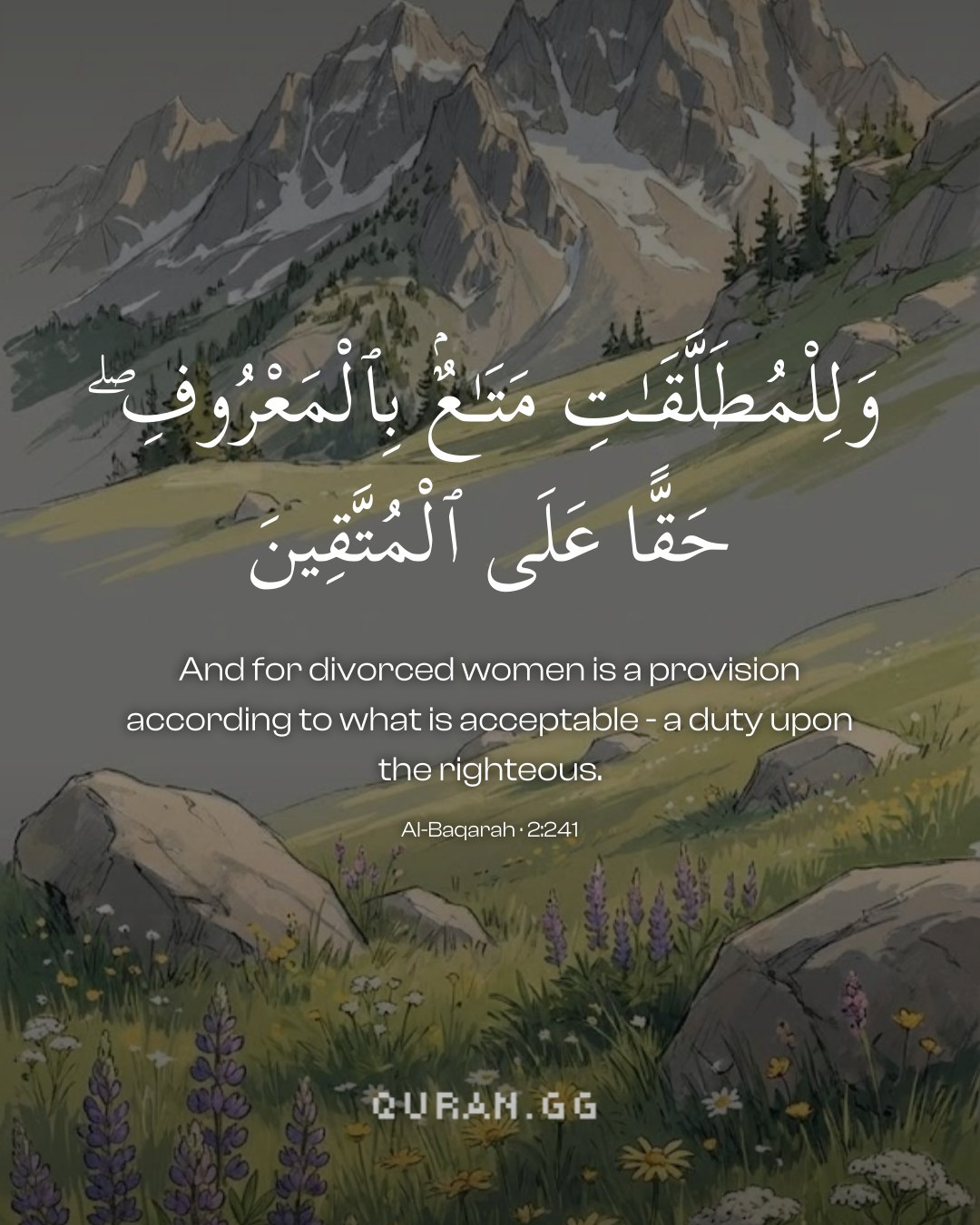
Providing compensatory benefits (` mata متاع `) for divorced women has also been dealt with in verses earlier than this, but that was restricted to two types of divorced women who were divorced before privacy and consummation. The first case of providing compensatory benefits was the giving of a set of clothes. The second case was of providing compensatory benefit in the form of half of the dower. Now remains the case of divorcees who were divorced after privacy and con-summation. Here, providing compensatory benefits to one whose dower has already been fixed lies in giving her the full amount of dower or mahr. For one whose dower has not already been fixed, a post-consummation divorce will make it obligatory to give her mahr almithl مھر المثل or 'equivalent dower' (as customarily given in the immediate family circle of the woman). If the word 'benefit' used in this verse is taken to mean 'dower', its payment is obligatory according to these de-tails. However, if we take math' to mean a particular benefit, that is, the giving of a gift or set of clothes, then giving this to a particular type of divorced woman is obligatory which has been pointed out earlier. In the rest of the cases, this is mustahabb مستحب or desirable. And should math` be taken to mean maintenance or nafaqah, then it is obligatory until the expiry of ` iddah in the case of a divorce after which ` iddah has to be observed. The divorce may be revocable (رجعی) or irrevocable (باین) --it does not matter. To sum up, the verse, by using universally applicable words, covers all situations.
Tazkirul Quran
Maulana Wahiduddin KhanOn ayahs 240–241
The word hafizu (literally ‘guard’) is used to denote yet another aspect of prayer. It is as if prayer were an object to be guarded just the way wealth is. Great care in observing the proper timings of prayer, even in times of the greatest danger, and refraining from all such actions as may mar the spirit of prayer—all this is implied by the ‘guarding’ of prayer. The third aspect of prayer is humility. It is the essence of prayer. Prayer is the standing of His servants before their Lord. Therefore, it is essential that at times of prayer that state of mind should be induced in the suppliant, which prevails when the most humble stands before the Most High.
Uthmani text of the Madinah mushaf (King Fahd Complex). Translation: Saheeh International. Tafsir via Quran.com.