The Story of the Dead People
Ibn Abu Hatim related that Ibn `Abbas said that these people mentioned herein, were the residents of a village called Dawardan. `Ali bin `Asim said that they were from Dawardan, a village several miles away from Wasit (in Iraq).
In his Tafsir, Waki` bin Jarrah said that Ibn `Abbas commented,
أَلَمْ تَرَ إِلَى الَّذِينَ خَرَجُواْ مِن دِيَـرِهِمْ وَهُمْ أُلُوفٌ حَذَرَ الْمَوْتِ
(Did you (O Muhammad ) not think of those who went forth from their homes in thousands, fearing death) that they were four thousand persons who escaped the plague (that broke out in their land). They said, "We should go to a land that is free of death!" When they reached a certain area, Allah said to them:
Continue reading the tafsir of ayahs 243–245Ma'arif al-Qur'an
Mufti Muhammad Shafi
Commentary
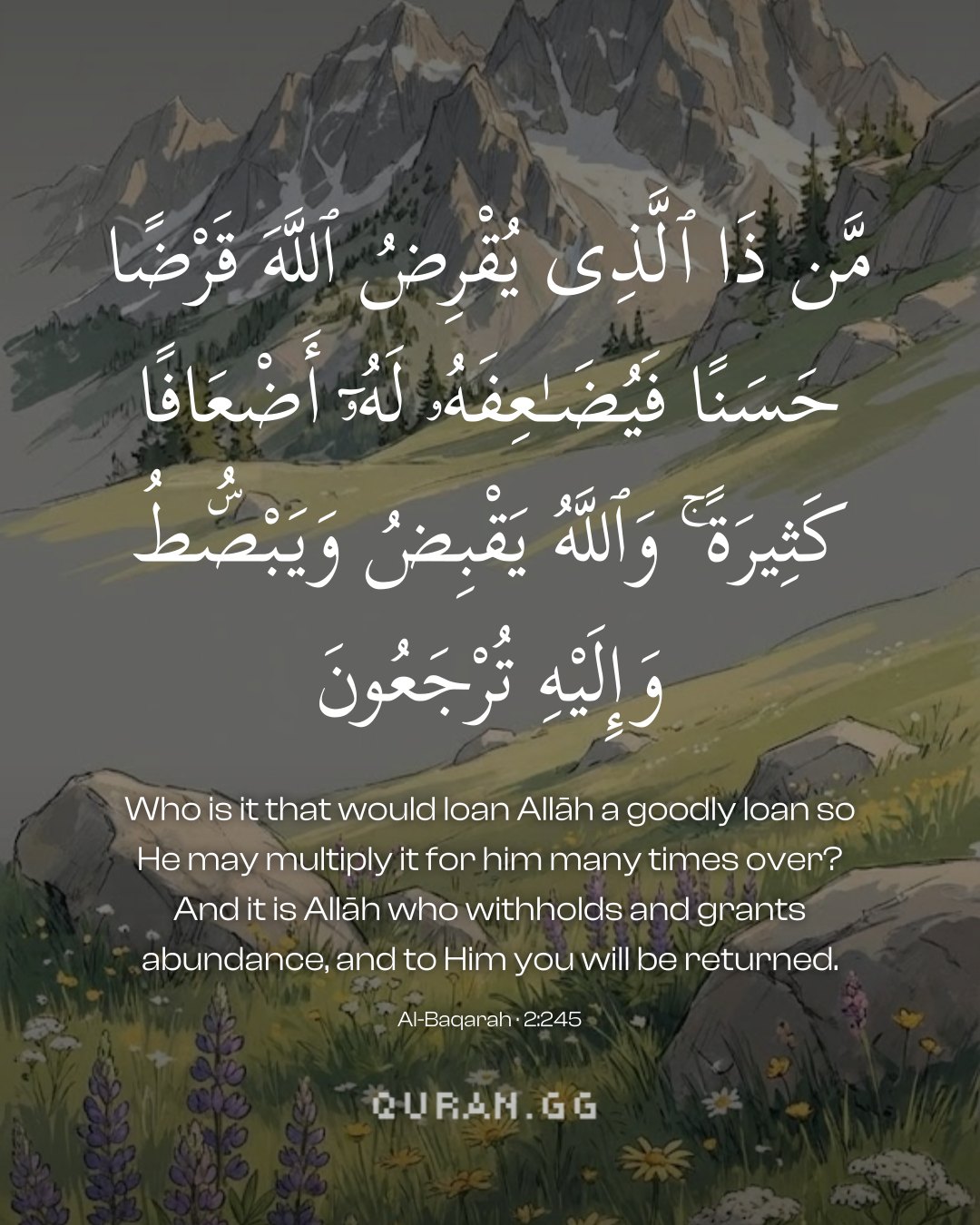
1. يُقْرِضُ اللَّـهَ قَرْضًا حَسَنًا (who would give Allah a good loan?) the word 'loan' refers to good deeds and to the act of spending in the way of Allah, This was expressed figuratively as qard قرض (literally, 'loan' ), otherwise everything belongs to Allah. It simply means that whatever you spend will surely be returned to you (in the form of a reward in the Hereafter) just as a loan is surely returned. The promise of increased or multiplied return appears in a hadith which declares that a date spent in the way of Allah is so increased by Allah Almighty that it outgrows the mountain of Uhud.
Giving 'loan' to Allah Almighty has also been explained as the giving of actual loan to His slaves i.e. the human beings and thereby helping them in their hour of need. So, the act of giving loan has been credited with great merit in Hadith. The noble Prophet ﷺ said:
ما من مسلم یقرض مسلما قرضا مرۃ اِلا کان کصدقتہ مرتین
For every Muslim, who gives loan to another Muslim, it will be equal to having given sadaqah (charity) twice. (Mazhari with reference to Ibn Majah)
2. Hearing this verse, says Ibn al-'Arabi, people split in three groups. The first group is that of those unfortunate people who, after hearing this verse, said: 'Muhammad's Lord is poor, and we are rich.' The reply to this comment was given by another verse:
لَّقَدْ سَمِعَ اللَّـهُ قَوْلَ الَّذِينَ قَالُوا إِنَّ اللَّـهَ فَقِيرٌ وَنَحْنُ أَغْنِيَاءُ
Allah has surely heard the saying of those who said, "Allah is poor and we are rich". (3:181)
The second group is that of those who, hearing this verse, elected to act against it and adopted miserliness as their way of life. The love and greed of material possessions so tied them down that they remained deprived of the very ability to spend in the way of Allah.
The third group is that of sincere Muslims who lost no time and acted as directed by the verse giving the best of their possessions in the way of Allah, such as is the case of Companion Abu al-Dahdah ؓ and others. When this verse was revealed, Sayyidna Abu al-Dahdah ؓ presented himself before the Holy Prophet ﷺ and asked him: '0 Messenger of Allah, may my father and mother be sacrificed to you, does Allah Almighty need loan from us, although He is Ghani غنی ، the one who needs no loan?' The Holy Prophet ﷺ said: 'Yes, Allah Almighty does wish to grant you entry in Paradise through it.' Hearing this, Sayyidna Abu al-Dahdah ؓ said. 'Let the Messenger of Allah ﷺ stretch his hand forward.' He stretched his hand forward. Now Abu al-Dahdah ؓ started saying:
'I own two date farms. I own nothing except these. I give the loan of these two farms of mine to Allah Almighty.'
The Holy Prophet ﷺ said to him: 'Dedicate one of these as waqf (endowment) in the way of Allah and keep the other to take care of your family needs.' Abu al-Dahdah ؓ said: "You be my witness that I 'spend' the better of the two farms which has six hundred date trees in the way of Allah." He said: 'Allah will bless you with Paradise in return.
Abu al-Dahdah ؓ came to his house and told his wife about it. She too was very pleased with this wonderful deal. The noble Prophet ﷺ said:
کم من عذق رداح و دار فباح لابی الدحداح
Countless trees laden with dates and spacious palaces are eagerly waiting for Abu al-Dahdah (in Paradise). (Qurtubi)
3. While returning qard قرض (loan), paying a little more than taken is a favourable practice only if any increase on the amount of loan has not been made a pre-condition. The Holy Prophet ﷺ said:
اِن خیارکم احسنکم قضاء
The best person among you is the one who fulfils his obligation (loan) in a good manner.
If increase or premium has been made a condition, then, that is haram (unlawful), and it is riba (interest) as well.
The Muslims left Makkah for Madinah as a result of severe persecution at the hands of the Makkans. In Madinah they were free to live in accordance with their religion. But the opponents of Islam did not leave matters at that. They began launching armed onslaughts on the Muslims in order to uproot them from Madinah. The Muslims at that time were far less in number and had fewer resources as compared to their opponents. This discouraged them from going ahead and facing the enemy. On this occasion God reminded them of an event in the history of the Israelites, where in the trials of life, fear of defeat was defeat itself. The Philistines, a neighbouring people, once attacked the Israelites and defeated them, slaying more than four thousand Hebrews. The Israelites were so greatly stricken with fear that they abandoned their homes and ran away. ‘Thus the glory departed from Israel,’ and in the words of the Bible, ‘All the houses of Israel trembled with fear and beseeched the Lord.’ Twenty years passed in this state. Then they all gave serious thought as to why they had been defeated by the Philistines. Their prophet Samuel said to them, ‘If you return to the Lord with all your hearts, then put away the foreign gods... from among you, and prepare your hearts for the Lord, and serve Him only; and He will deliver you out of the hand of the Philistines’ (1 Samuel 7:3). So they put away the foreign gods and served only their Lord. Now the Philistines drew near to battle against Israel, ‘But the Lord thundered on that day, with a great thunder upon the Philistines and discomfited them; and they were smitten before Israel’ (Samuel 7:10). Abandoning the path of trust in God leads to the moral death of nations and communities, while opting for the path of trust in God leads to their regeneration.
Continue reading the tafsir of ayahs 244–245 Uthmani text of the Madinah mushaf (King Fahd Complex). Translation: Saheeh International. Tafsir via Quran.com.