Surah Al-Baqarah Ayah 259 (2:259) — Meaning & Tafsir | Quran.GG

Surah Al-Baqarah, Ayah 259

2:259 · Meaning and tafsir

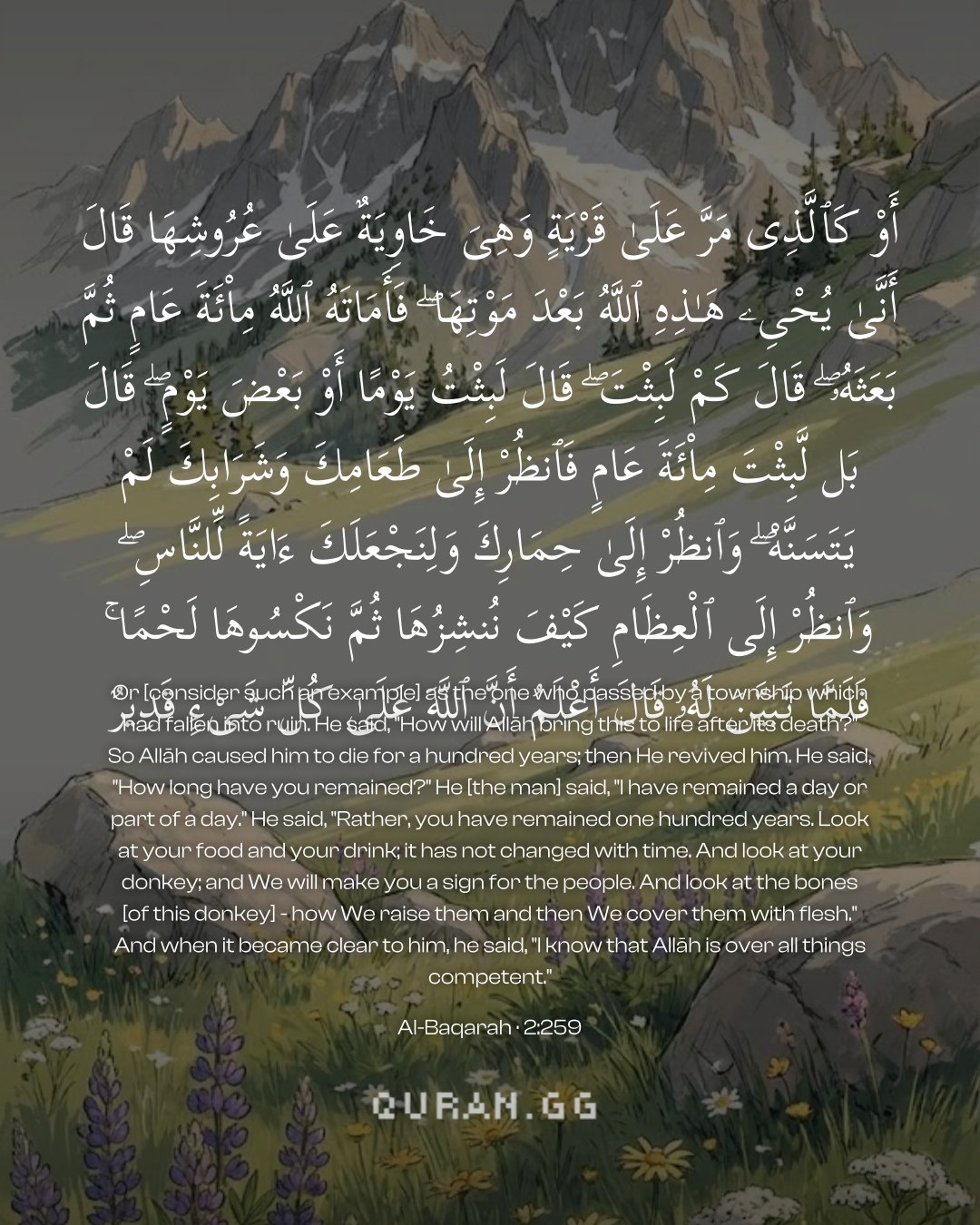
أَوْ كَٱلَّذِى مَرَّ عَلَىٰ قَرْيَةٍ وَهِىَ خَاوِيَةٌ عَلَىٰ عُرُوشِهَا قَالَ أَنَّىٰ يُحْىِۦ هَـٰذِهِ ٱللَّهُ بَعْدَ مَوْتِهَا ۖ فَأَمَاتَهُ ٱللَّهُ مِا۟ئَةَ عَامٍ ثُمَّ بَعَثَهُۥ ۖ قَالَ كَمْ لَبِثْتَ ۖ قَالَ لَبِثْتُ يَوْمًا أَوْ بَعْضَ يَوْمٍ ۖ قَالَ بَل لَّبِثْتَ مِا۟ئَةَ عَامٍ فَٱنظُرْ إِلَىٰ طَعَامِكَ وَشَرَابِكَ لَمْ يَتَسَنَّهْ ۖ وَٱنظُرْ إِلَىٰ حِمَارِكَ وَلِنَجْعَلَكَ ءَايَةً لِّلنَّاسِ ۖ وَٱنظُرْ إِلَى ٱلْعِظَامِ كَيْفَ نُنشِزُهَا ثُمَّ نَكْسُوهَا لَحْمًا ۚ فَلَمَّا تَبَيَّنَ لَهُۥ قَالَ أَعْلَمُ أَنَّ ٱللَّهَ عَلَىٰ كُلِّ شَىْءٍ قَدِيرٌ ٢٥٩

Or [consider such an example] as the one who passed by a township which had fallen into ruin. He said, "How will Allāh bring this to life after its death?" So Allāh caused him to die for a hundred years; then He revived him. He said, "How long have you remained?" He [the man] said, "I have remained a day or part of a day." He said, "Rather, you have remained one hundred years. Look at your food and your drink; it has not changed with time. And look at your donkey; and We will make you a sign for the people. And look at the bones [of this donkey] - how We raise them and then We cover them with flesh." And when it became clear to him, he said, "I know that Allāh is over all things competent."

Surah Al-Baqarah 2:259 in Arabic with its translation: “Or [consider such an example] as the one who passed by a township which had fallen into ruin. He said, "How…”

Make something with this ayah

Turn it into a video for Stories, Reels or TikTok, recited by the reciter you pick, or an image on a background you choose. Free, in your browser.

Download this image

Tafsir Ibn Kathir (abridged)

The Story of `Uzayr

Allah's statement,

أَلَمْ تَرَ إِلَى الَّذِى حَآجَّ إِبْرَهِيمَ فِى رِبِّهِ

(Have you not looked at him who disputed with Ibrahim about his Lord) means, "Have you seen anyone like the person who disputed with Ibrahim about his Lord" Then, Allah connected the Ayah,

أَوْ كَالَّذِى مَرَّ عَلَى قَرْيَةٍ وَهِىَ خَاوِيَةٌ عَلَى عُرُوشِهَا

(Or like the one who passed by a town in ruin up to its roofs) to the Ayah above by using `or'.

Ibn Abi Hatim recorded that `Ali bin Abi Talib said that the Ayah 2:259 meant `Uzayr. Ibn Jarir also reported it, and this explanation was also reported by Ibn Jarir and Ibn Abi Hatim from Ibn `Abbas, Al-Hasan, Qatadah, As-Suddi and Sulayman bin Buraydah.

Mujahid bin Jabr said that the Ayah refers to a man from the Children of Israel, and the village was Jerusalem, after Nebuchadnezzar destroyed it and killed its people.

وَهِىَ خَاوِيَةٌ

(in ruin) means, it became empty of people. Allah's statement,

عَلَى عُرُوشِهَا

(up to its roofs) indicates that the roofs and walls (of the village) fell to the ground. `Uzayr stood contemplating about what had happened to that city, after a great civilization used to inhabit it. He said,

أَنَّى يُحْىِ هَـذِهِ اللَّهُ بَعْدَ مَوْتِهَا

(Oh! How will Allah ever bring it to life after its death) because of the utter destruction he saw and the implausibility of its returning to what it used to be. Allah said,

فَأَمَاتَهُ اللَّهُ مِاْئَةَ عَامٍ ثُمَّ بَعَثَهُ

(So Allah caused him to die for a hundred years, then raised him up (again).)

The city was rebuilt seventy years after the man (`Uzayr) died, and its inhabitants increased and the Children of Israel moved back to it. When Allah resurrected `Uzayr after he died, the first organ that He resurrected were his eyes, so that he could witness what Allah does with him, how He brings life back to his body. When his resurrection was complete, Allah said to him, meaning through the angel,

كَمْ لَبِثْتَ قَالَ لَبِثْتُ يَوْمًا أَوْ بَعْضَ يَوْمٍ

("How long did you remain (dead)" He (the man) said: "(Perhaps) I remained (dead) a day or part of a day.")

The scholars said that since the man died in the early part of the day and Allah resurrected him in the latter part of the day, when he saw that the sun was still apparent, he thought that it was the sun of that very day. He said,

أَوْ بَعْضَ يَوْمٍ قَالَ بَل لَّبِثْتَ مِاْئَةَ عَامٍ فَانظُرْ إِلَى طَعَامِكَ وَشَرَابِكَ لَمْ يَتَسَنَّهْ

("Or part of a day. " He said: "Nay, you have remained (dead) for a hundred years, look at your food and your drink, they show no change.")

He had grapes, figs and juice, and he found them as he left them; neither did the juice spoil nor the figs become bitter nor the grapes rot.

وَانظُرْ إِلَى حِمَارِكَ

(And look at your donkey!), "How Allah brings it back to life while you are watching."

وَلِنَجْعَلَكَ ءَايَةً لِلنَّاسِ

(And thus We have made of you a sign for the people) that Resurrection occurs.

وَانظُرْ إِلَى العِظَامِ كَيْفَ نُنشِزُهَا

(Look at the bones, how We Nunshizuha) meaning, collect them and put them back together. In his Mustadrak, Al-Hakim, recorded that Kharijah bin Zayd bin Thabit said that his father said that the Messenger of Allah ﷺ read this Ayah,

كَيْفَ نُنشِزُهَا

(how We Nunshizuha.) Al-Hakim said; "Its chain is Sahih and they (Al-Bukhari and Muslim) did not record it." The Ayah was also read,

(نُنْشِرُهَا)

"Nunshiruha" meaning, bring them back to life, as Mujahid stated.

ثُمَّ نَكْسُوهَا لَحْمًا

(And clothe them with flesh. )

As-Suddi said, " `Uzayr observed the bones of his donkey, which were scattered all around him to his right and left, and Allah sent a wind that collected the bones from all over the area. Allah then brought every bone to its place, until they formed a full donkey made of fleshless bones. Allah then covered these bones with flesh, nerves, veins and skin. Allah sent an angel who blew life in the donkeys' nostrils, and the donkey started to bray by Allah's leave." All this occurred while `Uzayr was watching, and this is when he proclaimed,

قَالَ أَعْلَمُ أَنَّ اللَّهَ عَلَى كُلِّ شَيْءٍ قَدِيرٌ

(He said, "I know (now) that Allah is able to do all things,") meaning, "I know that, and I did witness it with my own eyes. Therefore, I am the most knowledgeable in this matter among the people of my time."

Ma'arif al-Qur'an

The verse refers to Namrud نمرود ، the emperor of Babylon, who denied the very existence of God and had a debate with Sayyidna Ibrahim (علیہ السلام) on this issue. Allah has given him political power over a large territory. He should have been grateful to his Lord. But, on the contrary, his political power inflated him with pride and arrogance; he started denying the very existence of Him. It is in this context that the Holy Qur'an says: 'the one who argued with Ibrahim about his Lord, because Allah had given him kingship."

In the course of argument, he asked Ibrahim (علیہ السلام) about the basic attributes of God. He replied, "My Lord is the One who gives life and brings death." The foolish king did not understand the real nature of 'giving life' and 'bringing death.' Therefore, he argued that he, too, can kill anyone through his order and bring thereby death to him and can also let off a person sentenced to death and give thereby life to him. Obviously, his argument was totally absurd, because 'giving life' means to give life to something lifeless56.

Continue reading the tafsir of ayahs 258–259

Tazkirul Quran

In the modern age, the right to govern a people is secured by popular support. However, that was not the case in pre-democratic times, when kings sanctioned their rule over their subjects by laying claim to being some kind of divine incarnation. Nimrod, a king of ancient Iraq, was a case in point. A contemporary of Abraham, he was one of those monarchs who used this method to back up his right of sovereignty over the people. The sun was believed by his people to be the Chief of the gods and was thus revered by them as an object of worship. Nimrod claimed that he was an incarnation of the sun-god, a position which gave him a divine right to worldly sovereignty. When Abraham preached the message of the One God in the land of Iraq, his teachings had no direct connection with politics or government in the country. All he did was to impress upon the people that there was but One God; He was their sole Lord and Master. There were no partners with Him in the godhead, so mankind should worship Him alone, fearing Him and placing their hopes in Him. Though Abraham’s message was apolitical, it nevertheless appeared to Nimrod as a threat to his political claims, for according to the message taught by Abraham, even the sun was part of God’s creation. It had no power of its own, but was controlled by God Almighty. Had his subjects accepted Abraham’s message of the One God, it would have amounted to demolishing the theological base on which the edifice of his political power rested. It was for this reason that Nimrod turned vehemently against Abraham and his teachings. The dialogue conducted between Abraham and Nimrod shows us the method adopted by the prophets in the communication of their message. First of all, Abraham pointed out that his Lord had control over life and death. Immediately, Nimrod disputed this, claiming himself to have power over life and death. Abraham, of course, could have answered this claim made by Nimrod, but he did not want the conversation to deteriorate into a heated polemical discussion. So, instead of persisting with this point, he changed the subject and chose another example, one with which Nimrod would not be able to argue. Abraham did not consider Nimrod his enemy or rival. Rather, he had compassion for him as a madu‘ (addressee) and earnestly wished to communicate to him the message of Truth. It was this compassion which showed Abraham the correct method to be adopted in addressing the Iraqi king. Since the present world is a place where man is being tested, there are always different options open to everyone. This causes people to construe situations in different ways. For instance, should one be endowed with worldly wealth and power, one may consider these to be a personal success, the outcome of one’s own talent. One may, on the other hand, look at them purely as blessings from God. The former way of seeing things amounts to grave injustice, while the latter shows a grateful disposition. For one who is thankless in his outlook, everything in this world will only serve to lead him further astray. Everything he experiences will only add to his pride and conceit. But for those who are grateful for what they have been given, everything they experience in this world leads them closer to God. The world, and all that it contains, serves to stimulate their faith in God.

Continue reading the tafsir of ayahs 258–259

Uthmani text of the Madinah mushaf (King Fahd Complex). Translation: Saheeh International. Tafsir via Quran.com.