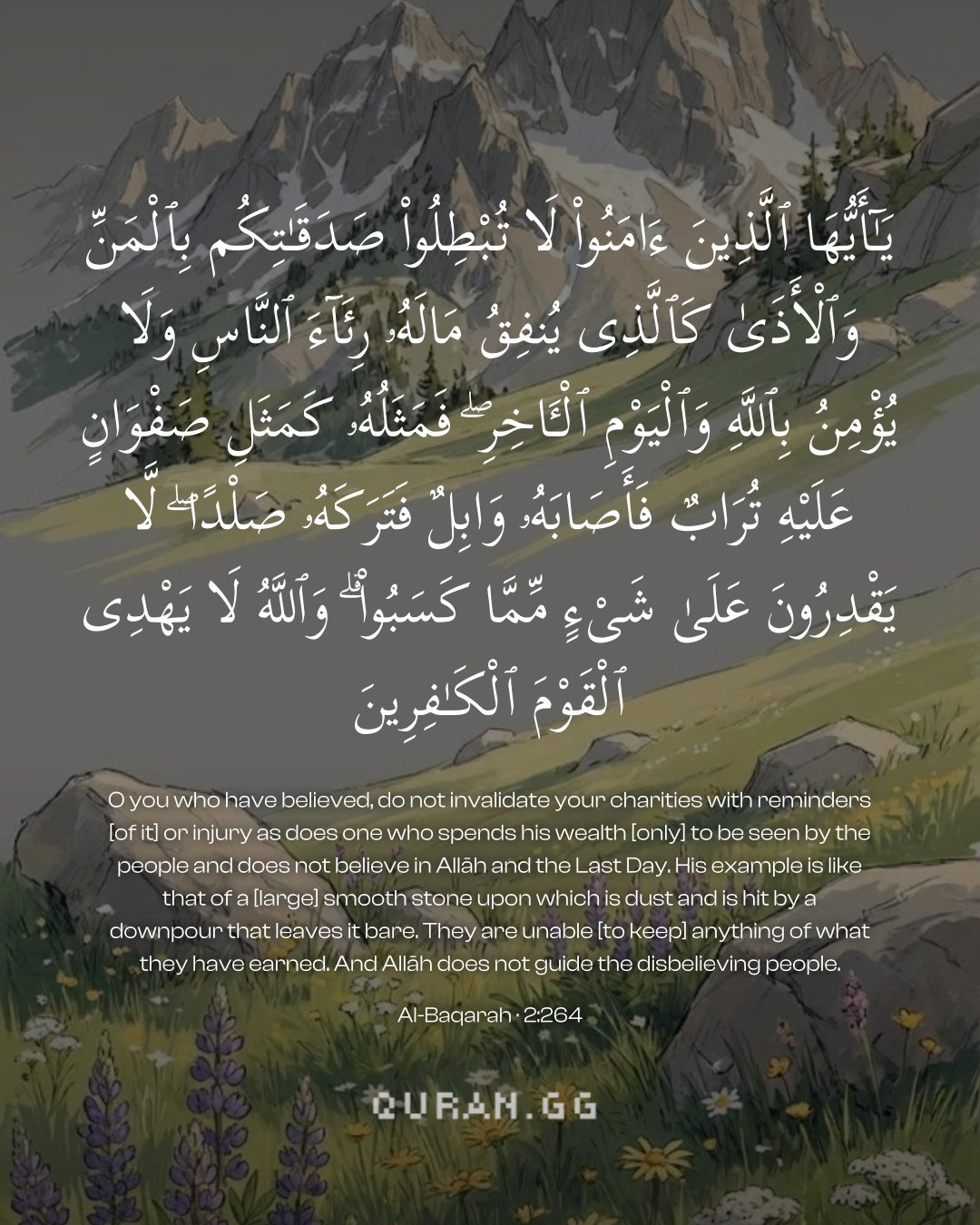
O you who have believed, do not invalidate your charities with reminders [of it] or injury as does one who spends his wealth [only] to be seen by the people and does not believe in Allāh and the Last Day. His example is like that of a [large] smooth stone upon which is dust and is hit by a downpour that leaves it bare. They are unable [to keep] anything of what they have earned. And Allāh does not guide the disbelieving people.
Allah praises those who spend from their money in His cause, and then refrain from reminding those who received the charity of that fact, whether these hints take the form of words or actions.
Allah's statement,
وَلاَ أَذًى
(or with injury), indicates that they do not cause harm to those whom they gave the charity to, for this harm will only annul the charity. Allah next promised them the best rewards for this good deed,
لَهُمْ أَجْرُهُمْ عِندَ رَبِّهِمْ
(their reward is with their Lord), indicating that Allah Himself will reward them for these righteous actions. Further,
وَلاَ خَوْفٌ عَلَيْهِمْ
(On them shall be no fear) regarding the horrors of the Day of Resurrection,
In the fourth verse, the same subject has been taken up differently with a little more emphasis. It was said: Do not waste your charities: verbally -- by causing your favour to be known; or practically by causing pain.
This makes it clear that any form of favour-flashing or needy-bashing, after an act of charity renders such charity null and void. There is no reward for it.
In this verse, one more condition governing the acceptance of sadaqah صدقہ has been added by saying that one who spends for public exposure, for name and fame, and does not believe in Allah Almighty and the Day of Resurrection, can be likened to be acting in a situation where he sows a grain on a clean rock which has collected a layer of soil, then comes the rain and washes the whole thing clean. Such people will never reap what they have sown and Allah Almighty will not let the disbelievers see the way. From this we know the condition that governs the acceptance of sadaqah صدقہ and khayrat خیرات۔- spend only to seek the good pleasure of Allah Almighty and with the intention of getting thawab ثواب (reward) in the akhirah آخرۃ (Hereafter). Never do it with the intention of having public exposure, name and fame. Spending with the intention of earning name and fame is wasting what you spend. And should a true Muslim, who does believe in the Hereafter, expend something simply for name, fame, and under hypocritical motivation, he too, would not get any thawab ثواب (reward) for it. Moreover, there is a hint here in the use of the additional sentence ولا یؤمن باللہ ، (And does not believe in Allah); perhaps, it aims to suggest that hypocrisy and name-seeking is not just the sort of thing a person who believes in Allah Almighty and the Day of Resurrection would ever do since hypocrisy is a sign of something being wrong with his faith.
The meaning of وَاللَّـهُ لَا يَهْدِي الْقَوْمَ الظَّالِمِي 'Allah Almighty will not show disbelievers the way' towards the end of verse 264 is that the Qur'anic guidance is universal. It is common to all human beings. But, disbelievers do not take notice of this guidance, rather go a step farther and make fun of it. As a result, Allah Almighty lets them be deprived of the very taufiq توفیق ، the ability to accept guidance. The effect is that they do not accept any guidance.
Tazkirul Quran
Maulana Wahiduddin Khan
Some soil (earth) may collect on the surface of a boulder. Outwardly, it appears as though this is good, fertile soil, but when a gust of wind brings a rain-shower down upon it, then the earth is washed away, leaving the rock exposed to the elements. The same is true of one who has donned a superficial robe of piety, without that piety having permeated his entire being. Should he be addressed rudely by someone asking for financial help, or should his ego receive a wounding blow, he becomes so irritated that he exceeds all bounds of decency in his response. Incidents of this nature are like the showers of rain which wash away his outward garb of piety, leaving his true nature exposed to the outside world. To do things for God’s sake, is to give priority to the invisible over the visible world. It is to set one’s sights on an unseen world, over and above the world which meets the eye. This requires a loftiness of vision. Those who show such sublimity of vision have the door of God’s realization opened to them.
Uthmani text of the Madinah mushaf (King Fahd Complex). Translation: Saheeh International. Tafsir via Quran.com.