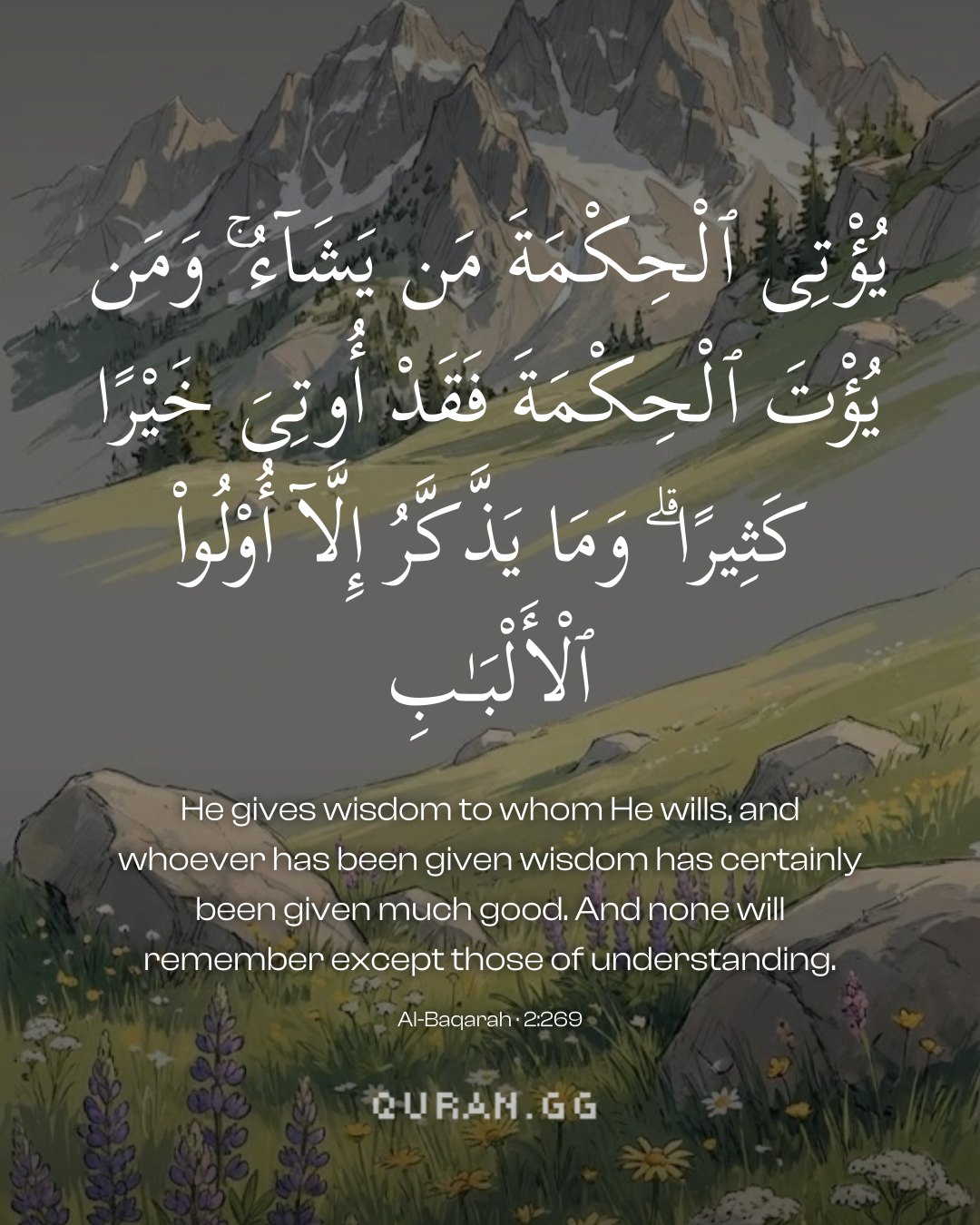
He gives wisdom to whom He wills, and whoever has been given wisdom has certainly been given much good. And none will remember except those of understanding.
The Encouragement to Spend Honest Money for Allah's Sake
Allah commands His believing servants to spend in charity, as Ibn `Abbas stated, from the pure, honest money that they earned and from the fruits and vegetables that He has grown for them in the land. Ibn `Abbas said, "Allah commanded them to spend from the purest, finest and best types of their money and prohibited spending from evil and dishonest money, because Allah is pure and good and only accepts that which is pure and good." This is why Allah said,
وَلاَ تَيَمَّمُواْ الْخَبِيثَ
(and do not aim at that which is bad) meaning, filthy (impure) money,
مِنْهُ تُنفِقُونَ وَلَسْتُم بِأَخِذِيهِ
(to spend from it, (though) you would not accept it) meaning, "If you were given this type, you would not take it, except if you tolerate the deficiency in it. Verily, Allah is far Richer than you, He is in no need of this money, so do not give, for His sake, what you would dislike for yourselves." It was reported that,
(3). Verse 269 يُؤْتِي الْحِكْمَةَ مَن يَشَاءُ : "He gives wisdom to whom He wills." The word, الْحِكْمَةَ (al-hikmah: wisdom) appears repeatedly in the Holy Qur'an, and at every place, its meaning has been explained differently. In Tafsir al-Bahr al-Muhit البحر المحیط ، all positions taken by commentators have been assembled at this point. These come to nearly thirty, however, towards the end it was said that all these positions are close together and there is no contradiction among them. The only difference is that of interpretations. The word, hikmah حِكْمَةَ is the verbal noun of 'ihkam الاحکام (the first letter, hamzah ھمزہ with kasrah کسرہ ) which means 'to complete what is said or done with all its properties and requisites.'
This is why the verse وَآتَاهُ اللَّـهُ الْمُلْكَ وَالْحِكْمَةَ : 'And Allah gave him the kingdom and the hikmah حکمہ ' (2:251) which concerns Sayyidna Dawud (علیہ السلام) ، was explained in al-Bahr al-Muhit in the following manner:
The real meaning of hikmah حکمہ is to place everything whereto it be-longs and this can only be accomplished ideally through prophethood. Therefore, hikmah حکمہ has been interpreted as prophethood here.
Imam Raghib al-Isfahani has said in Mufradat al-Qur'an: مفردات القرآن "When the word, hikmah حکمہ is used for Allah Almighty, it denotes the comprehensive knowledge and solid creative excellence of all things; and when attributed to the non-Divine, it means the rightly-guided knowledge of what exists, and the action which corresponds to it.
This sense has been interpreted in different words. Somewhere it means, the Qur'an; elsewhere, the Hadith. Then at different places, it carries different meanings, such as "the authentic knowledge", "the righteous deed", "the True Word", "the wisdom", "the understanding of religion", "correctness of opinion" and "the fear of Allah". Incidentally, the last meaning appears in Hadith as well: راس الحکمہ خشیۃ اللہ that is, "the real wisdom is the fear of Allah". The word, hikmah in the verse يُعَلِّمُهُمُ الْكِتَابَ وَالْحِكْمَةَ (teaches them the Book and the wisdom - 3:164) has been explained as "Hadith and Sunnah" by the Sahabah ؓ and the Tabi` in (the Companions and the Successors). Some commentators hold the opinion that hikmah in the verse یوتَ الحکمہ (whoever is given wisdom) under discussion covers all these things.
This is the more evident view; more so, since the words of the Qur'an وَمَن يُؤْتَ الْحِكْمَةَ فَقَدْ أُوتِيَ خَيْرًا كَثِيرًا "And whoever is given wisdom is certainly given a lot of good" do hint in that direction as they mean that the hikmah حِكْمَةَ covers a lot of good. Allah knows best.
Tazkirul Quran
Maulana Wahiduddin KhanOn ayahs 268–271
There are two ways of spending one’s earnings in this world. One is to spend in ways shown by Satan. Another is to spend in ways shown by God. What Satan does is to impress on the minds of human beings the importance of personal requirements, and bring about conviction that all their earnings are best spent on personal comforts and luxuries. When Satan sees that any individual has more wealth than is necessary for his personal needs, he kindles in him another desire, that of indulging in showy activities. At the instigation of Satan, man spends all his money on ostentatious living and feels happy that he has spent his money in the best possible way. What is desired of man is that he should not regard his wealth as his personal possession but rather as something that belongs only to God. He should spend as much of his wealth as is necessary for his actual needs and the rest he should spend on achieving higher goals. He should give this surplus wealth to the weaker of God’s servants and also spend for the cause of God’s religion. When he spends for the weaker section of society, he hopes that in the Hereafter, when he appears empty-handed before God, he will not be deprived of God’s blessings. Similarly, when he spends his wealth for the cause of God’s religion, he allies himself with God’s mission.
Uthmani text of the Madinah mushaf (King Fahd Complex). Translation: Saheeh International. Tafsir via Quran.com.