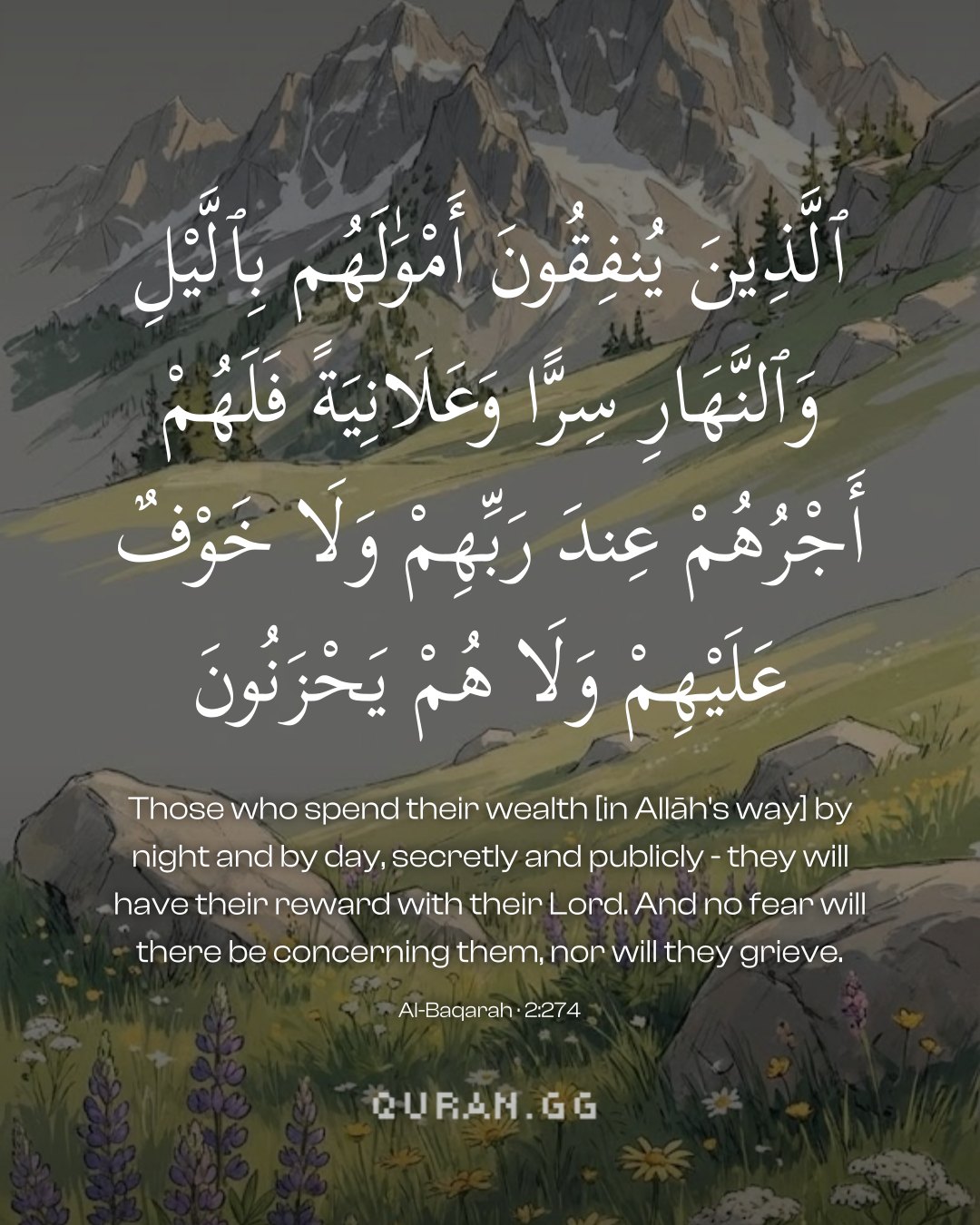
Those who spend their wealth [in Allāh's way] by night and by day, secretly and publicly - they will have their reward with their Lord. And no fear will there be concerning them, nor will they grieve.
Abu `Abdur-Rahman An-Nasa'i recorded that Ibn `Abbas said that they, "Disliked giving charity to their polytheist relatives, but were later on allowed to give it to them when they inquired about this matter, and this Ayah was revealed,
(Not upon you (Muhammad ) is their guidance, but Allah guides whom He wills. And whatever you spend in good, it is for yourselves, when you spend not except seeking Allah's Face. And whatever you spend in good, it will be repaid to you in full, and you shall not be wronged.)
(8). Verse 274: الَّذِينَ يُنفِقُونَ أَمْوَالَهُم بِاللَّيْلِ وَالنَّهَارِ "Those who spend their
wealth night and day."
Presented in this verse is the great reward and excellence of those who are used to spending in the way of Allah. They are those who, under all conditions and circumstances, during the day and during the night, secretly and openly, keep spending in the way of Allah in all sorts of ways. By implication, it was also stated that there is no time fixed for charities, i.e., sadaqah صدقہ and khayrat خیرات . There is no restriction of night or day. Similarly, spending in the way of Allah, secretly and openly, is an act of thawab ثواب both ways, however, the condition is that it should be done with sincerity (ikhlas اخلاص ), and not to earn name and fame. The excellence of spending secretly is limited to a situation where there be no pressing need to spend out openly; and where such a need does exist, spending there openly is certainly better.
Based on the authority of Ibn ` Asakir, there is a report in Ruh al-Ma` ani which says that Sayyidna Abu Bakr ؓ spent forty thousand dinars in the way of Allah - making it ten thousand during the day, ten thousand during the night, ten thousand openly and ten thousand secretly. Some commentators have said that this very event related to Sayyidna Abu Bakr ؓ was the background of the revelation of this verse. There are other views also regarding the circumstances of its revelation.
Tazkirul Quran
Maulana Wahiduddin Khan
The greatest way to spend money for the cause of God is to extend monetary help to those of God’s servants who have devoted themselves wholly to the cause of His religion, thus leaving themselves no time to earn for their personal needs. Just as a successful businessman has little free time for anything except his business, similarly one who serves the cause of religion full time has no time to work to make money for himself. Furthermore, each job shapes in a particular way the thinking of the person involved. One who involves himself in business develops the relevant skills, so that he is able to easily understand the complexities of commerce. But that same person will not be able to understand the nuances of religion’s cause. Similarly, a religious worker will not be able to successfully run a business, for he cannot concentrate on business matters due to his attention being diverted elsewhere. However, a society needs both kinds of activities. The solution to this problem is for those who possess monetary resources to arrange a share for those who, because of their religious commitments, are unable to provide for their own economic needs. This is like a tacit division of labour, which takes place between the two groups purely in order to earn God’s pleasure. The missionary, having devoted himself to God, does not ask anything from others, nor does he expect anything from them. On the other hand, those who are monetarily strong, knowing that they have amassed wealth through not devoting themselves to the cause of religion (which they should have done), think that they should, by way of compensation, give a share of their wealth to their brothers in faith. Spending for a peaceful religious struggle which brings no fame or laurels makes one all the more deserving of God’s blessings. For such spending is only to seek God’s pleasure.
Uthmani text of the Madinah mushaf (King Fahd Complex). Translation: Saheeh International. Tafsir via Quran.com.