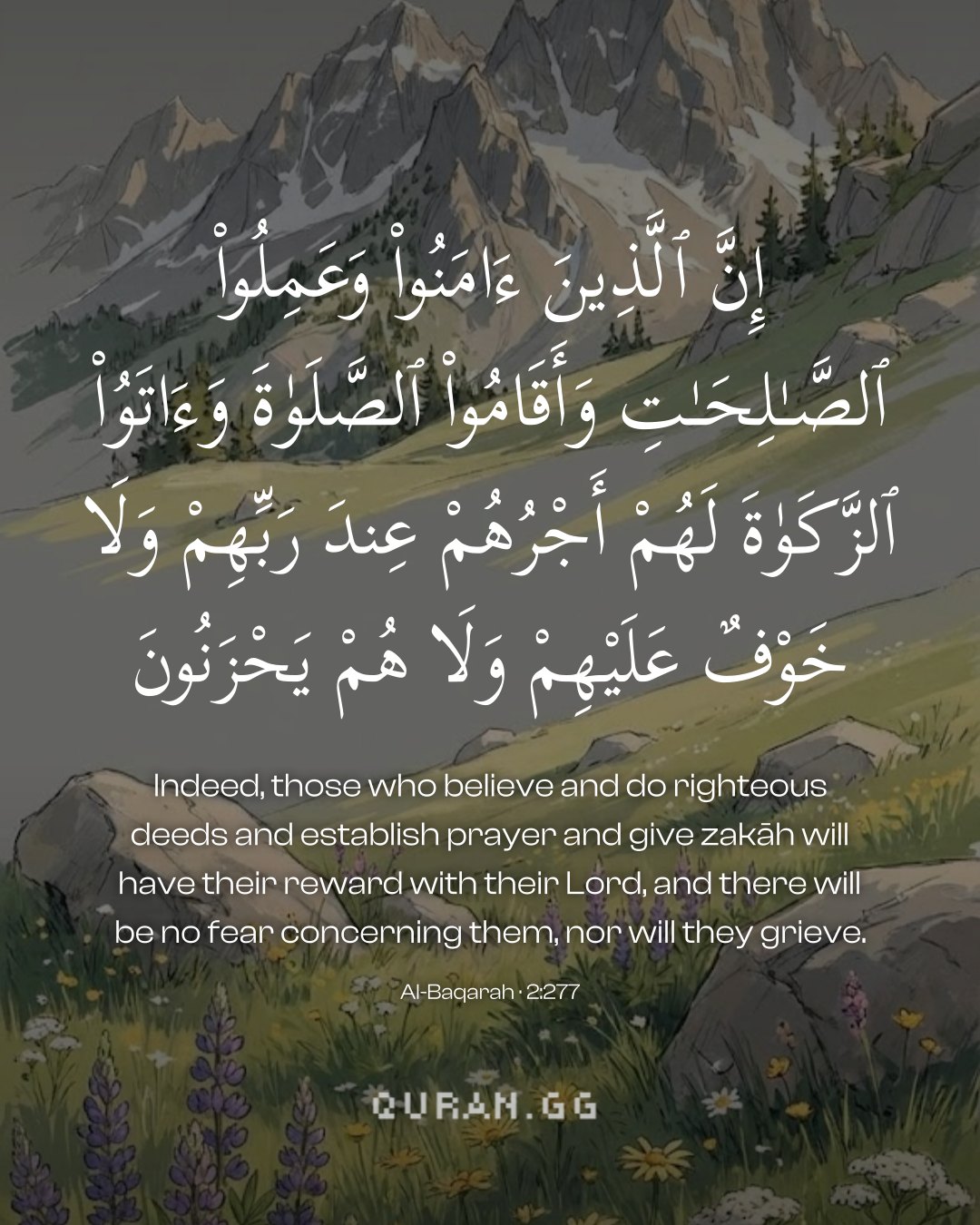
Indeed, those who believe and do righteous deeds and establish prayer and give zakāh will have their reward with their Lord, and there will be no fear concerning them, nor will they grieve.
Allah states that He destroys Riba, either by removing this money from those who eat it, or by depriving them of the blessing, and thus the benefit of their money. Because of their Riba, Allah will torment them in this life and punish them for it on the Day of Resurrection. Allah said,
The third verse (277) mentions the great reward of peace and comfort that awaits the truly believing and practising Muslims, who are steadfast in Salah نماز and زکاۃ Zakah. Since, in the verse previous to this, the punishment of Hell and the disgrace the consumers of ربا riba will be facing was mentioned, so in accordance with the general style of the noble Qur'an, the merit - in آخرۃ Akhirah - of the believing-practising Muslims, those steadfast in Salah نماز and زکاۃ Zakah, was mentioned alongside.
Tazkirul Quran
Maulana Wahiduddin KhanOn ayahs 277–279
Man has not been sent into this world to hoard wealth. All the good things of this life are meant for the next world. Man has been sent into this world so that it may be judged whether or not he has developed those qualities that would qualify him to inherit the world of Paradise in the Hereafter. Those adjudged fit to dwell in Paradise will be separated from the unfit, and the latter will be consigned to hell. Practicing charity (sadaqah) means giving one’s wealth to the needy for the sake of God, while engaging in usury means giving one’s wealth in order to exploit others. Sadaqah is an indication of the fact that man wants to see the massive array of God’s blessings in the next world, whereas usury is indicative of the fact that he wants to amass fortunes in this world itself. The alms-giver and the usurer are two different types of individuals. It is not possible that they will both have the same fate in the Hereafter. Only those find the world who have worked hard for it; similarly, only those will find the Hereafter who have sacrificed their wealth in order to receive God’s blessings in the Hereafter.
Uthmani text of the Madinah mushaf (King Fahd Complex). Translation: Saheeh International. Tafsir via Quran.com.