Surah Al-Baqarah Ayah 283 (2:283) — Meaning & Tafsir | Quran.GG

Surah Al-Baqarah, Ayah 283

2:283 · Meaning and tafsir

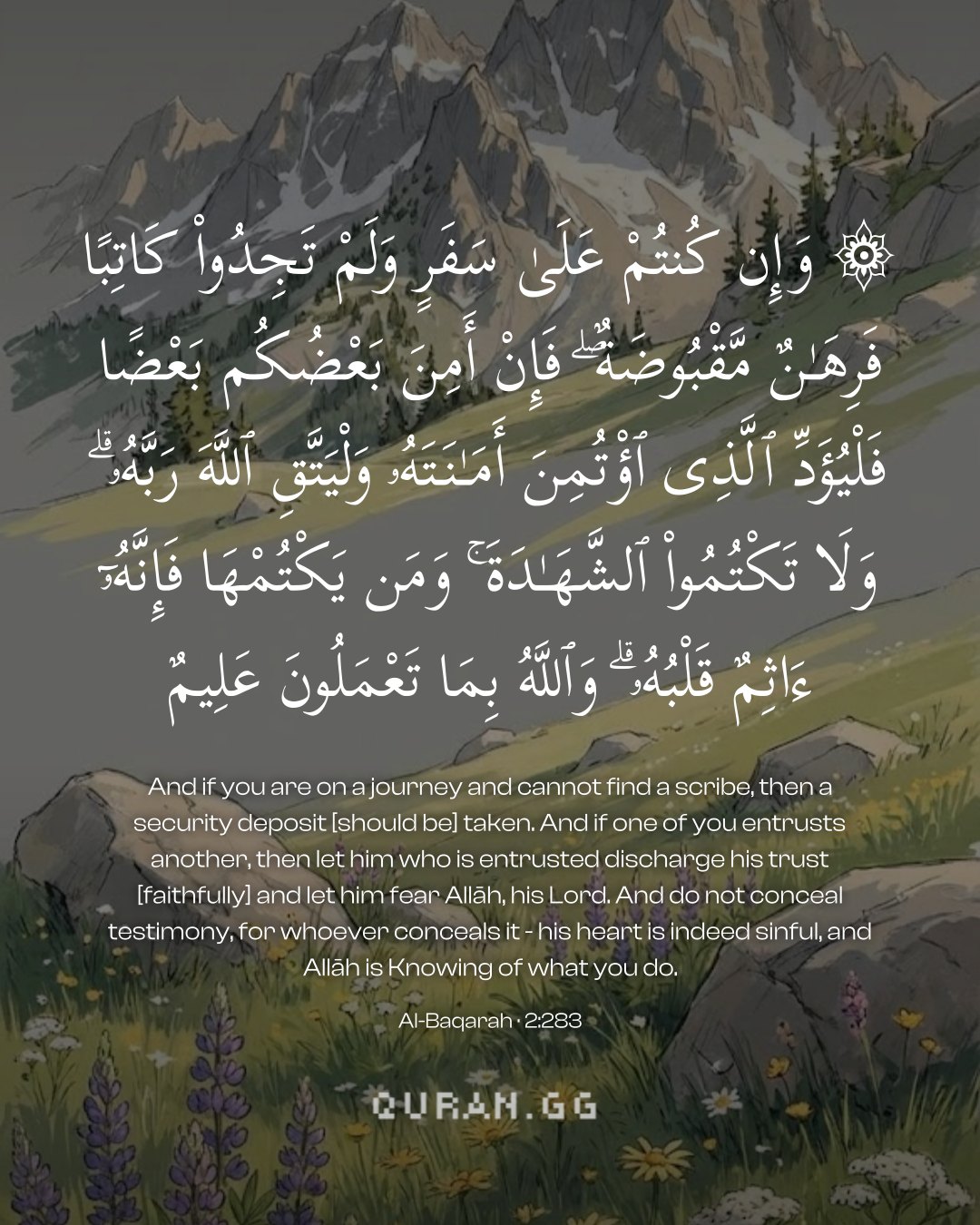
۞ وَإِن كُنتُمْ عَلَىٰ سَفَرٍ وَلَمْ تَجِدُوا۟ كَاتِبًا فَرِهَـٰنٌ مَّقْبُوضَةٌ ۖ فَإِنْ أَمِنَ بَعْضُكُم بَعْضًا فَلْيُؤَدِّ ٱلَّذِى ٱؤْتُمِنَ أَمَـٰنَتَهُۥ وَلْيَتَّقِ ٱللَّهَ رَبَّهُۥ ۗ وَلَا تَكْتُمُوا۟ ٱلشَّهَـٰدَةَ ۚ وَمَن يَكْتُمْهَا فَإِنَّهُۥٓ ءَاثِمٌ قَلْبُهُۥ ۗ وَٱللَّهُ بِمَا تَعْمَلُونَ عَلِيمٌ ٢٨٣

And if you are on a journey and cannot find a scribe, then a security deposit [should be] taken. And if one of you entrusts another, then let him who is entrusted discharge his trust [faithfully] and let him fear Allāh, his Lord. And do not conceal testimony, for whoever conceals it - his heart is indeed sinful, and Allāh is Knowing of what you do.

Surah Al-Baqarah 2:283 in Arabic with its translation: “And if you are on a journey and cannot find a scribe, then a security deposit [should be] taken. And if one…”

Make something with this ayah

Turn it into a video for Stories, Reels or TikTok, recited by the reciter you pick, or an image on a background you choose. Free, in your browser.

Download this image

Tafsir Ibn Kathir (abridged)

What is the `Mortgaging' Mentioned in the Ayah

Allah said,

وَإِن كُنتُمْ عَلَى سَفَرٍ

(And if you are on a journey) meaning, traveling and some of you borrowed some money to be paid at a later date,

وَلَمْ تَجِدُواْ كَاتِبًا

(and cannot find a scribe) who would record the debt for you. Ibn `Abbas said, "And even if they find a scribe, but did not find paper, ink or pen." Then,

فَرِهَـنٌ مَّقْبُوضَةٌ

(let there be a pledge taken (mortgaging)) given to the creditor in lieu of writing the transaction. The Two Sahihs recorded that Anas said that the Messenger of Allah ﷺ died while his shield was mortgaged with a Jew in return for thirty Wasq (approximately 180 kg) of barley, which the Prophet bought on credit as provisions for his household. In another narration, the Hadith stated that this Jew was among the Jews of Al-Madinah.

Allah said,

فَإِنْ أَمِنَ بَعْضُكُم بَعْضًا فَلْيُؤَدِّ الَّذِى اؤْتُمِنَ أَمَـنَتَهُ

(then if one of you entrusts the other, let the one who is entrusted discharge his trust (faithfully).)

Ibn Abi Hatim recorded, with a sound chain of narration, that Abu Sa`id Al-Khudri said, "This Ayah abrogated what came before it (i.e. that which required recording the transaction and having witnesses present)." Ash-Sha`bi said, "If you trust each other, then there is no harm if you do not write the loan or have witnesses present." Allah's statement,

وَلْيَتَّقِ اللَّهَ رَبَّهُ

(And let him have Taqwa of Allah) means, the debtor.

Imam Ahmad and the Sunan recorded that Qatadah said that Al-Hasan said that Samurah said that the Messenger of Allah ﷺ said,

«عَلَى الْيَدِ مَا أَخَذَتْ، حَتَّى تُؤَدِّيَه»

(The hand (of the debtor) will carry the burden of what it took until it gives it back.)

Allah's statement,

وَلاَ تَكْتُمُواْ الشَّهَـدَةَ

(And conceal not the evidence) means, do not hide it or refuse to announce it. Ibn `Abbas and other scholars said, "False testimony is one of the worst of the major sins, and such is the case with hiding the true testimony. This is why Allah said,

وَمَن يَكْتُمْهَا فَإِنَّهُ ءَاثِمٌ قَلْبُهُ

(For he who hides it, surely, his heart is sinful).

As-Suddi commented, "Meaning he is a sinner in his heart."

This is similar to Allah's statement,

وَلاَ نَكْتُمُ شَهَـدَةَ اللَّهِ إِنَّآ إِذَاً لَّمِنَ الاٌّثِمِينَ

(We shall not hide testimony of Allah, for then indeed we should be of the sinful) 5:106.

Allah said,

يَـأَيُّهَا الَّذِينَ ءَامَنُواْ كُونُواْ قَوَّامِينَ بِالْقِسْطِ شُهَدَآءِ للَّهِ وَلَوْ عَلَى أَنفُسِكُمْ أَوِ الْوَلِدَيْنِ وَالاٌّقْرَبِينَ إِن يَكُنْ غَنِيّاً أَوْ فَقَيراً فَاللَّهُ أَوْلَى بِهِمَا فَلاَ تَتَّبِعُواْ الْهَوَى أَن تَعْدِلُواْ وَإِن تَلْوُواْ أَوْ تُعْرِضُواْ فَإِنَّ اللَّهَ كَانَ بِمَا تَعْمَلُونَ خَبِيراً

(O you who believe! Stand out firmly for justice, as witnesses to Allah, even though it be against yourselves, or your parents, or your kin, be he rich or poor, Allah is a better Protector to both (than you). So follow not the lusts (of your hearts), lest you avoid justice; and if you distort your witness or refuse to give it, verily, Allah is Ever Well-Acquainted with what you do) 4:135 and in this Ayah 2:283 He said,

وَلاَ تَكْتُمُواْ الشَّهَـدَةَ وَمَن يَكْتُمْهَا فَإِنَّهُ ءَاثِمٌ قَلْبُهُ وَاللَّهُ بِمَا تَعْمَلُونَ عَلِيمٌ

(And conceal not the evidence, for he who hides it, surely, his heart is sinful. And Allah is All-Knower of what you do.)

Ma'arif al-Qur'an

The Qur'anic injunctions on Loan

An important principle of the Law of Dealings, or the Law of Contracts in modern legal terminology, has been taken up in the verses appearing above. Following this, appears a specific principle of the general rules of evidence.

These are times when writing is the rage. The written word has taken the place of human speech but think of the days of fourteen hundred years ago when almost the entire business of the world was conducted verbally. The principle of writing and retaining documents did not just exist. It was the Qur'an which first pointed out to its importance and said:

Continue reading the tafsir of ayahs 282–283

Tazkirul Quran

Where there is a cash transaction between two parties, the matter ends there itself. But contracting a debt is a different matter. In such a case, if the transaction is purely verbal, there is a possibility of differences arising due to the absence of written proof. Either party will present the matter according to his own perceptions, for there is no clear or absolute basis on which a proper decision may be arrived at. As a result, differences and complaints arise between the two parties at the time of payment. The only solution is to write down the particulars of the loan and then have witnesses testify to it. If any differences arise, this document would become the basis for a final decision. For a believer this would be a strategic safeguard based on taqwa and justice. In abiding by the written conditions and making a proper payment of dues, he acquits himself before the people and before God. Believers are witnesses of God’s religion. Just as they are not allowed to knowingly hide anything from God, they should similarly never conceal any evidence they may possess. Concealing evidence is to nurture a criminal mentality and to shirk the role they can play in making just decisions. Man’s conscience demands that the truth should be acknowledged and untruth should be proclaimed to be such. In matters of justice, one who withholds evidence for the sake of prestige or some other worldly considerations, is like a criminal who becomes a witness to his own crime.

Uthmani text of the Madinah mushaf (King Fahd Complex). Translation: Saheeh International. Tafsir via Quran.com.