Surah Al-Baqarah Ayah 37 (2:37) — Meaning & Tafsir | Quran.GG

Surah Al-Baqarah, Ayah 37

2:37 · Meaning and tafsir

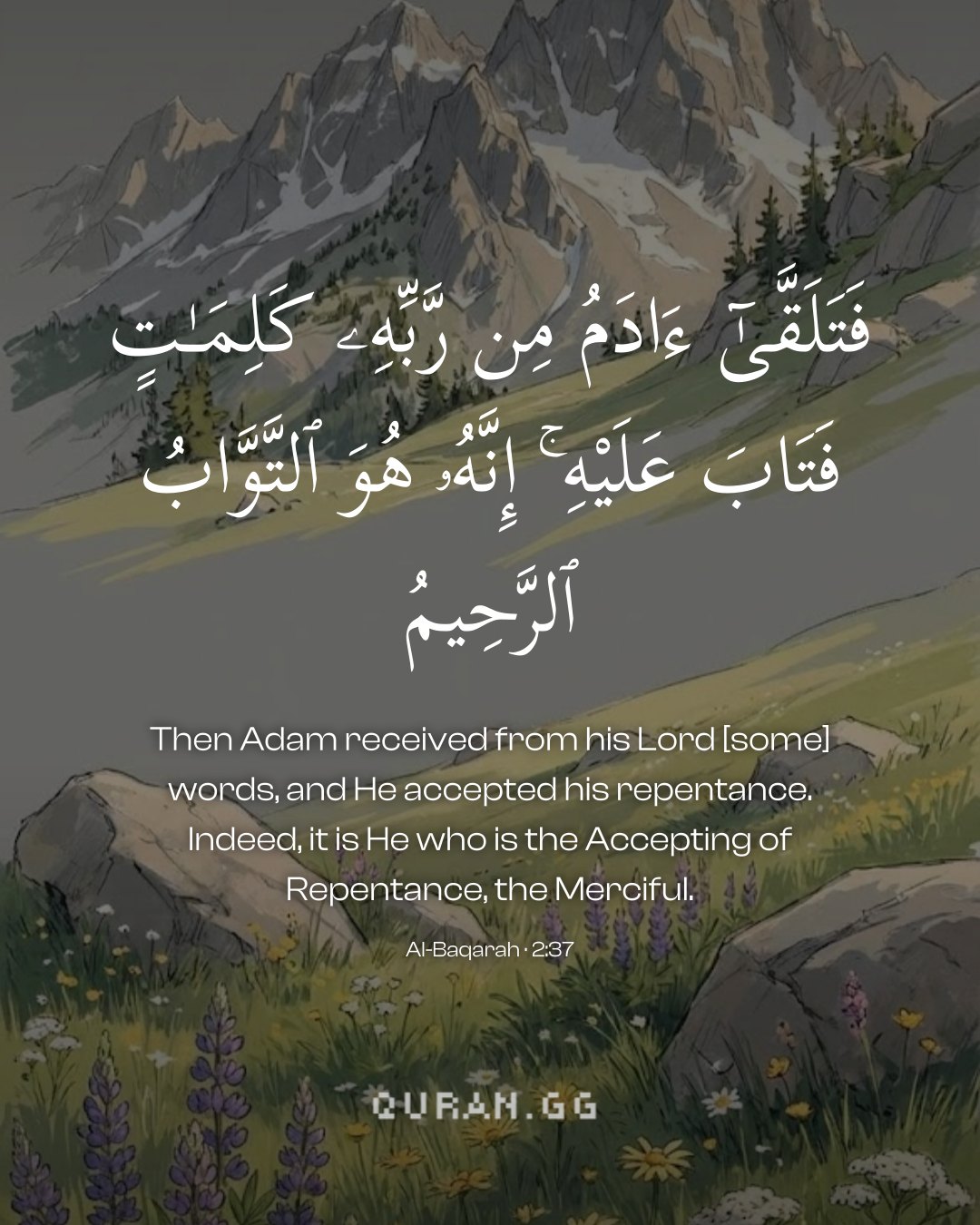
فَتَلَقَّىٰٓ ءَادَمُ مِن رَّبِّهِۦ كَلِمَـٰتٍ فَتَابَ عَلَيْهِ ۚ إِنَّهُۥ هُوَ ٱلتَّوَّابُ ٱلرَّحِيمُ ٣٧

Then Adam received from his Lord [some] words, and He accepted his repentance. Indeed, it is He who is the Accepting of Repentance, the Merciful.

Surah Al-Baqarah 2:37 in Arabic with its translation: “Then Adam received from his Lord [some] words, and He accepted his repentance. Indeed, it is He who is the…”

Make something with this ayah

Turn it into a video for Stories, Reels or TikTok, recited by the reciter you pick, or an image on a background you choose. Free, in your browser.

Download this image

Tafsir Ibn Kathir (abridged)

Adam repents and supplicates to Allah

It was reported that the above Ayah is explained by Allah's statement,

قَالاَ رَبَّنَا ظَلَمْنَآ أَنفُسَنَا وَإِن لَّمْ تَغْفِرْ لَنَا وَتَرْحَمْنَا لَنَكُونَنَّ مِنَ الْخَـسِرِينَ

(They said: "Our Lord! We have wronged ourselves. If You forgive us not, and bestow not upon us Your mercy, we shall certainly be of the losers.") (7:23) as Mujahid, Sa`id bin Jubayr, Abu Al-`Aliyah, Ar-Rabi` bin Anas, Al-Hasan, Qatadah, Muhammad bin Ka`b Al-Qurazi, Khaلlid bin Ma`dan, `Ata' Al-Khurasani and `Abdur-Rahman bin Zayd bin Aslam have stated. As-Suddi said that Ibn `Abbas commented on,

فَتَلَقَّى ءَادَمُ مِن رَّبِّهِ كَلِمَاتٍ

(Then Adam received from his Lord Words) "Adam said, `O Lord! Did You not created me with Your Own Hands' He said, `Yes.' He said, `And blow life into me' He said, `Yes.' He said, `And when I sneezed, You said, `May Allah grant you His mercy.' Does not Your mercy precede Your anger' He was told, `Yes.' Adam said, `And You destined me to commit this evil act' He was told, `Yes.' He said, `If I repent, will You send me back to Paradise' Allah said, `Yes."' Similar is reported from Al-`Awfi, Sa`id bin Jubayr, Sa`id bin Ma`bad, and Ibn `Abbas. Al-Hakim recorded this Hadith in his Mustadrak from Ibn Jubayr, who narrated it from Ibn `Abbas. Al-Hakim said, "Its chain is Sahih and they (Al-Bukhari and Muslim) did not record it."

Allah's statement,

إِنَّهُ هُوَ التَّوَّابُ الرَّحِيمُ

(Verily, He is the One Who forgives (accepts repentance), the Most Merciful) (2:37) means that Allah forgives whoever regrets his error and returns to Him in repentance. This meaning is similar to Allah's statements,

أَلَمْ يَعْلَمُواْ أَنَّ اللَّهَ هُوَ يَقْبَلُ التَّوْبَةَ عَنْ عِبَادِهِ

(Know they not that Allah accepts repentance from His servants) (9:104),

وَمَن يَعْمَلْ سُوءاً أَوْ يَظْلِمْ نَفْسَهُ

(And whoever does evil or wrongs himself) (4:110) and

وَمَن تَابَ وَعَمِلَ صَـلِحاً

(And whosoever repents and does righteous good deeds) (25:71).

The Ayat mentioned above, testify to the fact that Allah forgives the sins of whoever repents, demonstrating His kindness and mercy towards His creation and servants. There is no deity worthy of worship except Allah, the Most Forgiving, the Most Merciful.

Ma'arif al-Qur'an

A question arises here as to how Satan got into Paradise for seducing Adam and Hawwa (علیہما السلام) when he had already been expelled from there for refusing to prostrate himself. There are many possible ways in which he can have played his trick. Possibly he never met them, but planted the suggestion in their minds from afar - a thing which Satan can always do, and of which we have a specimen in the work of the hypnotists. It is equally possible that Satan, being one of the jinns whom Allah has given certain unusual powers denied to man, assumed the shape of a snake or of something else, and thus succeeded in entering Paradise. Perhaps it was because of this disguise that Adam (علیہ السلام) did not remember Allah's warning that Satan was his enemy. According to the Holy Qur'an, Satan assured them on oath that he was one of their well-wishers (7:21). It apparently suggests that he did actually meet them, and speak to them face o face.

Continue reading the tafsir of ayahs 36–37

Tazkirul Quran

When God made Adam stand up in front of the angels including Iblis (Satan), and tested them by commanding them to bow down before Adam, He was giving the first man on earth a practical demonstration of the two paths that would be open to his progeny. Either they would follow the example of the angels and bow to God’s commandments, even if it meant bowing before someone they held inferior to themselves; or else they would be proud like Satan, and refuse to bow to others. This is the test that man faces throughout his entire life. Here on earth man is constantly faced with two alternative courses of action. He can either follow the course set by the angels and carry out God’s commandments by bowing before truth and justice in all that he does; or he can act as Satan did and, letting himself be controlled by arrogance and contempt, refuse to concede the right of others.

Uthmani text of the Madinah mushaf (King Fahd Complex). Translation: Saheeh International. Tafsir via Quran.com.