The Terms of the Covenant and their Breach of It
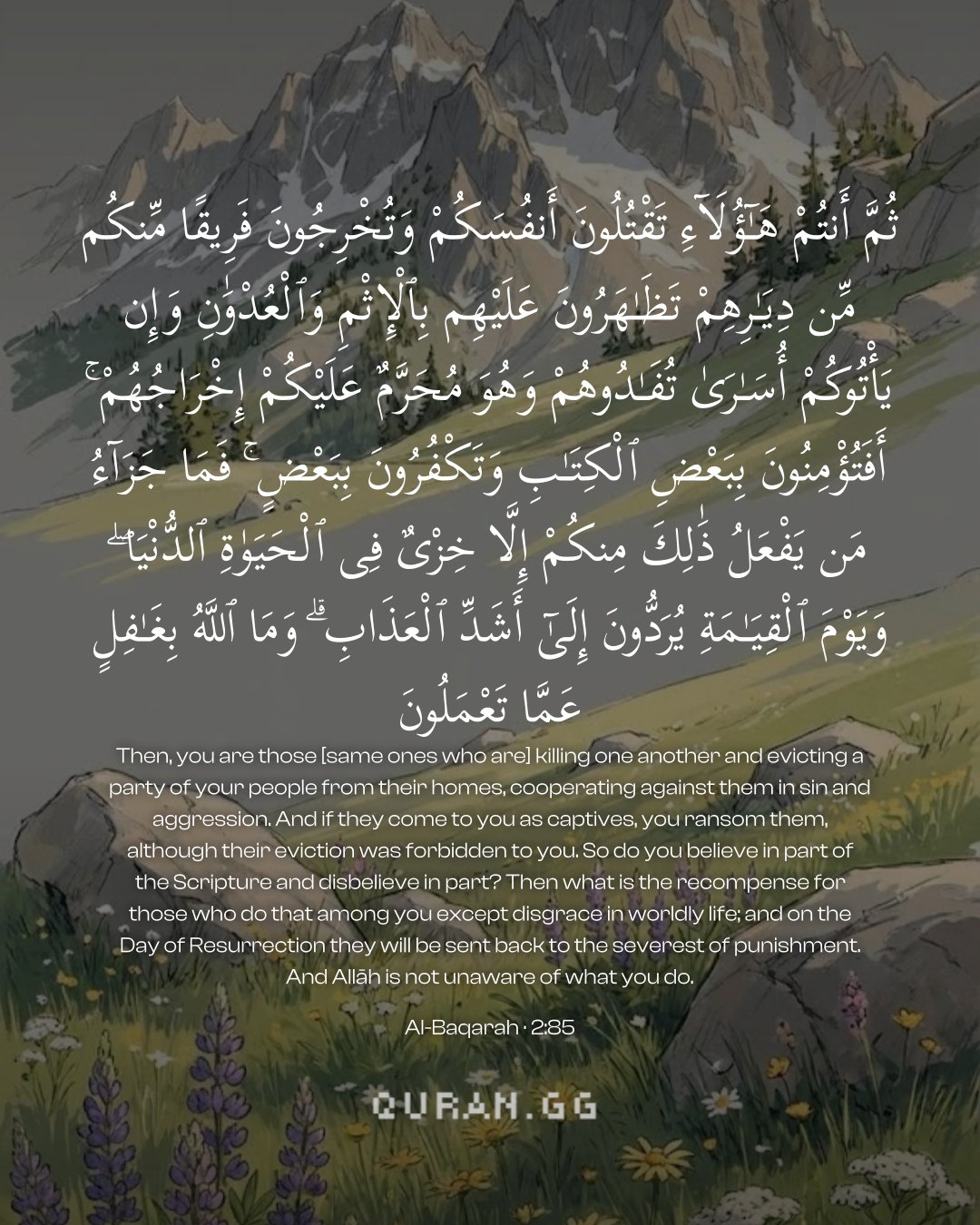
Allah criticized the Jews who lived in Al-Madinah during the time of the Messenger of Allah ﷺ. They used to suffer, because of the armed conflicts between the tribes of Al-Madinah, Aws and Khazraj. Before Islam, the Aws and Khazraj worshipped idols, and many battles took place between them. There were three Jewish tribes in Al-Madinah at that time, Banu Qaynuqa` and Banu An-Nadir, the allies of the Khazraj, and Banu Qurayzah, who used to be the allies of the Aws. When war erupted between Aws and Khazraj, their Jewish allies would assist them. The Jew would kill his Arab enemy, and sometimes they also killed Jews who were the allies of the other Arab tribe, although the Jews were prohibited from killing each other according to clear religious texts in their Books. They would also drive each other from their homes and loot whatever furniture and money they could. When the war ended, the victorious Jews would release the prisoners from the defeated party, according to the rulings of the Tawrah. This is why Allah said,
Continue reading the tafsir of ayahs 84–86Ma'arif al-Qur'an
Mufti Muhammad Shafi
This verse recounts how the Israelites broke the pledge they had willingly made. Allah had laid down three special injunctions for the Israelites: (1) They should not kill one another in an internecine war. (2) They should not force their own people into exile. (3) If they found a man from amongst them a prisoner of war, they should pay a ransom, and get him released. The Israelites disregarded the first two injunctions, and acted upon the third alone which they supposed easier to be carried out.
It happened like this. There lived in Madinah two tribes, the Aws اوس and the Khazraj خزرج ، who were hostile to each other, and would often go to war. In the environs of Madinah, there also lived two tribes of the Jews, the Bani Qurayzah بنی قریظہ and the Bani Nadir. The former had friendly relations with the Aws اوس ، and the latter with the Khazraj خزرج . When the Aws اوس and the Khazraj خزرج went to war against each other, the two tribes of the Jews also took part in the battle, each on the side of its own friends. In these battles, many Jews lost their lives or were rendered homeless as much as the non-Jews. In other words, the Jews of the Bani Qurayzah بنی قریظہ tribe had a share in the slaughter and exile of the Jews of the Bani Nadir tribe, and vice versa. However, when some of the Jews became prisoners of war, each of the two Jewish groups would persuade their respective friends among the non-Jews to accept a ransom and to release the prisoners. When they were asked why they showed such a solicitude for the prisoners, they would say that it was obligatory for them to get prisoners released. But when someone objected to their helping the non-Jews in slaughtering the Jews, they used to reply that it would be a real disgrace if they did not go to the aid of their friends, even if they were not Jews.
So, the present verse exposes their duplicity and their perversity. The Holy Qur'an indicts their behaviour as "sin and aggression," and this suggests that the Israelites were infringing on two kinds of rights -- the right of Allah, by disobeying Him; and the right of His creatures, by inflicting pain and loss on them.
The verse proceeds to reprimand them for accepting certain injunctions laid down in the Torah, while rejecting others, and following their own whims in both the cases. At the end, this long verse announces the grave punishment for such misdeeds the Israelites will have to bear in this world as well as in the other.
Let it be clearly understood that the Jews referred to in this verse had already become infidels (Kafirs کفار) by refusing to accept and affirm the prophethood of Sayyidna Muhammad ﷺ . But instead of referring to this aspect of their infidelity, the verse points out another aspect. It reprimands them for having faith ('Iman ایمان ) only in some part of the Book (Torah تورات ) and not having faith in some other. If we take the words of the present verse literally, it means that the Jews had become infidels by not having faith in some parts (that is to say, some injunctions) of the Torah. For, a Divine Book has to be accepted as a whole; to reject a part is to reject the whole, and clearly amounts to disbelief and infidelity (Kufr کفر ). But if we interpret the present verse in a different way, and take it to be reprimanding the Jews for not acting upon certain injunctions, then a question would arise here: How is it that the verse delineates their infringement of certain commandments as Kufr کفر or infidelity, although a believer cannot be considered an infidel so long as he accepts, at least in principle, the distinctions between the Halal حلال (lawful) and the Haram حرام ( unlawful) exactly as laid down by the Shari'ah? The answer to the question is that when a sin is very grave, the idiom of the Shari'ah sometimes delineates it as Kufr کفر (infidelity) in order to emphasize its gravity and its moral nature. This is also what the hadith intends to do when it says: مَن تَرَکَ الصَلاۃ مُتَعمَّداً فَقَد کَفَرَ :"He who gave up the Salah wilfully became an infidel.
This second interpretation does not, however, attenuate or modify the Kufr کفر (infidelity) of the Jews of which they had already been guilty by denying the prophethood of Sayyidna Muhammad ﷺ .
The verse announces that the Jews will have to bear a punishment not only in the other world, but in this world too - in the shape of humiliation and disgrace. It took place as it had been foretold. In the time of the Holy Prophet ﷺ himself, the Jews of the Bani Qurayzah بنی قریظہ tribe had to lose their lives or to undergo imprisonment, and those of the Bani Nadir tribe were expelled for having broken the pact they had earlier made with the Muslims.
A doctrinal point
Verse 85 announces the "punishment" for Jews. One may very well ask here why the direst punishment should be reserved for the Jews, and not for atheists, for the Jews at least believe in Allah. The famous Commentator 'Aids' says in his "Ruh al-Ma'ani" that every punishment meted out to the infidels will be "the direst" in the sense that it will have no end or limit. So, what the verse implies is not that the punishment given to the Jews will be more severe than the one given to all the other infidels, but that they will be given the kind of punishment which is "the direst" in the sense of having no end or limit. In other words, the verse suggests that the punishment given to the infidels will be more severe than the one given to Muslim sinners. But if there are going to be different degrees in the punishment meted out to different kinds of infidels, it does not in any way go against the implications of this verse. (Bayan al-Qur an)
Man’s first duty to God is to become His worshipper without ascribing any partners to Him. Secondly, he should show kindness to others. Kindness starts at home, with one’s parents and family, extends to one’s neighbours and relatives, and finally reaches out to everyone with whom one comes into contact. There is only one proper way to deal with others, and that is with justice and well-wishing. Where one is really tested is in one’s dealings with ‘orphans and the needy’, that is, with the weaker members of society. As for the strong, their strength itself guarantees that they will be given deferential treatment. But so far as the weak are concerned there is no such incentive to deal with them justly. Therefore, one should be especially careful to behave well towards them. People who are good to those who wield no worldly power and possess scant resources, do so for God’s sake alone, for they have no other incentive. There are various reasons for having little inclination to show kindness when dealing with the weak. Benefactors frequently regard themselves as ‘superior’ persons and, when they are not shown what they consider to be due deference, they tend to treat people less fortunate than themselves with disdain. Then the thought of a permanent liability is often so irksome to them that they resort to ill-mannered behaviour to rid themselves of a burdensome obligation. This attitude leaves no room for the notion that the weak also have their self-respect. When the benefactor is not shown what he considers to be due deference, he regards the beneficiary as unworthy and incompetent. This thinking finds expression in various ways.
Continue reading the tafsir of ayahs 83–85 Uthmani text of the Madinah mushaf (King Fahd Complex). Translation: Saheeh International. Tafsir via Quran.com.