Tafsir Ibn Kathir (abridged)
Ismail ibn Kathir
The Jews were awaiting the Prophet's coming, but They disbelieved in Him when He was sent
Allah said,
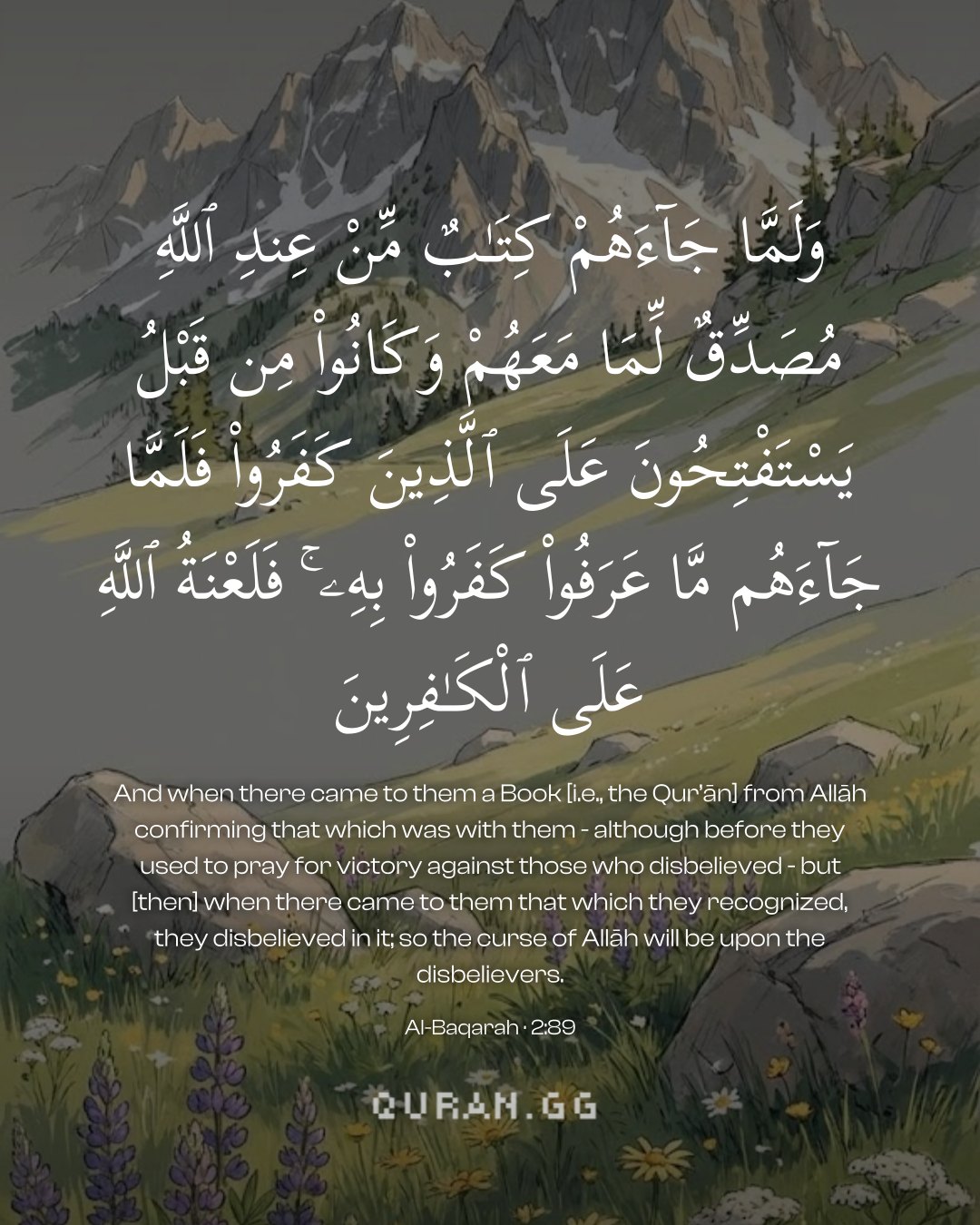
وَلَمَّا جَآءَهُمُ
(And when there came to them) meaning, the Jews,
كِتَـبٌ مِّنْ عِندِ اللَّهِ
(a Book from Allah) meaning, the Qur'an that Allah sent down to Muhammad,
مُصَدِّقٌ لِّمَا مَعَهُمْ
(confirming what is with them) meaning, the Tawrah. Further, Allah said,
وَكَانُواْ مِن قَبْلُ يَسْتَفْتِحُونَ عَلَى الَّذِينَ كَفَرُواْ
(although aforetime they had invoked Allah (for coming of Muhammad ) in order to gain victory over those who disbelieved) meaning, before this Messenger came to them, they used to ask Allah to aid them by his arrival, against their polytheistic enemies in war. They used to say to the polytheists, "A Prophet shall be sent just before the end of this world and we, along with him, shall exterminate you, just as the nations of `Ad and Iram were exterminated." Also, Muhammad bin Ishaq narrated that Ibn `Abbas said, "The Jews used to invoke Allah (for the coming of Muhammad ) in order to gain victory over the Aws and Khazraj, before the Prophet was sent. When Allah sent him to the Arabs, they rejected him and denied what they used to say about him. Hence, Mu`adh bin Jabal and Bishr bin Al-Bara' bin Ma`rur, from Bani Salamah, said to them, `O Jews! Fear Allah and embrace Islam. You used to invoke Allah for the coming of Muhammad when we were still disbelievers and you used to tell us that he would come and describe him to us,' Salam bin Mushkim from Bani An-Nadir replied, `He did not bring anything that we recognize. He is not the Prophet we told you about.' Allah then revealed this Ayah about their statement,
وَلَمَّا جَآءَهُمْ كِتَـبٌ مِّنْ عِندِ اللَّهِ مُصَدِّقٌ لِّمَا مَعَهُمْ
(And when there came to them (the Jews), a Book (this Qur'an) from Allah confirming what is with them (the Tawrah) and the Injil (Gospel))."'
Abu Al-`Aliyah said, "The Jews used to ask Allah to send Muhammad so that they would gain victory over the Arab disbelievers. They used to say, `O Allah! Send the Prophet that we read about - in the Tawrah - so that we can torment and kill the disbelievers alongside him.' When Allah sent Muhammad and they saw that he was not one of them, they rejected him and envied the Arabs, even though they knew that he was the Messenger of Allah ﷺ. Hence, Allah said,
فَلَمَّا جَآءَهُم مَّا عَرَفُواْ كَفَرُواْ بِهِ فَلَعْنَةُ اللَّهِ عَلَى الْكَـفِرِينَ
(Then when there came to them that which they had recognized, they disbelieved in it. So let the curse of Allah be on the disbelievers). "
Ma'arif al-Qur'an
Mufti Muhammad Shafi
The Torah تورات had in several places foretold the coming of the Holy Prophet ﷺ . In fact, the Jews themselves used to tell the Arabs that a new prophet and a new Divine Book was soon to come. But when the Holy Qur'an came down from Allah, and even when they had recognized its authenticity, the Jews denied it out of sheer spite.
The verse says that the Holy Qur'an confirms the Torah تورات it means that the Holy Qur'an is a concrete evidence of the truth of the prophecies made in the Torah تورات with regard to the coming of the Holy Prophet ﷺ and of the Holy Qur'an. One who believes in the Torah تورات cannot justifiably deny the Holy Qur'an and the Holy Prophet ﷺ ، for such a denial would involve a denial of the Torah تورات itself.
Knowledge is not enough for 'Iman ایمان
One may want to know why the Holy Qur'an calls the Jews Kafirin کافرون (infidels), when they did recognize the truth as truth, which should qualify them to be called "believers." Let us explain that 'Iman ایمان (faith) does not merely mean "knowing the truth", but really signifies "accepting the truth and affirming it deed-wise." Otherwise, Satan too will have to be called a believer, for he knows fully well what the truth is. In fact, this knowledge of the truth on the part of Satan شیطان intensifies the gravity of his Kufr کفر (infidelity) all the more.
However, the next verse attributes the infidelity of the Jews to their malice.
The Torah was the Book of God revealed to the Jews. Gradually, however, they ceased to treat it as a source of divine guidance and came to regard it as a sacred relic of their national heritage, a symbol of ethnic superiority; it became more a guarantee of salvation than a guide as to how salvation could be earned. After Moses, several prophets arose among the Jewish people—Joshua, David, Zachariah, John the Baptist and finally Jesus, to name but a few—all of whom pointed out to the Jews that it was not enough just to revere the Torah as a holy book. Its teachings had to be actually practised. It is futile to believe in the sacredness of the holy scriptures if one does not implement their message in one’s everyday life. But the Jews, the very people who held the Torah in such high esteem, were extremely intolerant of the Prophet’s exhortations. The reason for such a reaction on their part was that they had allowed self-interest and worldly ambitions to rule their lives, while passing themselves off as bearers and upholders of the true faith. As long as religion served to consolidate their worldly status, they welcomed it, but were loath to accept the message of truth—presented to them in all its purity—which they saw as a threat to the hegemony they had secured for themselves on the basis of religion. It was their egoism which came in the way of true religiosity. Instead of being the first to believe in it, they rejected the message as well as the messenger, subjecting God’s prophets to scorn and victimisation. They called them impostors and even went to the extent of killing them.
Continue reading the tafsir of ayahs 88–89 Uthmani text of the Madinah mushaf (King Fahd Complex). Translation: Saheeh International. Tafsir via Quran.com.