Surah Al-Fath Ayah 16 (48:16) — Meaning & Tafsir | Quran.GG

Surah Al-Fath, Ayah 16

48:16 · Meaning and tafsir

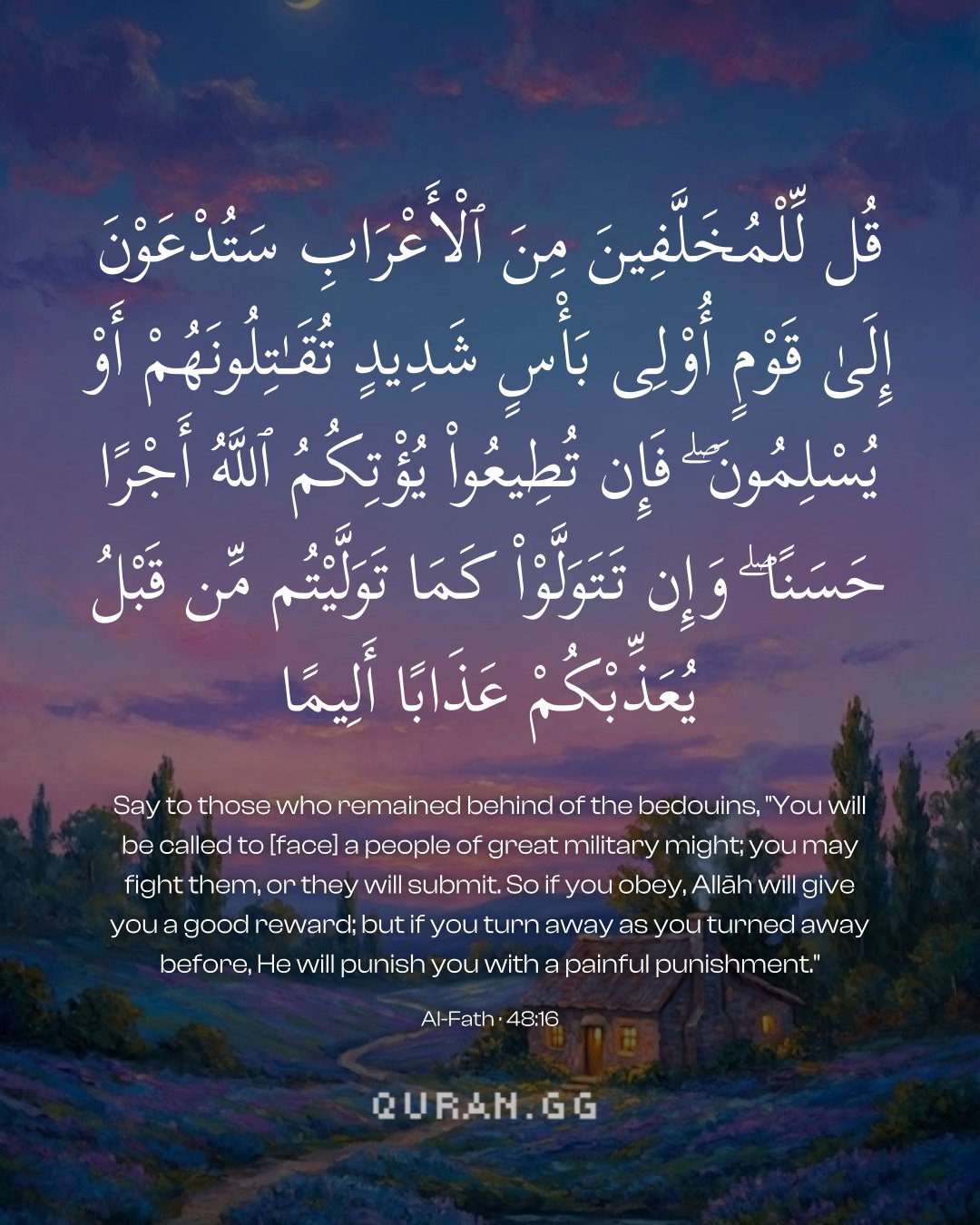
قُل لِّلْمُخَلَّفِينَ مِنَ ٱلْأَعْرَابِ سَتُدْعَوْنَ إِلَىٰ قَوْمٍ أُو۟لِى بَأْسٍ شَدِيدٍ تُقَـٰتِلُونَهُمْ أَوْ يُسْلِمُونَ ۖ فَإِن تُطِيعُوا۟ يُؤْتِكُمُ ٱللَّهُ أَجْرًا حَسَنًا ۖ وَإِن تَتَوَلَّوْا۟ كَمَا تَوَلَّيْتُم مِّن قَبْلُ يُعَذِّبْكُمْ عَذَابًا أَلِيمًا ١٦

Say to those who remained behind of the bedouins, "You will be called to [face] a people of great military might; you may fight them, or they will submit. So if you obey, Allāh will give you a good reward; but if you turn away as you turned away before, He will punish you with a painful punishment."

Surah Al-Fath 48:16 in Arabic with its translation: “Say to those who remained behind of the bedouins, "You will be called to [face] a people of great military…”

Make something with this ayah

Turn it into a video for Stories, Reels or TikTok, recited by the reciter you pick, or an image on a background you choose. Free, in your browser.

Download this image

Tafsir Ibn Kathir (abridged)

Allah conveys the News that there will be Many Cases of Jihad, and that Jihad distinguishes the Ranks of the Believers and exposes the Hypocrite

Scholars of Tafsir differ over who the people mentioned here are. They are people experienced at warfare who will be called to fight. There are many opinions, first, they are the tribe of Hawazin, as Shu`bah narrated from Abu Bishr from Sa`id bin Jubayr, or `Ikrimah, or both of them. Hushaym narrated this explanation from Abu Bishr, from both Sa`id bin Jubayr and `Ikrimah. Qatadah, as narrated from him in one version, held the same view. The second view is that these people are the tribe of Thaqif, according to Ad-Dahhak. The third view is that they are Banu Hanifah, according to Juwaybir and Az-Zuhri, as Muhammad bin Ishaq narrated from him. Similar was narrated from Sa`id bin Jubayr and `Ikrimah. The fourth opinion is that they are the Persians, according to `Ali bin Abi Talhah who reported that from `Abdullah bin `Abbas. This is also the view of `Ata', Mujahid, and `Ikrimah. Ka`b Al-Ahbar said that they are the Romans, while Ibn Abi Layla, `Ata, Al-Hasan and Qatadah -- in a different narration from him, said that they are the Persians and Romans. Mujahid also said that they are the idolators. In another narration Mujahid said, "They are men given to great warfare," and did not specify any particular people. This last explanation is the view preferred by Ibn Jurayj and Ibn Jarir. Allah's statement,

تُقَـتِلُونَهُمْ أَوْ يُسْلِمُونَ

(Then you shall fight them, or they shall surrender.) means, `you are called to fight them in Jihad, through constant warfare, until you become victorious over them or they surrender. Or, they will embrace your religion without a fight, but with their full consent.' Allah the Exalted and Most Honored said next,

فَإِن تُطِيعُواْ

(Then if you obey,) `if you accept the call to Jihad and prepare for it and fulfill your duty in this regard,'

يُؤْتِكُمُ اللَّهُ أَجْراً حَسَناً وَإِن تَتَوَلَّوْاْ كَمَا تَوَلَّيْتُمْ مِّن قَبْلُ

(Allah will give you a fair reward; but if you turn away as you turned away before,) `on the day of Al-Hudaybiyyah, when you were called to Jihad, yet lagged behind,'

يُعَذِّبْكُمْ عَذَاباً أَلِيماً

(He will punish you with a painful torment.)

Acceptable Reasons for not joining Jihad

Allah then mentions the legal reasons that allow one to be excused from joining the Jihad, such as blindness and being lame, and various illnesses that strike one and are remedied in few days. When one is ill, he is allowed to remain behind and will have a valid excuse to do so, until his illness ends. Allah the Exalted and Most honored then said, while ordaining joining the Jihad and obeying Allah and His Messenger ,

وَمَن يُطِعِ اللَّهَ وَرَسُولَهُ يُدْخِلْهُ جَنَّـتٍ تَجْرِى مِن تَحْتِهَا الاٌّنْهَـرُ وَمَن يَتَوَلَّ

(And whosoever obeys Allah and His Messenger, He will admit him to Gardens beneath which rivers flow; and whosoever turns back,) from joining the Jihad and busies himself in his livelihood,

يُعَذِّبْهُ عَذَاباً أَلِيماً

(He will punish him with a painful torment.) in this life with humiliation and in the Hereafter with the Fire. Allah the Exalted has the best knowledge.

Ma'arif al-Qur'an

Injunctions and Related Issues

The reference in this passage is to the incident which took place in the 7th year of Hijrah after the Holy Prophet ﷺ returned from Hudaibiyah. When he intended to march on Khaibar, he took with him only those sincere Muslims who were with him at Hudaibiyah and participated in the Pledge of Ridwan. When Allah promised His Messenger ﷺ the conquest of Khaibar and great spoils, those Bedouin tribes who had contrived to remain behind when the Holy Prophet ﷺ went for ` Umrah, requested the Holy Prophet ﷺ to be allowed to join the Muslim army, either because they guessed that Khaibar would be conquered and they would receive a good share of the booty, or because they perceived the divine blessings bestowed on the Muslims as a result of the expedition of Hudaibiyah' and being remorseful on their wrong decision, they intended to join the new expedition. In response to their request, the Qur'an says: يُرِ‌يدُونَ أَن يُبَدِّلُوا كَلَامَ اللَّـهِ "They wish to change the statement of Allah...[ 48:15] " 'Allah's statement' refers to the injunction that the right to participate in the expedition of Khaibar and receiving a share in its spoils is reserved exclusively for those sincere Muslims who were with the Holy Prophet ﷺ at Hudaibiyah. The same injunction is again referred to by saying, كَذَٰلِكُمْ قَالَ اللَّـهُ مِن قَبْلُ "Allah had said like this beforehand.... [ 48:15] " It means that the injunction of restricting the right of participation in Khyber to the participants of Hudaibiyah had been revealed by Allah before the revelation of these verses. However, this injunction is not available in the Qur'an anywhere else. So the question is: how is it then correct to refer this injunction as a 'statement of Allah' or as 'Allah has said like this'? Answer to this question depends on understanding the different kinds of the divine revelation which follow:

Continue reading the tafsir of ayahs 15–16

Tazkirul Quran

Before the Hudaybiyyah Treaty the Jews were very open in their hostility for the Muslims, because earlier they had had the full cooperation of Quraysh in this regard. The ‘no-war’ pact with the Quraysh at Hudaybiyyah cut off the Jews from the Quraysh and thereafter they were left on their own. For this reason, the morale of the Jews of Khybar, Tema, Fidak, etc. was lowered. So, three months after the signing of the treaty, when the Prophet besieged Khybar, the Jews of that place surrendered their arms without fighting and the Muslims acquired large amounts of booty on that occasion. People of weak faith who did not accompany the Prophet on his Hudaybiyyah journey, considering it risky, now wanted to take part in the campaign against the Jews and thus have a share in the spoils, but they were prohibited from doing so. It is the rule of God that it is the one who takes risks who should receive the benefit. If a man wants to achieve something without taking a risk, he wants, in fact, to change Divine Law. But it is not possible for anybody in this world to change God’s Law.

Uthmani text of the Madinah mushaf (King Fahd Complex). Translation: Saheeh International. Tafsir via Quran.com.