Surah Al-Fath Ayah 2 (48:2) — Meaning & Tafsir | Quran.GG

Surah Al-Fath, Ayah 2

48:2 · Meaning and tafsir

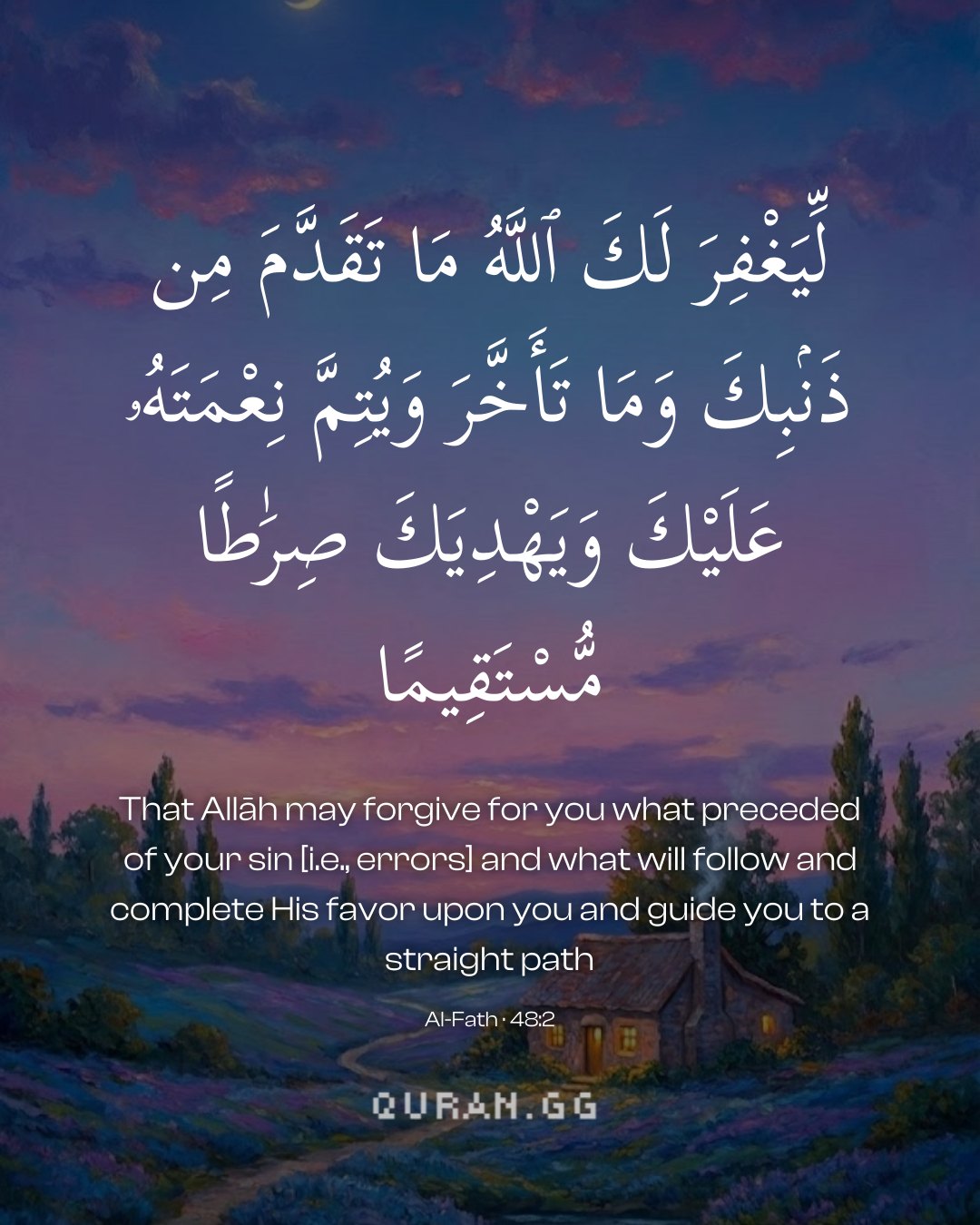
لِّيَغْفِرَ لَكَ ٱللَّهُ مَا تَقَدَّمَ مِن ذَنۢبِكَ وَمَا تَأَخَّرَ وَيُتِمَّ نِعْمَتَهُۥ عَلَيْكَ وَيَهْدِيَكَ صِرَٰطًا مُّسْتَقِيمًا ٢

That Allāh may forgive for you what preceded of your sin [i.e., errors] and what will follow and complete His favor upon you and guide you to a straight path

Surah Al-Fath 48:2 in Arabic with its translation: “That Allāh may forgive for you what preceded of your sin [i.e., errors] and what will follow and complete His…”

Make something with this ayah

Turn it into a video for Stories, Reels or TikTok, recited by the reciter you pick, or an image on a background you choose. Free, in your browser.

Download this image

Tafsir Ibn Kathir (abridged)

Which was revealed in Al-Madinah

The Merit of Surah Al-Fath

Imam Ahmad recorded from `Abdullah bin Mughaffal, who said that Allah's Messenger ﷺ recited Surah Al-Fath on the (day) of the conquest of Makkah, riding on his she-camel. He recited it in a vibrating and pleasant tone. Mu`awiyah (a subnarrator) added: "Were I not afraid that the people would crowd around me, I would surely try to imitate and produce his recitation." Both Al-Bukhari and Muslim recorded this Hadith through Shu`bah.

بِسْمِ اللَّهِ الرَّحْمَـنِ الرَّحِيمِ

In the Name of Allah, the Most Gracious, the Most Merciful.

The Reason behind revealing Surat Al-Fath

This honorable Surah was revealed after the Messenger of Allah ﷺ returned from the area of Al-Hudaybiyyah, during the month of Dhul-Qa`dah, in the sixth year of Hijrah. This is when the idolators prevented him from reaching Al-Masjid Al-Haram to perform the `Umrah he intended. They stopped the Prophet from reaching Makkah at that time, but then were prone to peace negotiations. A peace treaty was conducted stipulating that the Messenger would return this year and then come back for `Umrah the following year. The Messenger ﷺ agreed. However, some of the Companions disliked these terms, including `Umar bin Al-Khattab, as we will mention in detail, Allah willing, while explaining this Surah. After the Prophet slaughtered his sacrificial animals in the area where he was stopped and headed back to Al-Madinah, Allah the Exalted and Most Honored revealed this Surah about what occurred between him and the idolators. Allah declared the Al-Hudaybiyyah peace treaty a manifest victory, because of the benefits peace would carry and the good results that did originate from it. `Abdullah bin Mas`ud and other Companions said, "You consider the conquering of Makkah to be Al-Fath (the victory), while to us, Al-Fath is the treaty conducted at Al-Hلudaybiyyah." Jabir (bin `Abdullah) said, "We only considered Al-Fath to be the day of Hلudaybiyyah!" Al-Bukhari recorded that Al-Bara' (bin `Azib) said, "You consider Al-Fath to be the conquest of Makkah, which was indeed a victory. However, we consider Al-Fath to be the pledge of Ar-Ridwan on the Day of Al-Hudaybiyyah. Then, we were fourteen hundred with the Messenger of Allah ﷺ. Al-Hudaybiyyah had a well, whose water we consumed, not leaving a drop of water in it. When the news of what happened reached the Messenger of Allah ﷺ, he came towards us and sat on the edge of the well. Then he asked to be brought a bucket of water and used it for ablution. He next rinsed his mouth, invoked Allah and poured that water into the well. Soon after, that well provided us, as well as our animals, with sufficient water, in whatever amount of water we wished. Imam Ahmad recorded that `Umar bin Al-Khattab said, "We were with the Messenger of Allah ﷺ on a trip, and I asked him about a matter three times, but he did not answer me. So I said to myself, `May your mother lose you, O son of Al-Khattab! You were stubborn in repeating your question three times to the Messenger of Allah ﷺ; each time he did not respond to you.' So I mounted my animal, my camel, and went ahead for fear that a part of the Qur'an might be revealed in my case. Suddenly, I heard a caller calling, `O `Umar!' So, I went to the Messenger while fearing that part of the Qur'an was revealed about me. The Prophet said,

Continue reading the tafsir of ayahs 1–3

Ma'arif al-Qur'an

Analysis of Verses

لِّيَغْفِرَ‌ لَكَ اللَّـهُ مَا تَقَدَّمَ مِن ذَنبِكَ وَمَا تَأَخَّرَ‌ (so that Allah may forgive you of your previous and subsequent faults...." - 48:2). If the particle "lam" (translated above as 'so that' ) is taken to be for "ta'lil", it indicates the purpose for which, and the reason why, such a manifest Victory is given to the Holy Prophet ﷺ . It is mentioned in this verse that the victory was given to him to bless him with three different bounties. The first bounty is forgiveness of all his past and future shortcomings. Attention was drawn in Surah Muhammad that all Prophets (علیہم السلام) are infallible. Wherever words likes ذَنب dhanb and عصیان ` isyan ('sin' or 'fault' ) are attributed to them in the Qur'an, they are in relation to their lofty status. Works that are merely unadvisable contrary to the preferred practice are also referred to as dhanb in relation to the high status of the Prophets (علیہم السلام) by way of reprimand. 'Previous' refers to shortcomings committed before conferment of prophethood, and 'subsequent' refers to shortcomings committed after the conferment of prophethood (Mazhari). The reason why this victory caused forgiveness for such shortcomings is that large masses of people entered the fold of Islam after it, and naturally the credit of spreading the call of Islam goes to the Holy Prophet ﷺ for which he deserved the divine reward, and an increase in reward always entails forgiveness of the shortcomings.

وَيَهْدِيَكَ صِرَ‌اطًا مُّسْتَقِيمًا ("...and may guide you to a straight path," 48:2.) This is the second bounty which resulted from the manifest victory. Here arises a question of the highest significance: The Holy Prophet was established in the right path from the very outset. Not only was he himself on the right path, but also a source of guidance for the entire world. His night-and-day preoccupation was to call the people towards the Straight Path. So what then is the meaning of guidance to the straight path through manifest victory in the 6th year of Hijrah? A detailed answer to this question can be found in Ma’ ariful-Qur an Vol 1/pp 71-81 - particularly look at the definitions and the three degrees of Hidayah [ guidance ].

Definition of Hidayah

Hidayah has been defined as to show the path or to lead someone gently and kindly towards his destination. The real destination of man is to attain Allah's pleasure and his proximity. The degrees of pleasure and proximity are unlimited. Having attained the first degree, man needs to go for the next one, then he should aim for the third one and so on to no end. Not any man, Muslim, saint or prophet is above the need of such spiritual and moral attainment. Therefore, the instruction to pray for right guidance in the first Surah is not only to the Muslim Community, but also to the Holy Prophet ﷺ . He is to soar higher and higher in the path of spiritual and moral attainment. Allah has, in this manifest victory, raised the Holy Prophet ﷺ to the highest pinnacles of spiritual eminence which is described by the clause yahdiyaka.

Uthmani text of the Madinah mushaf (King Fahd Complex). Translation: Saheeh International. Tafsir via Quran.com.