Surah Al-Furqan Ayah 16 (25:16) — Meaning & Tafsir | Quran.GG

Surah Al-Furqan, Ayah 16

25:16 · Meaning and tafsir

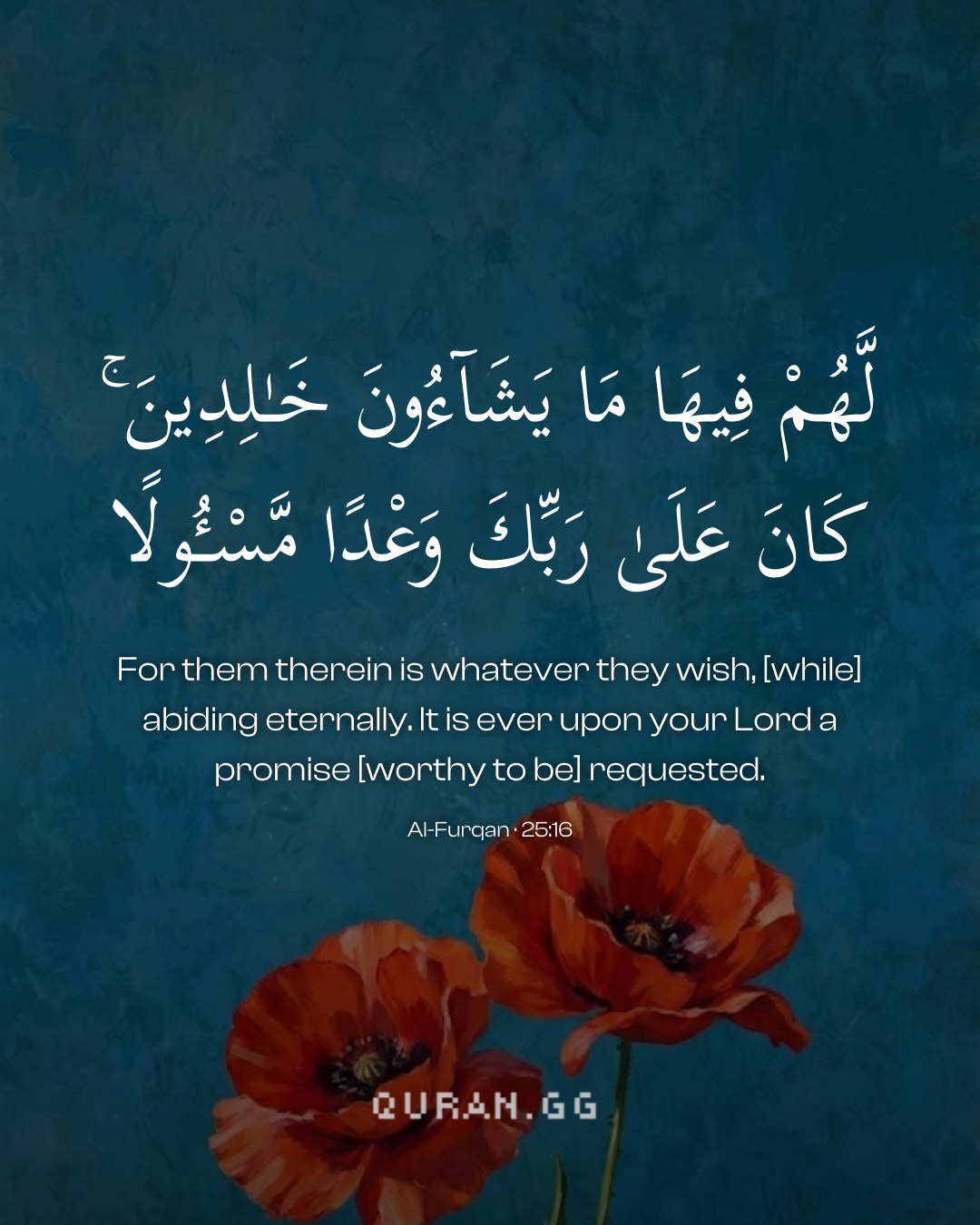
لَّهُمْ فِيهَا مَا يَشَآءُونَ خَـٰلِدِينَ ۚ كَانَ عَلَىٰ رَبِّكَ وَعْدًا مَّسْـُٔولًا ١٦

For them therein is whatever they wish, [while] abiding eternally. It is ever upon your Lord a promise [worthy to be] requested.

Surah Al-Furqan 25:16 in Arabic with its translation: “For them therein is whatever they wish, [while] abiding eternally. It is ever upon your Lord a promise…”

Make something with this ayah

Turn it into a video for Stories, Reels or TikTok, recited by the reciter you pick, or an image on a background you choose. Free, in your browser.

Download this image

Tafsir Ibn Kathir (abridged)

Is the Fire better, or Paradise

Here Allah says: `O Muhammad, this that We have described to you about the state of those who are doomed, who will be dragged on their faces to Hell, which will receive them with a scowling face, with hatred and moans. There they will be thrown into their constricted spaces, tied up to their shoulders, unable to move or call for help, and unable to escape their plight --- is this better, or the eternal Paradise which Allah has promised to the pious among His servants, which He has prepared for them as a reward and ultimate destiny in return for their obedience to Him in this world'

لَّهُمْ فِيهَا مَا يَشَآءُونَ

Continue reading the tafsir of ayahs 15–16

Ma'arif al-Qur'an

The Second Objection was that if the Holy Prophet ﷺ was a prophet, he should not have been eating and drinking like common people; instead he should have been free from eating and drinking like angels. And if this was not so, he should have at least enough wealth and gardens to take care of his day to day needs, so that he may not need to care for his living. Furthermore, how could he be accepted as a prophet when he is neither an angel nor does an angel accompany him to endorse what he preaches, therefore it appears that he has been charmed by someone which has turned his head and that is why he talks like this. A general answer to this objection is given in the verse انظُرْ‌ كَيْفَ ضَرَ‌بُوا لَكَ لِلْعَالَمِينَ at is (See how they coined similes for you, so they have gone astray and cannot find a way. - 25:9). The detailed answer to the objection is given in the next few verses.

Tazkirul Quran

The opponents of Truth frequently make the character of the preacher of Truth their target. In order to prove him untrustworthy, they indulge in all sorts of slander. Thus they give the impression that they would have accepted what the preacher had to say, had he been up to their standard. But this is not correct. Their real problem is not that they do not find the preacher of truth trustworthy. Their real problem is that they have no fear of the reckoning of Judgement Day. Therefore, they go on casting aspersions in an irresponsible manner. The matter of Truth and untruth is important because they will be examined on this basis in the life hereafter. Those who are fearless about being censured in the Hereafter are consequently not serious about Truth or untruth. And when a man is not serious about something, he does not realise its importance, though numerous arguments may be advanced in its support. The meaningless utterances of such people will cease only when the terrible roar of Doomsday snatches away their words.

Uthmani text of the Madinah mushaf (King Fahd Complex). Translation: Saheeh International. Tafsir via Quran.com.