Allah threatens the idolators who denied and opposed His Messenger Muhammad ﷺ and He warns them of the punishment and painful torment He sent upon the previous nations who rejected their Messengers. Allah begins by mentioning Musa, upon him be peace, whom He sent along with his brother Harun as a helper -- i.e., as another Prophet who helped and supported him -- but Fir`awn and his chiefs denied them both:
(Allah destroyed them completely, and similar (awaits) the disbelievers) (47:10). And when the people of Nuh denied him, Allah destroyed them likewise, for whoever denies one Messenger denies all the Messengers, because there is no difference between one Messenger and another. If it had so happened that Allah had sent all His Messengers to them, they would have denied them all. Allah says:
In the above verses it is mentioned that it had been the common practice of the people through the ages to rebuff the prophets and the message they had brought. In order to give weight to this assertion a few of the well known prophets are mentioned who were rejected by their people and then they were subjected to Allah's wrath and were annihilated completely. By drawing a parallel with the past generations it is elucidated that the pagans of Makkah would not listen to any reason as they were no better than the animals or even worse than that.
It is stated about the people of Sayyidna Nuh (علیہ السلام) that they had rejected the prophets, although they had neither seen the past prophets nor had they rejected them. at is actually meant here is that while denying Sayyidna Nuh (علیہ السلام) they had by implication rejected all the prophets, because the principals of religion expounded by all prophets are essentially the same. Hence rejection of one prophet is tantamount to rejection of all.
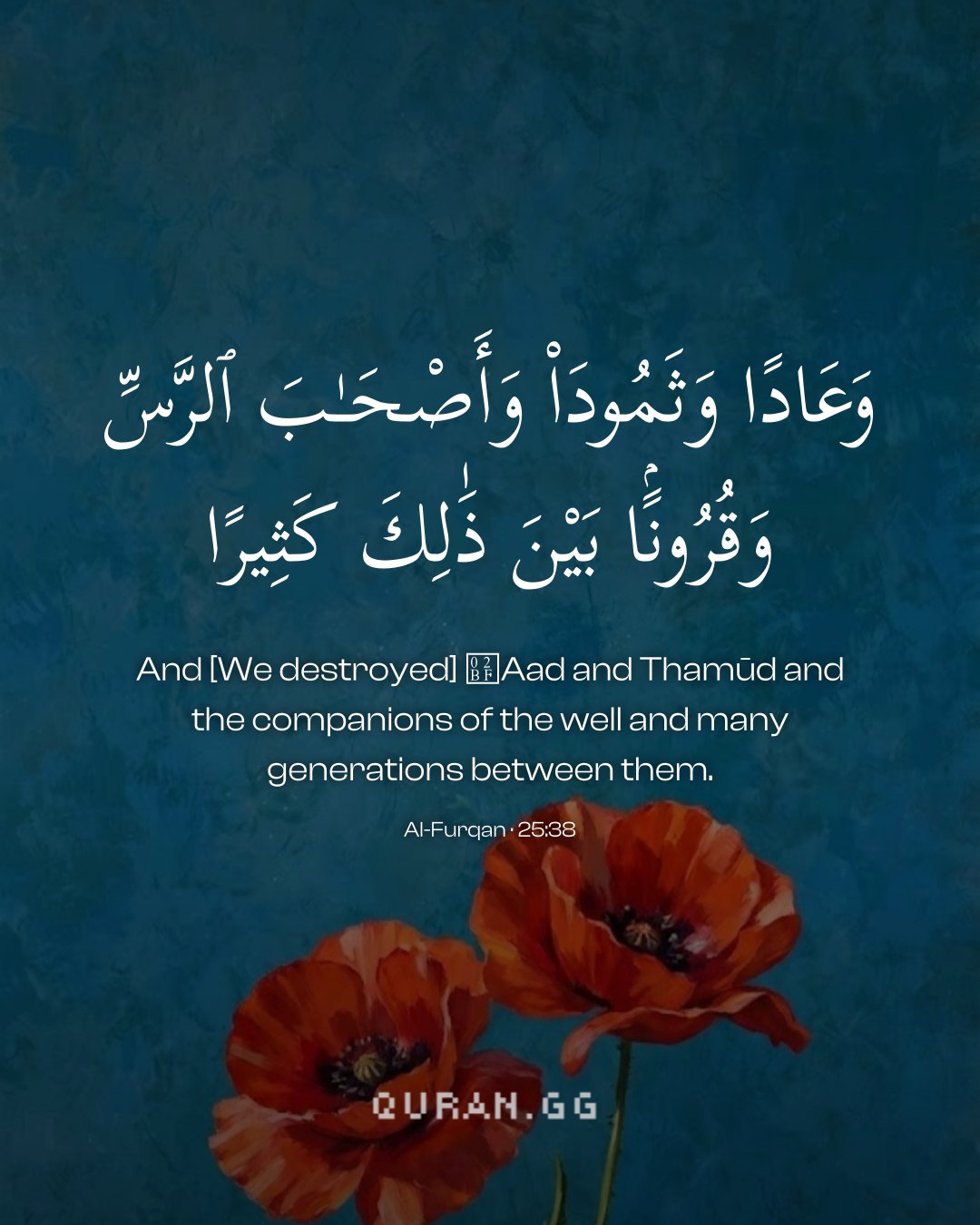
أَصْحَابَ الرَّسِّ (People of Rass - 25:38). In Arabic رَس (Rass) means unlined well. Neither Qur'an nor any authentic tradition describes these people in any detail. Whatever information is available about them is through Israelite traditions, which differ from one another. It is more likely that the remaining people of Thamud had settled down near a well. It is not mentioned in the Qur'an or any tradition as to how they were tormented. (Bayan u1-Qur'an)
Tazkirul Quran
Maulana Wahiduddin KhanOn ayahs 34–39
When the Quran was revealed, it was not revealed all at once, but part by part over a period of 23 years. Those who denied the truth made this an excuse to say that this was a man-made book and not the book of God, because it would not have been difficult for God to prepare the whole book at one time. It was clarified that the Quran was not simply the work of any author. It was a divine proclamation of the Truth. One of the strategies of preaching God’s will is that it is presented to people gradually, so that it progressively takes root in society. Every objection against such activity—which is based on perfect Truth—is a false one. Whenever such an objection is raised, but then is properly clarified, the authenticity of the preacher’s call is reinforced; it is never in doubt at any stage.
Uthmani text of the Madinah mushaf (King Fahd Complex). Translation: Saheeh International. Tafsir via Quran.com.