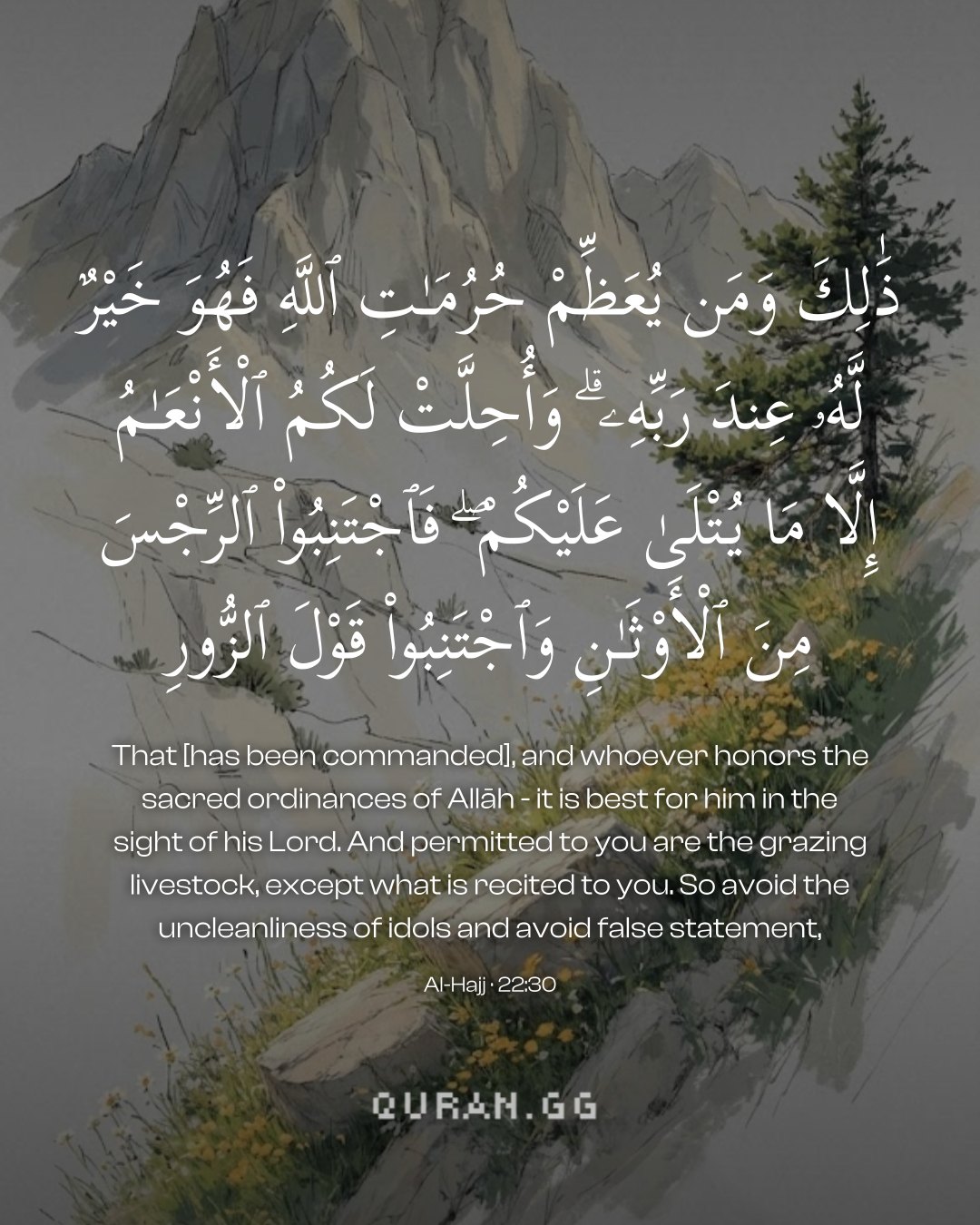
That [has been commanded], and whoever honors the sacred ordinances of Allāh - it is best for him in the sight of his Lord. And permitted to you are the grazing livestock, except what is recited to you. So avoid the uncleanliness of idols and avoid false statement,
Allah says: `This is what We have commanded you to do in the rituals (of Hajj), and this is the great reward that the person who does that will gain.'
وَمَن يُعَظِّمْ حُرُمَـتِ اللَّهِ
(whoever honors the sacred things of Allah,) means, whoever avoids disobeying Him and does not transgress that which is sacred, and regards committing sin as a very serious matter,
فَهُوَ خَيْرٌ لَّهُ عِندَ رَبِّهِ
(then that is better for him with his Lord.) means, he will attain much good and a great reward for doing that. Just as the one who does acts of obedience will earn a great reward, so too, the one who avoids sin will earn a great reward.
حُرُمَاتِ اللَّـهِ (22:30) are the things sanctified by Allah Ta’ ala, that is the religious laws. They are a source of welfare in this world and in the Hereafter for those pious Muslims who seek to learn them and act upon them.
وَأُحِلَّتْ لَكُمُ الْأَنْعَامُ إِلَّا مَا يُتْلَىٰ عَلَيْكُمْ (And permitted to you are the cattle, except those mentioned to you through recitation (of the verses) - 22:30) The word اَنعَام (cattle) includes camels, cows, goats, sheep etc. which are made lawful at all times and even when one is in the state of ihram. Then the verse contains an exception in the words إِلَّا مَا يُتْلَىٰ عَلَيْكُمْ (except those mentioned to you.. - 22:30) These are the animals which have been made unlawful in all circumstances, whether one is in the state of ihram or not. The detail of these animals is given in other verses, such as carrion, an animal which is beaten to death, or slaughtered without reciting the name of Allah, or in the name of someone other than Allah.
فَاجْتَنِبُوا الرِّجْسَ مِنَ الْأَوْثَانِ (So refrain from the filth of the idols - 22:30) The word رِجس means filth or moral impurity, and أَوْثَانِ is the plural of وَثَن which means idol. Idols have been described as filth, because they fill a man's heart and soul with moral impurity.
وَاجْتَنِبُوا قَوْلَ الزُّورِ (And refrain from a word of falsehood - 22:30) The phrase قَوْلَ الزُّورِ means lies. Anything which is contrary to truth is a lie and false, whether it is corrupt beliefs and practices or whether it is false evidence. The Holy Prophet ﷺ once said ` Among the major sins are associating anyone with Allah, disobedience of one's parents, giving false evidence and telling lies in general talk'. He used the phrase; قَوْلَ الزُّورِ (word of falsehood) repeatedly. (Bukhari)
Tazkirul Quran
Maulana Wahiduddin Khan
What is permitted (halal) and what is prohibited (haram); what is sacred and what is not; which way of worship are proper and which improper—all these matters have been made absolutely clear by God through His prophets. Any changes in these matters are not permissible. Any change made in these things is highly wrong, in the eyes of God. Therefore, it is necessary for man to follow the Prophet’s instructions. He should in no case increase or decrease what is prescribed by the Prophet. These are matters the reality of which is known only to God. When a man on his own says something on this subject, he virtually claims, in effect, to have knowledge about things of which he has no knowledge. Obviously, what wrong can be greater than this.
Uthmani text of the Madinah mushaf (King Fahd Complex). Translation: Saheeh International. Tafsir via Quran.com.