Explanation of the Udhiyyah and the Sha`a'ir of Allah
وَمَن يُعَظِّمْ شَعَـئِرَ اللَّهِ
(and whosoever honors the Sha`a'ir of Allah,) means, His commands.
فَإِنَّهَا مِن تَقْوَى الْقُلُوبِ
(then it is truly from the Taqwa of the hearts.) This also includes obeying His commands in the best way when it comes to offering sacrifices, as Al-Hakam said narrating from Miqsam, from Ibn `Abbas: "Honoring them means choosing fat, healthy animals (for sacrifice)." Abu Umamah bin Sahl said: "We used to fatten the Udhiyyah in Al-Madinah, and the Muslims used to fatten them." This was recorded by Al-Bukhari. In Sunan Ibn Majah, it was recorded from Abu Rafi` that the Messenger of Allah ﷺ sacrificed two castrated, fat, horned rams. Abu Dawud and Ibn Majah recorded from Jabir: "The Messenger of Allah ﷺ sacrificed two castrated, fat, horned rams." It was said, "The Messenger of Allah ﷺ commanded us to examine their eyes and ears, and not to sacrifice the Muqabilah, the Mudabirah, the Sharqa, nor the Kharqa'." This was recorded by Ahmad and the Sunan compilers, and At-Tirmidhi graded it Sahih. As for the Muqabilah, it is the one whose ear is cut at the front, Mudabirah is the one whose ear is cut at the back, the Shurqa is the one whose ear is split, as Ash-Shafi`i said. The Kharqa' is the one whose ear is pierced with a hole. And Allah knows best. It was recorded that Al-Bara' said, "The Messenger of Allah ﷺ said:
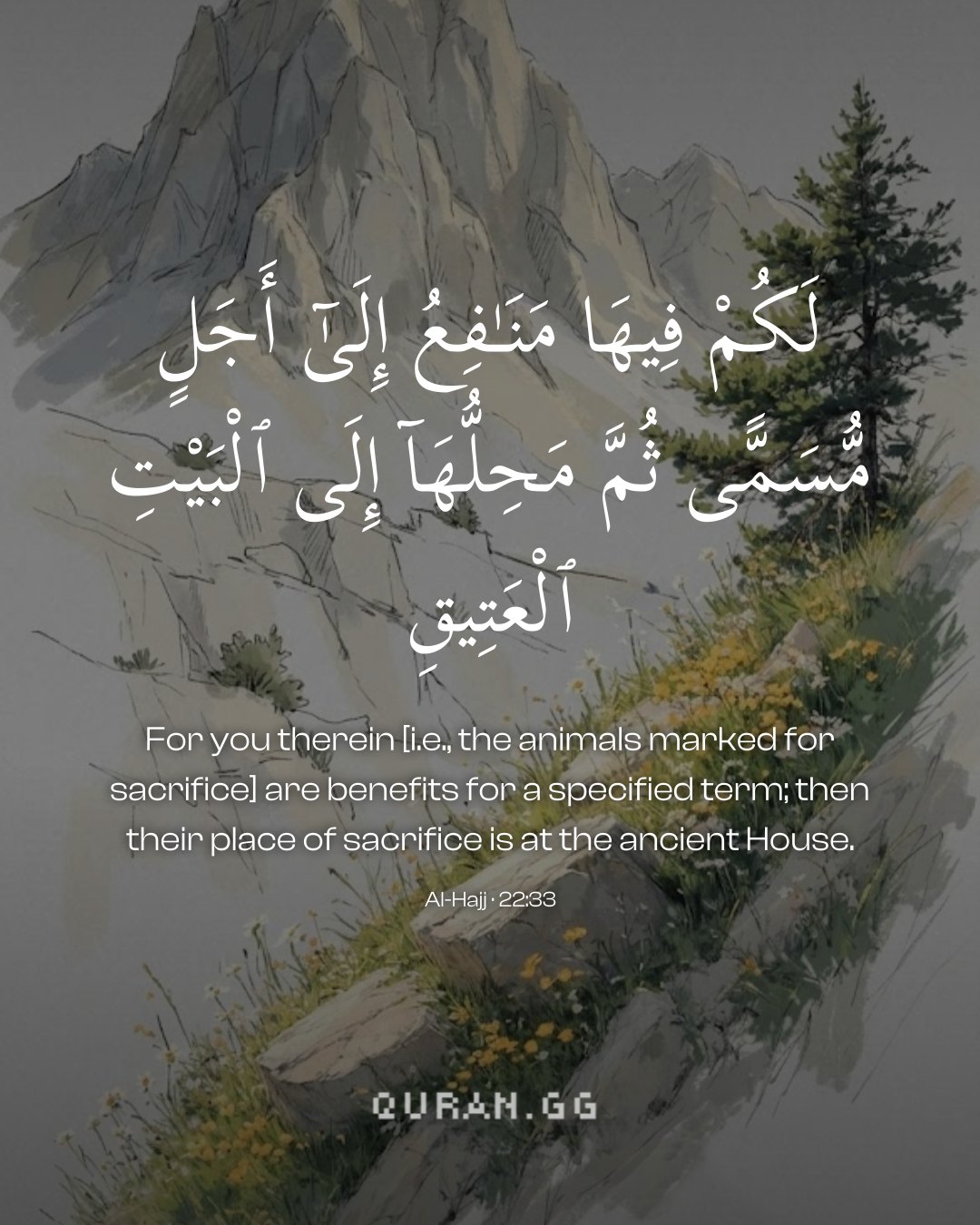
لَكُمْ فِيهَا مَنَافِعُ إِلَىٰ أَجَلٍ مُّسَمًّى (And for you there are benefits in them upto a specified time - 22:33). It means that it is lawful for the Muslims to use the quadruped animals for their benefit (such as using their milk, riding them or using them for transport of goods) unless the animals have been made ھَدِی (Hady) by reserving them for sacrifice to be offered within the precincts of haram. When a person takes along with him an animal for the specific purpose of sacrificing it within haram, the animal is described as hady, and no benefit may be derived from it, except in extreme emergency. A person leading a camel after it has been nominated as hady may lawfully ride it only if he is unable to walk and no other mount is available.
ثُمَّ مَحِلُّهَا إِلَى الْبَيْتِ الْعَتِيقِ (Then their place of sacrifice is by the Ancient House - 22:33) Here الْبَيْتِ الْعَتِيقِ includes the entire precincts of haram, as was the case in the previous verse where the word Al-Masjid Al-Haram was used for the entire area of haram, and mahill (place) means the place of slaughtering the animals of hady. Thus the entire haram is declared as the slaughtering place of the animals of hady. The meaning of the verse is that the hady (animals nominated for sacrifice during Hajj) may be slaughtered within, and not outside the area of haram which includes Mina and all other places of Makkah. (Ruh ul Ma ani)
Tazkirul Quran
Maulana Wahiduddin KhanOn ayahs 33–34
The rites of worship or prayer in Islam have two aspects—the outward and the inward. The inward aspect is the real essence of worship. The outward aspect serves as a symbol (sha‘irah, pl. sha‘a’ir) of this inward aspect. The rites specified by God cannot be treated as being carried out properly if they are simply observed outwardly. In order to be properly observed, these deserve to be performed with a pure and God-fearing heart. Animals specified for sacrifice are among God’s symbols. They are the symbols of realities and not the realities themselves. In order to please God, it is not enough to colour these animals, or to abstain from riding them or utilizing them in any manner. God’s pleasure lies in whatever is done being done purely for His sake. What God appreciates is the innermost feelings of the heart and not merely external trappings.
Uthmani text of the Madinah mushaf (King Fahd Complex). Translation: Saheeh International. Tafsir via Quran.com.