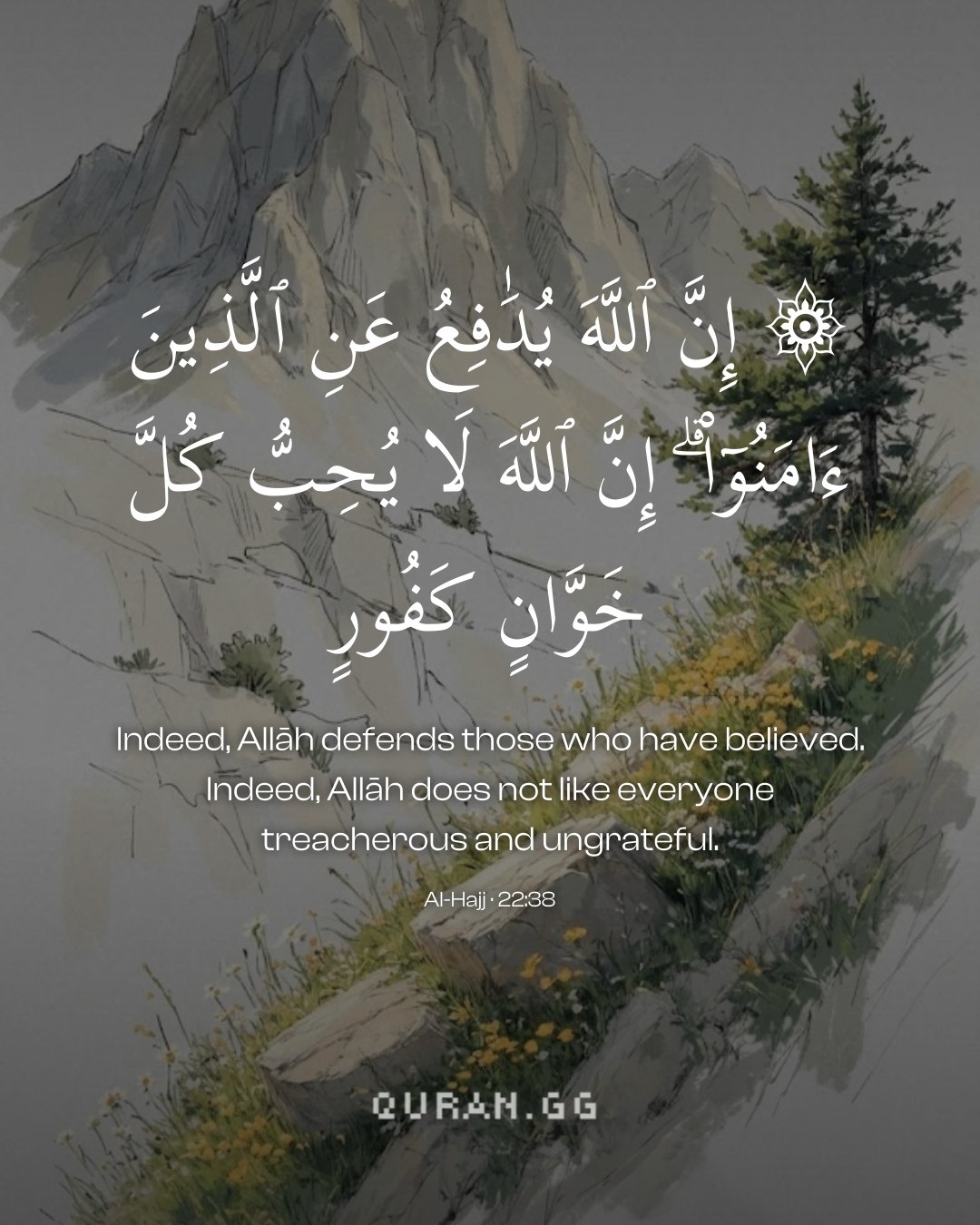
Here Allah tells us that He defends His servants who put their trust in Him and turn to Him in repentance; He protects them from the the worst of evil people and the plots of the sinners; He protects them, guards them and supports them, as He tells us elsewhere:
(And whosoever puts his trust in Allah, then He will suffice him. Verily, Allah will accomplish his purpose. Indeed Allah has set a measure for all things) 65:3.
إِنَّ اللَّهَ لاَ يُحِبُّ كُلَّ خَوَّانٍ كَفُورٍ
(Verily, Allah likes not any treacherous ingrate) means, He does not like any of His servants who bear these characteristics, i.e., treachery in covenants and promises whereby a person does not do what he says, and ingratitude is to deny the blessings, whereby one does not acknowledge or appreciate them.
Ma'arif al-Qur'an
Mufti Muhammad Shafi
Commentary
The previous verses contain an account of how the infidels of Makkah prevented the Holy Prophet ﷺ and his companions from entering the Haram and the Holy Mosque to perform ` Umrah when, having put on ihram, they had reached as far as Hudaibiyah, a place not far from Makkah. In this verse Allah Ta’ ala consoled the Muslims with the promise that He would deprive the infidels of their power to harm them anymore.
This incident took place in the year 6 A.H. and thereafter the power and the morale of the infidels suffered continuous decline until in the year 8 A.H. the Muslims conquered Makkah. The following verses describe this event in detail.
Tazkirul Quran
Maulana Wahiduddin KhanOn ayahs 37–39
Had there been no animals like camels or cattle in this world and had there been only wild beasts like tigers, bears and wolves, man would have found it very difficult to put them to use, and it would have been absolutely impossible to offer them up for ritual sacrifice on a general scale. It is a great blessing of Almighty God that He created not only wild beasts but also some animals who, by their very nature, have the tendency to surrender themselves to human beings, this surrender takes its ultimate form when man can slaughter them for food and sacrifice. The rites of sacrifice have been prescribed, not because God needs meat and blood, but purely as symbolic actions. The sacrifice of an animal is symbolic of the man who has sacrificed himself for the sake of God. This is, in fact, the sacrifice of one’s own self which takes the shape of the sacrifice of an animal. Such people are fortunate for whom the sacrifice of animals becomes synonymous with the sacrifice of their own selves.
Uthmani text of the Madinah mushaf (King Fahd Complex). Translation: Saheeh International. Tafsir via Quran.com.