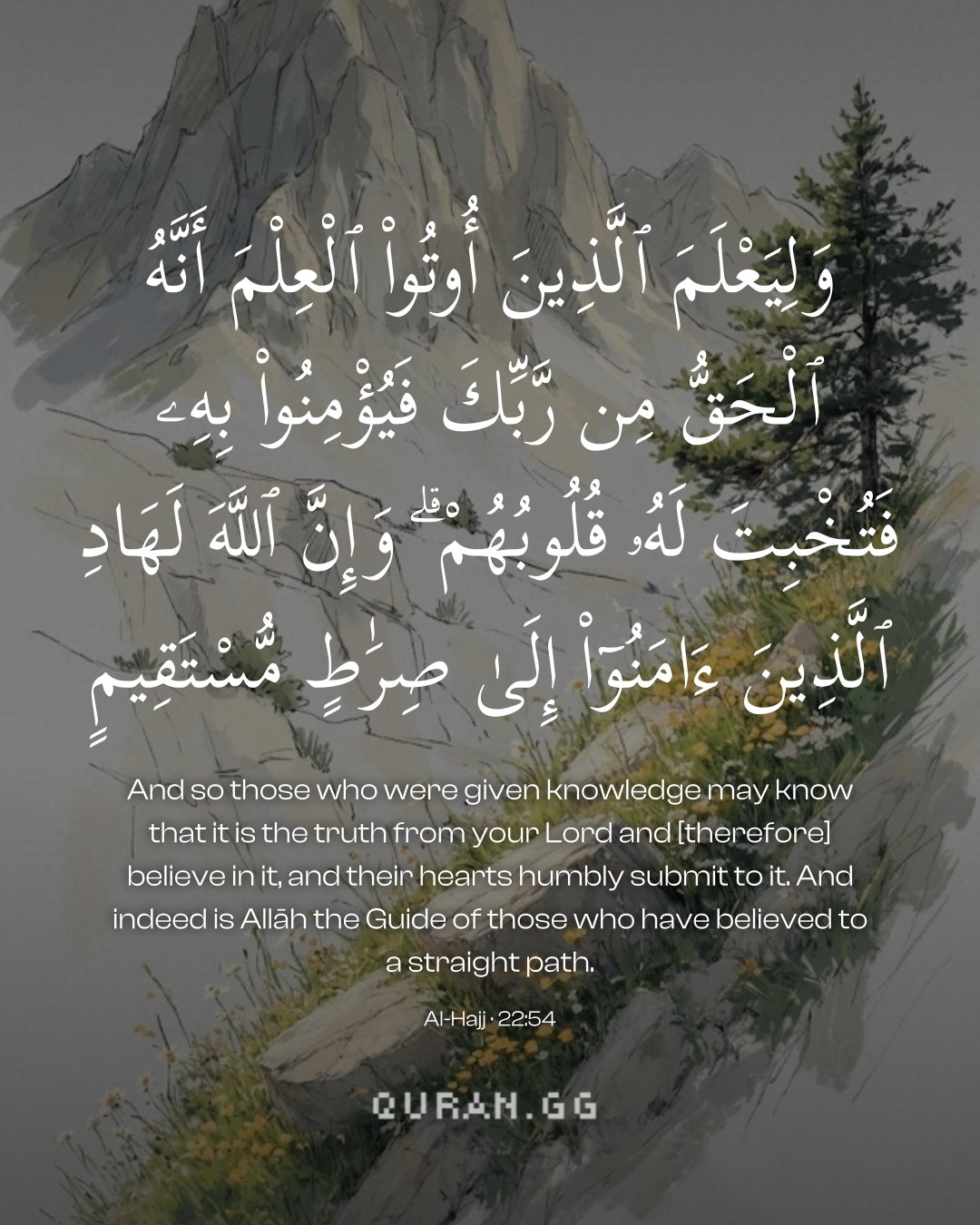
And so those who were given knowledge may know that it is the truth from your Lord and [therefore] believe in it, and their hearts humbly submit to it. And indeed is Allāh the Guide of those who have believed to a straight path.
How the Shaytan threw some Falsehood into the Words of the Messengers, and how Allah abolished
At this point many of the scholars of Tafsir mentioned the story of the Gharaniq and how many of those who had migrated to Ethiopia came back when they thought that the idolators of the Quraysh had become Muslims, but these reports all come through Mursal chains of narration and I do not think that any of them may be regarded as Sahih. And Allah knows best. Al-Bukhari said, "Ibn `Abbas said,
فِى أُمْنِيَّتِهِ
(in his recitation (of the revelation).) "When he spoke, the Shaytan threw (some falsehood) into his speech, but Allah abolished that which the Shaytan threw in."
مِن رَّسُولٍ وَلَا نَبِيٍّ (any messenger and any prophet - 22:52) This shows that the words Rasul رَّسُولٍ and Nabi carry different meanings, though there is no consensus as to the precise nature of the difference. For our purpose it is enough to understand that Nabi نَبِيٍّ is a person whom Allah Ta’ ala designates with a mission to reform his people and who receives revelations from Him. He may receive a Scripture and a code of laws or he may be commanded to convey the message of an earlier Book and code of laws. Sayyidna Musa (علیہ السلام) and ` Isa' (علیہ السلام) belong to the first category, whereas Sayyidna Harun (علیہ السلام) ، who was directed to propagate the teachings of Torah and the Mosaic Laws, falls in the second category. On the other hand a Rasul رَّسُولٍ is a person who receives from Allah Ta’ ala a Scripture and a code of laws. Thus every رَّسُولٍ Rasul is necessarily a Nabi also, but every Nabi is not a Rasul. These distinctions are applicable to human beings only. That an angel who carries wahy from Allah Ta’ ala is also named as Rasul does not contradict this position. This subject has already been discussed in detail in Surah Maryam in the beginning of this volume.
It invariably happens that when one proclaims the divine Truth, whether he is a prophet or not, his opponents bring up various types of irrelevant points with a view to casting doubt on the truth of the message. Such points are always baseless. However, when they are raised, the preacher finds the opportunity to clarify his message and make it more cogent and well-established. This enhances the faith of sincere believers. Thereafter, their bonds with God become still stronger. But for those who are devoid of sincere understanding, these baseless objections become a source of trial for them. They are misled by them and move away from the Truth. ‘God will surely guide the faithful to a straight path’ means that those who are really sincere in their faith are not affected by false propaganda. They are never misled by the magic of false words. Their faith gives them deep insight into things, so that they are not carried away by outward appearances.
Uthmani text of the Madinah mushaf (King Fahd Complex). Translation: Saheeh International. Tafsir via Quran.com.