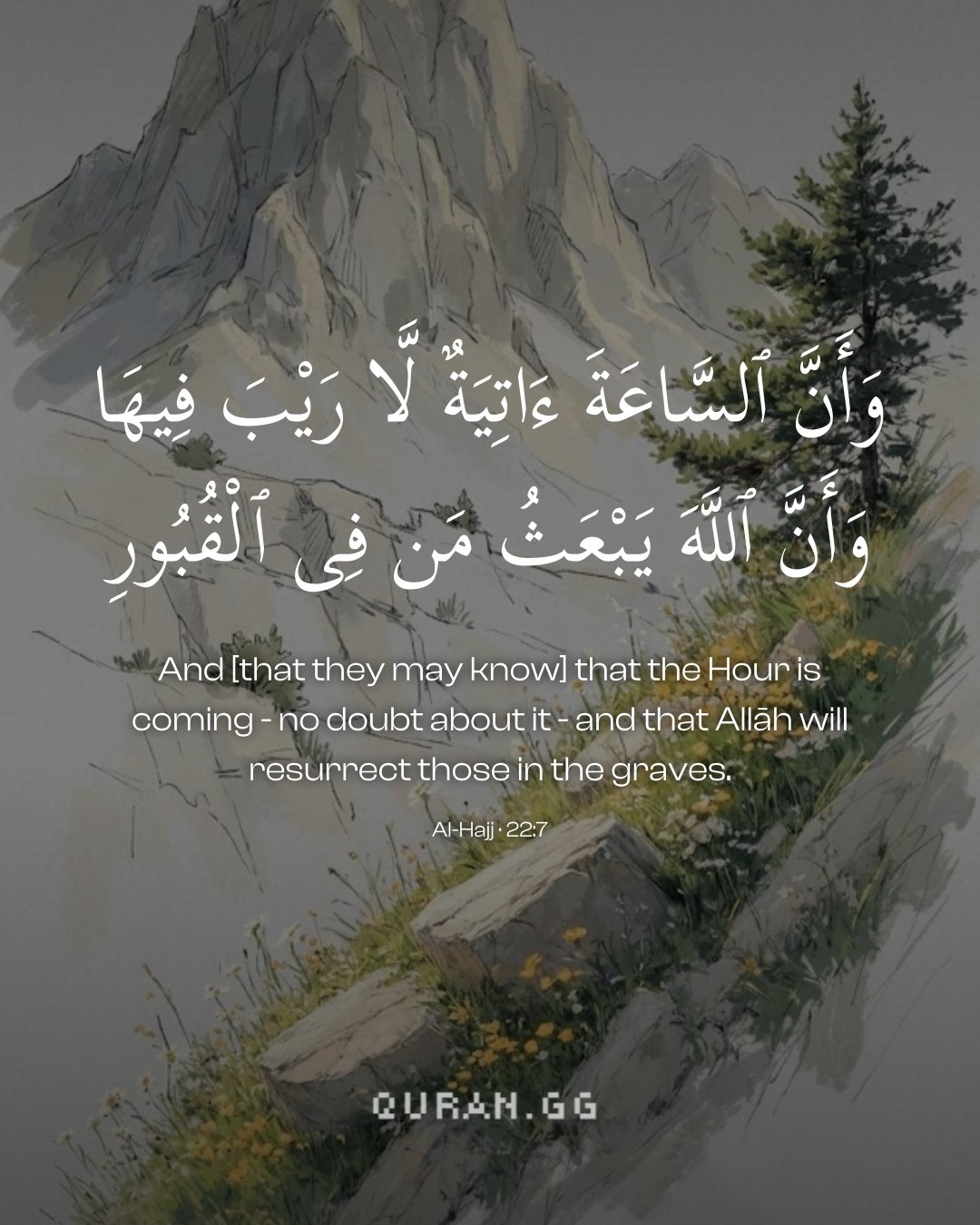
Evidence of the Resurrection in the creation of Man and of Plants
When Allah speaks of disbelief in the Resurrection, He also mentions the evidence of His power and ability to resurrect that is evident from the way He initiates creation. Allah says:
(O mankind! If you are in doubt about the Resurrection,) which means the time when souls and bodies will be raised up on the Day of Resurrection,
فَإِنَّا خَلَقْنَـكُمْ مِّن تُرَابٍ
(then verily, We have created you from dust,) meaning, `you were originally created from dust', which is what Adam, peace be upon him, was created from.
ثُمَّ مِن نُّطْفَةٍ
(then from a Nutfah,) 32:8 meaning, then He made his offspring from semen of despised water.
Different stages in the development of foetus in mother's womb
فَإِنَّا خَلَقْنَاكُم مِّن تُرَابٍ (We created you from dust - 22:5.) This verse deals with the different stages through which the foetus passes in its mother's womb before taking a human form. There is a detailed hadith on this subject, which is reproduced in Sahih of Bukhari on the authority of Sayyidna Ibn Masud ؓ to the effect that the Holy Prophet ﷺ said, "Human matter retains its original form in the woman's womb for forty days after which it becomes a clot of blood. After a further period of forty days it becomes a lump of flesh. Thereafter an angel is sent by Allah Ta’ ala who breaths a soul into it and records four things about it, namely how long it will live, how much sustenance it will receive, what acts he will do, and finally whether its end will be wretched or fortunate. (Qurtubi)
Man is doubtful about the life hereafter for the simple reason that he is unable to understand how a human being who is dead and gone can come back to life. He wonders how a dead universe can become a live universe. The reply to this question can be found in the structure of our present world itself. What is the present world? It is nothing but a change from one condition to another. What we call a ‘live’ existence is in fact the result of a change, a metamorphosis of a non-living existence. An analysis of the human body shows that it is composed of iron, carbon, calcium, salts, water, gases, etc. These compounds which comprise the human body are all lifeless. But these inanimate soul-less things convert into animate objects having souls and start moving about in the shape of human beings. In the case of human beings, therefore, when non-living things have initially taken the shape of living things, the assertion that, once again, non-living things will change into living things, is not at all surprising. Similarly, if one looks at the green vegetation growing on the earth, it will be seen that it is formed from a number of constituents found in the soil. All these constituents are initially devoid of the qualities found in vegetation. Yet this type of transformation takes place every day before our eyes. Then why should we have doubts about the recurrence of such a feasible event? The fact is that the coming into existence of the first world in itself proves the feasibility of the coming into existence of the second world. After experiencing one world, the understanding of a second world, rationally and logically, is not at all difficult.
Uthmani text of the Madinah mushaf (King Fahd Complex). Translation: Saheeh International. Tafsir via Quran.com.