Those Who deserve the Fai'; and the Virtues of the Muhajirin and Al-Ansar
Allah states the categories of needy people who also deserve a part of the Fai',
الَّذِينَ أُخْرِجُواْ مِن دِيَـرِهِمْ وَأَمْوَلِهِمْ يَبْتَغُونَ فَضْلاً مِّنَ اللَّهِ وَرِضْوَناً
(who were expelled from their homes and their property, seeking bounties from Allah and (His) good pleasure,) meaning, departed their homes and defied their people, seeking the acceptance of Allah and His favor,
وَيَنصُرُونَ اللَّهَ وَرَسُولَهُ أُوْلَـئِكَ هُمُ الصَّـدِقُونَ
(and helping Allah and His Messenger. Such are indeed the truthful.) meaning, `they are those who were truthful in statement and deed, and they are the chiefs of the Muhajirin.' Allah the Exalted praised the Ansar next and emphasized their virtue, status and honor, preferring to give to others over themselves, even though they were in need, and not feeling enviousness. Allah the Exalted said,
Continue reading the tafsir of ayahs 8–10 All Muslims after the Muhajirin and the Ansar are entitled to fai'
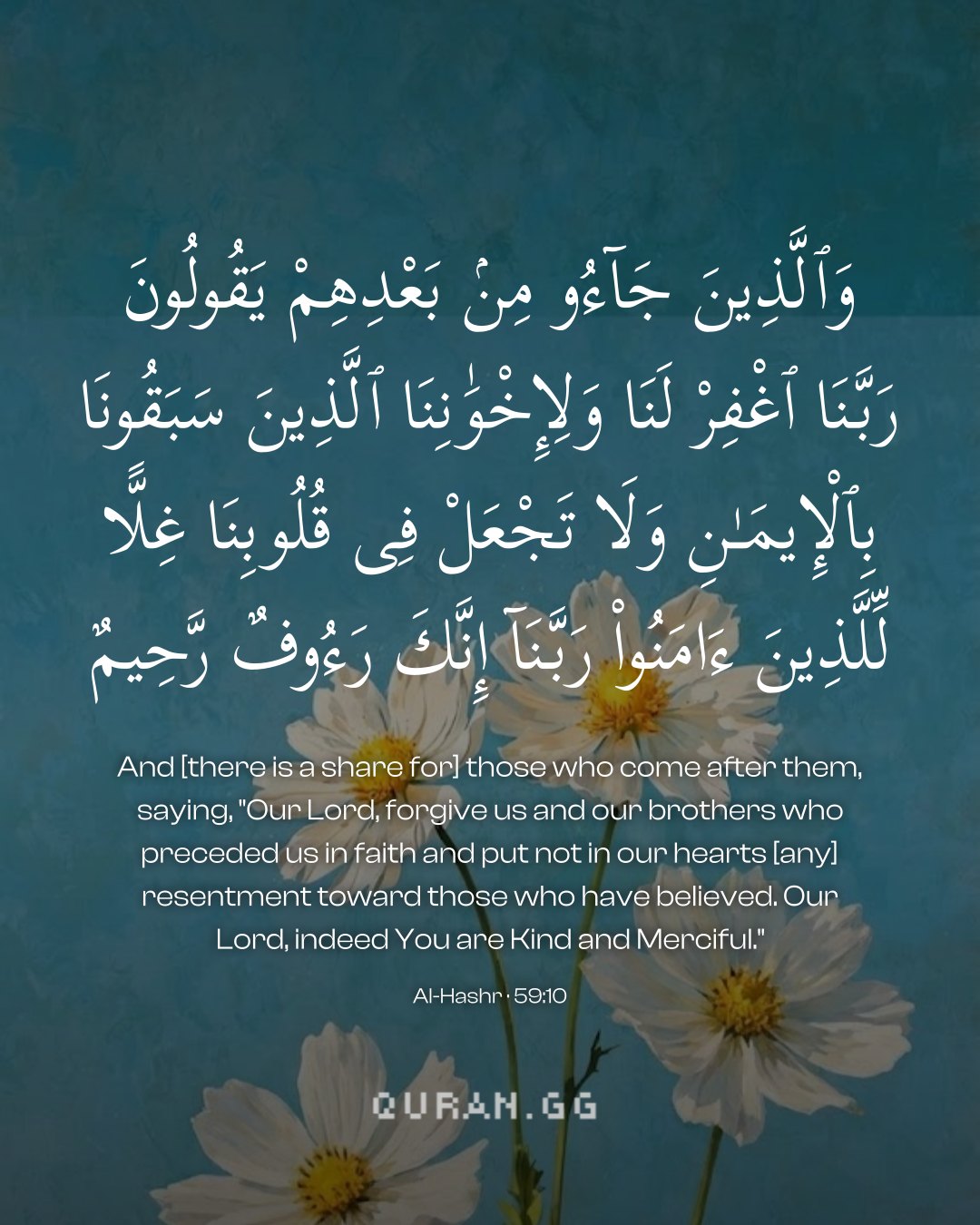
وَالَّذِينَ جَاءُوا مِن بَعْدِهِمْ "And [ fai' is also ] for those who came after them ....59:10) This verse lays down that all Muslims until the Last Hour, after the noble Companions from amongst the Muhajirin and Ansar, are entitled to a share in the fai' property. This was the reason why Sayyidna ` Umar Al-Faruq ؓ conquered great territories like ` Iraq, Syria, Egypt and so on, but did not distribute them among the fighters. He retained them as public endowment for next generations, so that the income might accrue to the Islamic public treasury and the Muslims till the Last Hour may benefit from it. When some of the blessed Companions enquired about the distribution of the conquered territories, he referred to this verse and said: Had it not been for the future generations of Muslims, I would have distributed all the conquered territories among the fighters as they were captured, following the example of the Messenger of Allah ﷺ . When Khaibar was conquered, the Holy Prophet ﷺ distributed all its lands. If all the lands are distributed among the present Muslim generation, nothing will be left for future generations." [ Transmitted by Malik and Qurtubi ].
Love for the Blessed Companions ؓ is a sign that the Ummah is on Truth
On this occasion, Allah has put the Ummah of Muhammad ﷺ into three different categories: [ 1] Muhajirin; [ 2] Ansar; and [ 3] the general body of the Ummah. The special characteristics of the Muhajirin and the sterling qualities of the Ansars are described in the relevant verses above. As for the merits of the rest of the Ummah, the verse merely mentions one quality of theirs that they recognize the high status of Muhajirin and the Ansar in that they had preceded them in faith and were means of communicating it to us. Further, they pray for forgiveness of all, and also pray that their own hearts be completely cleansed of all bitterness and spite towards true and sincere Muslims.
This shows that for the validity and acceptance of faith and Islam of all the coming generations of Muslims, after the blessed Companions, it is a necessary condition that they have love and respect for the Companions of the Holy Prophet ﷺ ، and pray for their brethren in Faith of earlier generations. Where this necessary condition is lacking, such people are not worthy of being called Muslims. Therefore, Sayyidna Mus'ab Ibn Sa'd ؓ says that the Muslims of this Ummah are divided into three categories, of which two categories [ those of Muhajirin and Ansar ] have already been mentioned. The third category remains. If anyone wishes to have a place in the Ummah, he should join the third category by showing love, respect and honour to the blessed Companions.
Someone approached Sayyidna Husain ؓ and inquired about Sayyidna ` Uthman ؓ [ who had by then been martyred ], the former asked the inquirer: "Are you one of the Muhajirin?" He replied: "No". Then he asked him: "Are you one of the Ansar?" He replied: "No." He then said: 'There remains only the third verse وَالَّذِينَ جَاءُوا مِن بَعْدِهِمْ "And... those who came after them...[ 59:10] ": If you wish to create doubt about Sayyidna ` Uthman ؓ ، then you will have to leave this category as well.'
Qurtubi says that this verse is a proof that love of the blessed Companions is obligatory. Sayyidna Imam Malik (رح) says that any person who reviles a Companion or holds a grudge against him, will not have a share in the fai' property of the Muslims. Then he argues, on the basis of this verse, that every Muslim has a share in the fai' property, and anyone who has no share, his faith in Islam is doubtul.
Sayyidna ` Abdullah Ibn ` Abbas ؓ has stated that Allah has commanded all Muslims to pray for the Companions of Muhammad ﷺ and for their forgiveness, whereas Allah knew that there would be conflicts and civil wars between them. Therefore, it is not permissible for any Muslim to hold evil thoughts about them on account of their conflicts.
Sayyidah ` A'shah Siddiqah ؓ says, "I have heard your Holy Prophet ﷺ say that this community will not perish unless the later generations curse the earlier generations."
Sayyidna ` Abdullah Ibn ` Umar ؓ says: "When you hear anyone reviling a Companion, tell him, 'May the curse of Allah be upon the one who is the worst of you'." Obviously, no Companion can ever be worse. The one who is cursing would be the worst one. In a word, it is a cause of curse to revile a Companion.
` Amr Ibn Haushab (رح) says: "I have found the earlier generations of this Ummah uniformly and strongly advise people to describe the merits of the noble Companions ؓ and their good qualities, so that they may develop love for them. Do not ever talk about their conflicts and disagreements, so that people may become bold and show disrespect to them." [ All these narratives have been adapted from Qurtubi ].
Uthmani text of the Madinah mushaf (King Fahd Complex). Translation: Saheeh International. Tafsir via Quran.com.