The Stubborn Disbelievers will never believe, no matter what Signs and Wonders They see
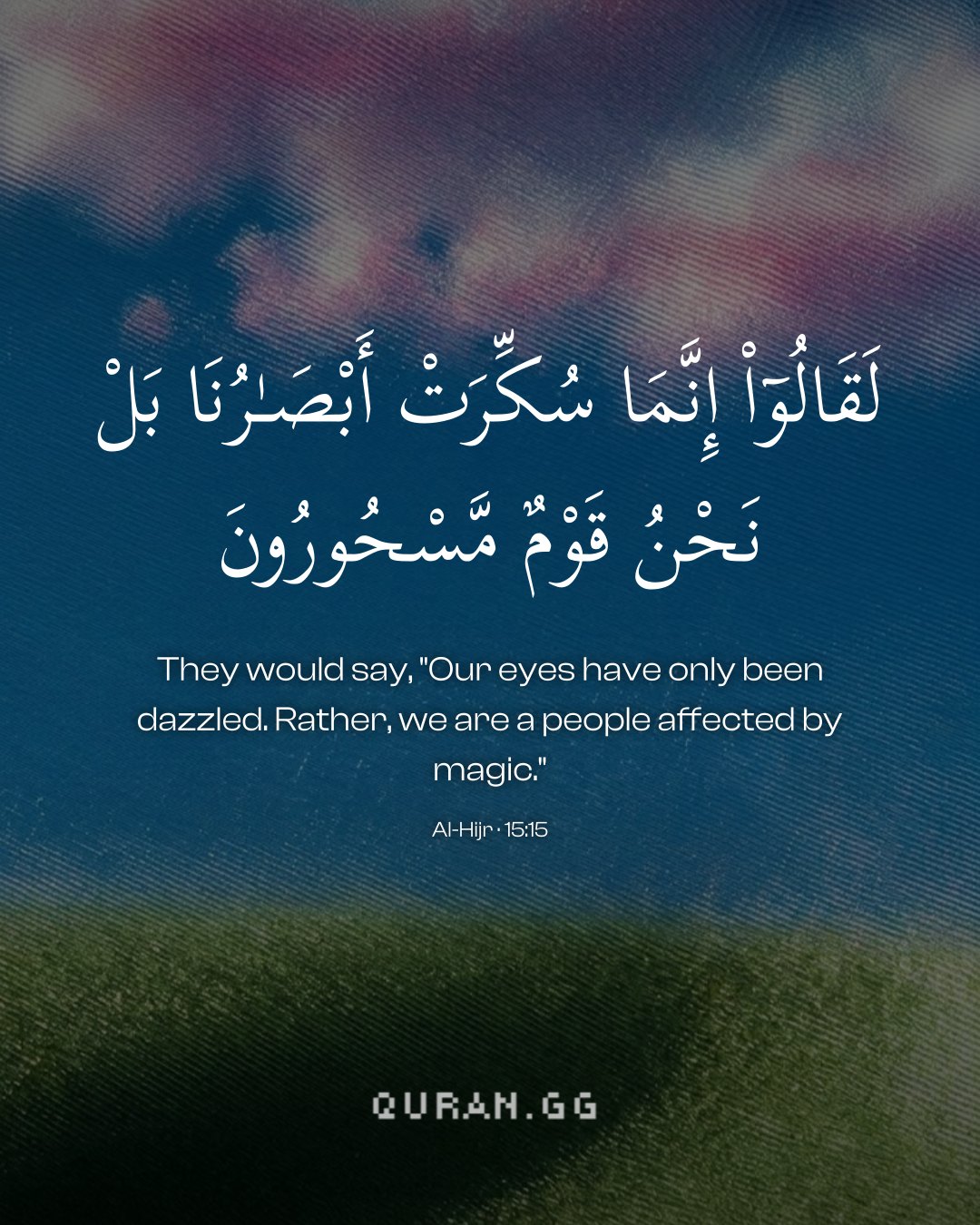
Allah explains the extent of their disbelief and stubborn resistance to the truth by stating that even if a door to heaven were to be opened for them, and they were to be taken up through it, they would still not believe. Rather, they would say:
إِنَّمَا سُكِّرَتْ أَبْصَـرُنَا
(Our eyes have been (as if) dazzled.) Mujahid, Ibn Kathir and Ad-Dahhak said, "this means our vision has been blocked." Qatadah narrated that Ibn `Abbas said, "this means our eyesight has been taken away." Al-`Awfi reported that Ibn `Abbas said, "this means we were confused and put under a spell."
سُكِّرَتْ أَبْصَـرُنَا
(Our eyes have been (as if) dazzled.) Ibn Zayd said: "The one who is dazzled lit. intoxicated is the one who cannot reason."
Ma'arif al-Qur'an
Mufti Muhammad ShafiOn ayahs 10–15
A Lexical Note of Explanation
The word: اَلشِيَعِ in the first verse (10) is the plural form of: شِیعہ (shah) which means the follower or helper of a person. Then, it is also used to denote a group which agrees upon particular beliefs and theoretical assumptions. So, the sense of the statement is that Allah Ta’ ala has sent messengers among every group or sect. Here, by using the word: فِی in فِي شِيَعِ الْأَوَّلِينَ ( in place of اِلٰی : ila: to (translated as 'among the groups of earlier peoples' ), the hint given is that the messenger for every group was sent from among that particular group so that people would find it easy to trust him, and that he too, by being aware of their taste and temperament, could make appropriate plans to work for their reform.
Tazkirul Quran
Maulana Wahiduddin Khan
God’s prophets were scoffed at in every age. The reason for this was that people judged their worth as representatives of God by self-devised, imaginary standards. The contemporary prophets did not appear to match up to the said standards, and so were dismissed as objects of ridicule. In order to discover a new reality, it is necessary for a man to think with an open mind and be prepared to form an opinion purely on the basis of facts. Those who reject the truth do so mostly because the truth appears to them strange in relation to their own familiar standards. Over a long period of time those familiar standards permeate their hearts to such an extent that it becomes impossible for them to think of accepting alternatives. Till the last moment they are unable to emerge from the sphere familiar to them and recognize the truth. The result of this attitude in communities was that the people belonging to them, in spite of being shown miracles, did not embrace the faith. Once they judged a prophet to be an ordinary man, basing their opinion on purely material factors, the person so judged could never be anything more than ordinary in their eyes. Even if he performed supernatural feats in front of them, their ideas were so rooted in the earlier traditions that he went on seeming unimportant, and so they would hold that his feats were just magic or some optical illusion and not a proof of his being a representative of God.
Uthmani text of the Madinah mushaf (King Fahd Complex). Translation: Saheeh International. Tafsir via Quran.com.