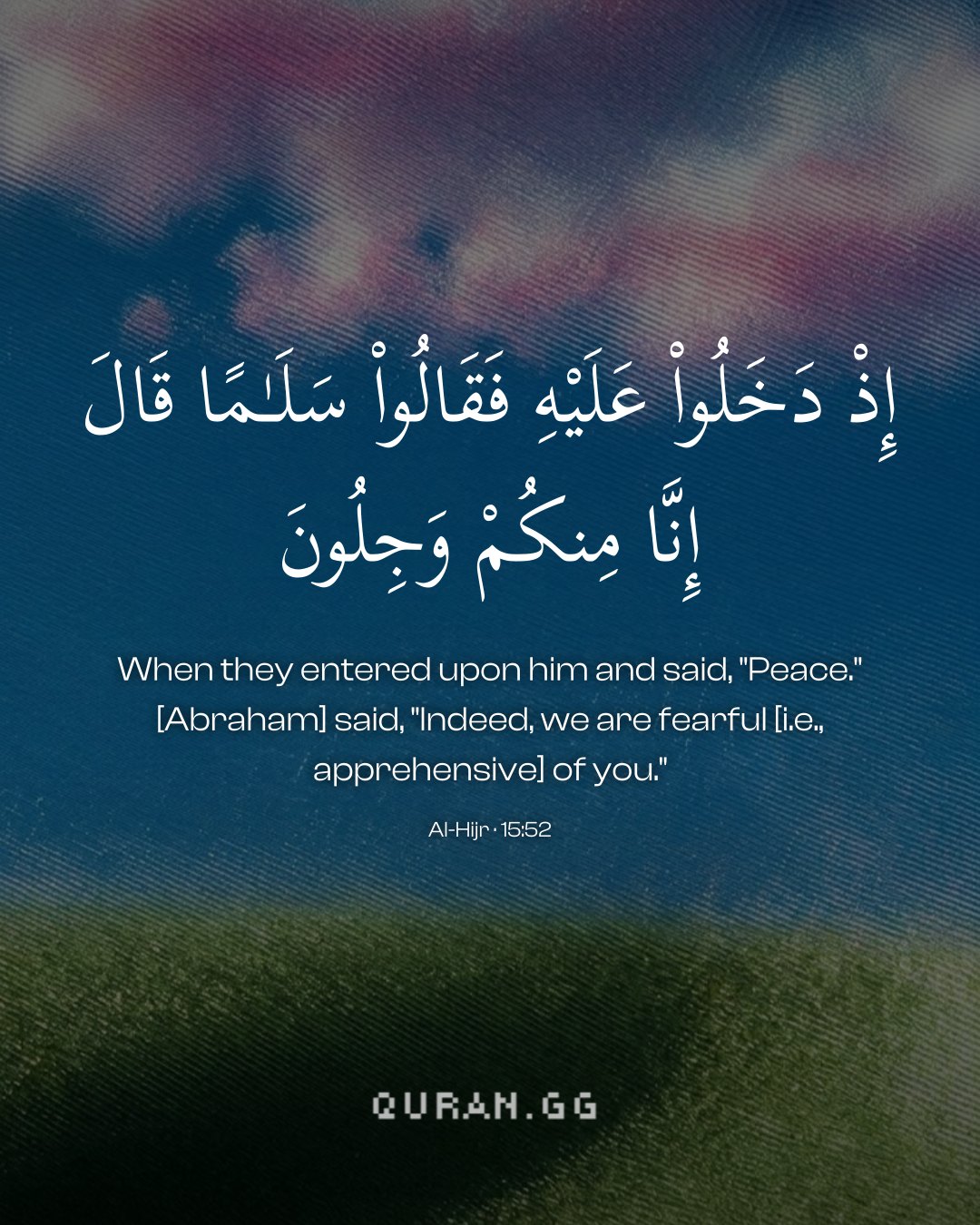
The Guests of Ibrahim and their Good News of a Son for Him
Allah is saying: `Tell them, O Muhammad, about the story of
ضَيْفِ إِبْرَاهِيمَ
(the guests of Ibrahim.)'
دَخَلُواْ عَلَيْهِ فَقَالُواْ سَلامًا قَالَ إِنَّا مِنْكُمْ وَجِلُونَ
(they entered upon him, and said: "Salaman (peace!)." He said: "Indeed we are frightened of you.") meaning that they were scared. The reason for their fear has been mentioned previously, which is that they noticed that these guests did not eat of the food that was offered, which was a fattened calf.
قَالُواْ لاَ تَوْجَلْ
(They said: "Do not be afraid!...") meaning, do not be scared.
وَبَشَّرُوهُ بِغُلَـمٍ عَلَيمٍ
(We bring you the good news of a boy possessing much knowledge and wisdom.) this refers to Ishaq, as was previously mentioned in Surat Hud. Then
قَالَ
(He said) meaning he spoke with wonder and astonishment, asking for confirmation, because he was old and his wife was old:
أَبَشَّرْتُمُونِى عَلَى أَن مَّسَّنِىَ الْكِبَرُ فَبِمَ تُبَشِّرُونَ
(Do you give me this good news while old age has overtaken me Of what then is your news about) They responded by confirming the good news they had brought, good news after good news:
قَالُواْ بَشَّرْنَـكَ بِالْحَقِّ فَلاَ تَكُن مِّنَ الْقَـنِطِينَ
(They said: "We give you good news in truth. So do not be of those who despair.")
From verse 48: لَا يَمَسُّهُمْ فِيهَا نَصَبٌ وَمَا هُم مِّنْهَا بِمُخْرَجِينَ (No weariness shall touch them therein nor will they be expelled from there), we learn about two features of Jannah: (1) No one shall ever feel tired or weak. This is contrary to what happens in our mortal world where hard work naturally results in fatigue. In fact, even a state of total rest and fun would sometimes tire a person out, no matter how enjoyable are things one is occupied with. (2) The other feature of Jannah we discover is that the blessings once received there shall be eternal. These blessings shall never diminish nor shall anyone be expelled from there. In Surah Sad, it was said:إِنَّ هَـٰذَا لَرِزْقُنَا مَا لَهُ مِن نَّفَادٍ (This is sustenance provided by Us which is never to exhaust - 38:54). And in the present verse, it was said: وَمَا هُم مِّنْهَا بِمُخْرَجِينَ (nor will they be expelled from there) that is, they shall never be deprived of the state of bliss bestowed upon them. This is contrary to the affairs of the mortal world where the recipient of the best of conveniences lives under the apprehension that the Over of the facilities may become displeased with him one of those days and expel him out.
Continue reading the tafsir of ayahs 48–71 The life of Paradise will be a life without fear. Only those who were mindful of God in this world will be considered eligible for this life. The fear of God in the present world is the price of a life without fear in the Hereafter. Mutual ill-will is of two types: one is due to arrogance and the other is due to misunderstanding. Engendering ill-will or enmity out of sheer arrogance is the greatest social evil. The people of the Faith should put an end to it in this very world itself. Those who do not do so incur the risk of Hell in the Hereafter. The type of ill-will which occurs due to misunderstanding, sometimes comes to an end, but sometimes, in spite of sincerity on both sides, continues till the very end. This second type of ill-will will completely end in the Hereafter, because the Hereafter is the world where realities are laid completely bare. When all the realities are unveiled before a sincere man, he will have no further reason to entertain feelings of ill-will against his brother. The life of Paradise is so aesthetic and refined that one cannot imagine it in the present world. However, the pleasures and luxuries of the present world are a preliminary introduction to the ensuing world of pleasures and luxuries. When this introduction to Paradise is so pleasing, one can imagine how pleasing Paradise itself is going to be. A man may accumulate all kinds of pleasure-giving things and luxuries in the world; but even then, various kinds of unpleasantness make all his accumulation meaningless. Paradise, however, is a place where pleasures and luxuries will be free of all unpleasantness. It is recorded in a tradition of the Prophet Muhammad that the people of Paradise will be told, ‘Now, you will always be healthy and will never be ill; now, you will be alive for ever and will never die; now you will always be young and you will never grow old; now you will always be here and you will never have to leave this place.’
Continue reading the tafsir of ayahs 50–55 Uthmani text of the Madinah mushaf (King Fahd Complex). Translation: Saheeh International. Tafsir via Quran.com.