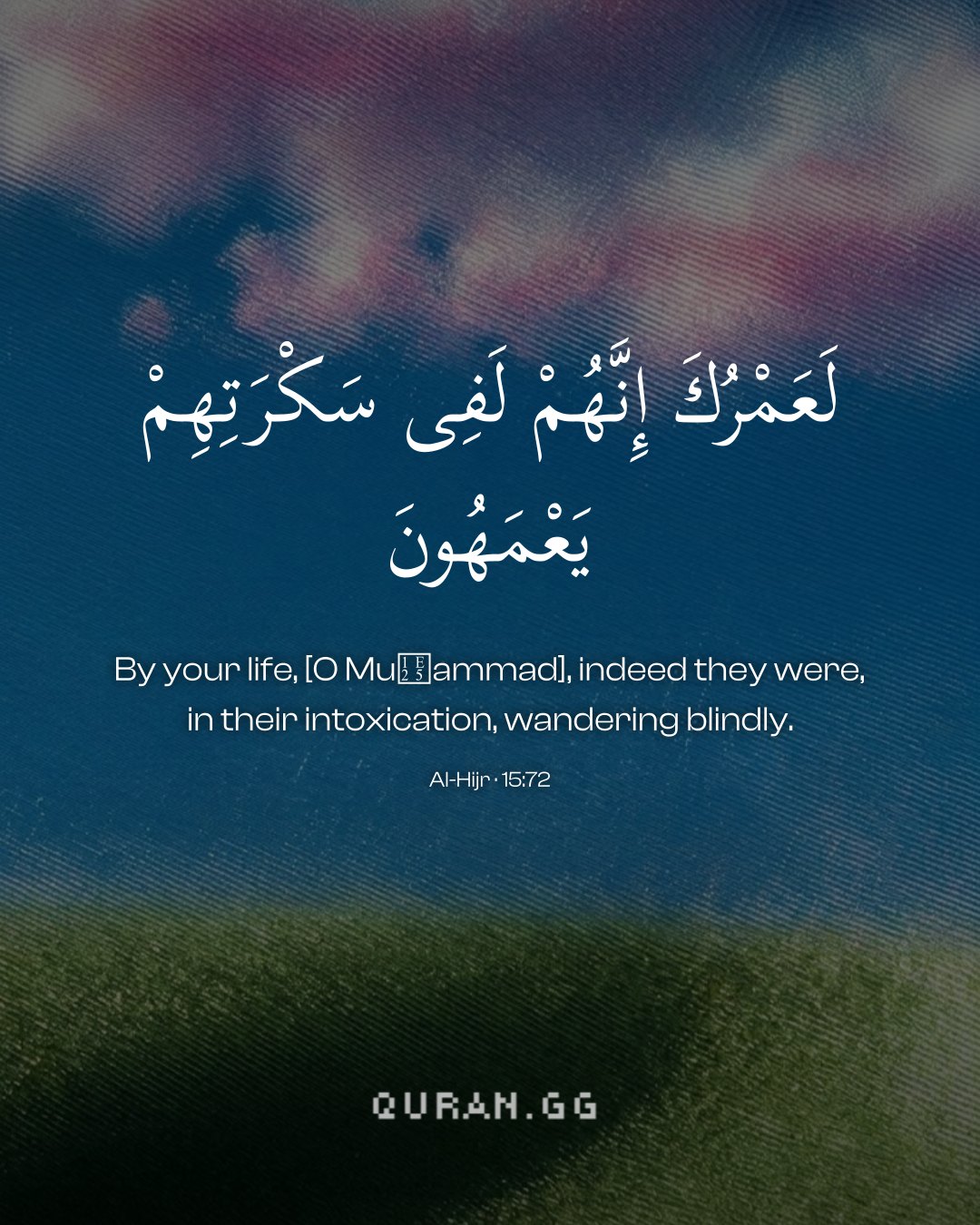
The People of the City arrive upon the Angels, thinking that they are Men
Allah tells us about how Lut's people came to him when they found out about his handsome guests, and they came happily rejoicing about them.
قَالَ إِنَّ هَـؤُلآءِ ضَيْفِى فَلاَ تَفْضَحُونِ - وَاتَّقُواْ اللَّهَ وَلاَ تُخْزُونِ
(Lut said: "Verily, these are my guests, so do not shame me. And have Taqwa of Allah, and do not disgrace me.") This is what Lut said to them before he knew that his guests were messengers from Allah, as mentioned in Surat Hud, but here (in this Surah), we have already been told that they are messengers from Allah, and this is followed by an account of Lut's people coming and his exchange with them. However, here the conjunction (wa, meaning "and") does not imply the sequence of events, especially since there is something to indicate that this is not the case. They said answering him,
Continue reading the tafsir of ayahs 67–72 Commentary
A Great Honour for the Holy Prophet ﷺ
About the word of Allah: لَعَمرُکَ (la'amruk : By your life), the majority of commentators, as reported in Ruh al-Ma’ ani, have said that the addressee of 'la'amruka' is the Holy Prophet ﷺ . It is his life that Allah Ta’ ala has sworn by. Al-Baihaqi in Dala'ilun-Nubuwwah, and Abu Nu'aym, Ibn Marduwayh and others have reported from Sayyidna ` Ab-dullah ibn ` Abbas ؓ that Allah Ta’ ala has not bestowed on anyone in the whole creation an honour and rank higher than that of Sayyidna Muhammad al-Mutafa ﷺ . This is the reason why Allah Ta’ ala has never sworn by the life of any prophet or angel, while in this verse, He has sworn by the age and life of the Holy Prophet ﷺ - which is the highest conceivable honour and deference accorded to him.
Swearing by Non-Allah
To swear by anyone or anything, other than the names and attributes of Allah Ta` ala, is not permissible for any human being because one would only swear by whoever is held in the highest of esteem - and, as obvious, Allah alone can be the highest.
According to Hadith, the Holy Prophet ﷺ said: Do not swear by your mothers, fathers and idols. And do not swear by anyone except Allah - and if you have to swear by Allah, do it only when you are truthful in your statement. (Reported by Abu Dawud and An-Nasa'i from Sayyidna Abu Hurairah~aow )
It appears in the Sahihayn (the Sahih of Al-Bukhari and the Sahih of Muslim) that the Holy Prophet ﷺ once saw Sayyidna ` Umar ibn al-Khattab ؓ swearing by his father. He called out to him and said: 'Watch out! Allah Ta’ ala forbids swearing by fathers. Whoever has to take an oath, let him do it in the name of Allah, otherwise, let him be silent. (Al-Qurtubi under the commentary on Surah al-Ma'idah)
But, this injunction applies to Allah's creation in general. As for Allah Ta’ ala Himelf, He swears by different things He has created. This is particular to Him. Its purpose is to state the sublimity and beneficence of something from the desired angle. Then, the cause of forbidding common people from swearing by anyone other than Allah is not present here - because, in the Word of Allah there is no probability that He would take someone from His creation to be the highest and the best. Again, the reason is that absolute greatness is particular only with Allah Ta’ ala.
This means that ‘here are the young girls of the city for you to marry’. When Lot saw that, in spite of his opposition, the rogues were rushing upon his guests, he said, ‘For God’s sake! Please don’t dishonour me in the eyes of my guests. If at all you want to do something, here are the daughters of the community. You can marry any of them you like.’
Uthmani text of the Madinah mushaf (King Fahd Complex). Translation: Saheeh International. Tafsir via Quran.com.