There is a Difference between a Believer and a Muslim
Allah chastises the bedouins who, when they embraced Islam, claimed for themselves the grade of faithful believers. However, Faith had not yet firmly entered their hearts,
(The bedouins say: "We believe." Say: "You do not believe, but say, `We have submitted,' for Faith has not yet entered your hearts...") This honorable Ayah provides proof that Faith is a higher grade than Islam, according to the scholars of the Ahl us-Sunnah wal-Jama`ah. This is also demostrated in the Hadith of Jibril, peace be upon him, when he questioned the Prophet about Islam, then Iman then Ihsan. Thus moving the general matter to one more specific, then even more specific. Imam Ahmad recorded that `Amir bin Sa`d bin Abi Waqqas said, "The Messenger of Allah ﷺ gave (something to) some men and did not give one of them. Sa`d said, `O Allah's Messenger, you gave to so-and-so and so-and-so. However, you gave nothing to so-and-so, even though he is a believer.' The Prophet said,
In the preceding verses of the Surah it was stated that the basis of honour in the sight of Allah is righteousness which is an inner quality, and Allah alone knows it. It is improper for any man to claim self-sanctification. In the current set of verses, it is stated, on account of a particular incident, that the real basis of faith is the inner acceptance of the heart. Mere lip-service to faith does not count the person as a faithful believer. In the entire Surah, first the rights of the Prophet were set out and then the rules of how to respect and honour him. Next the individual and collective rights and rules of mannerism were set down to be applied in social life. Now at the conclusion of the Surah it is reiterated that in the Hereafter good deeds will be accepted and rewarded on the basis of faith, sincere belief of the heart and obedience to Allah and His Messenger ﷺ .
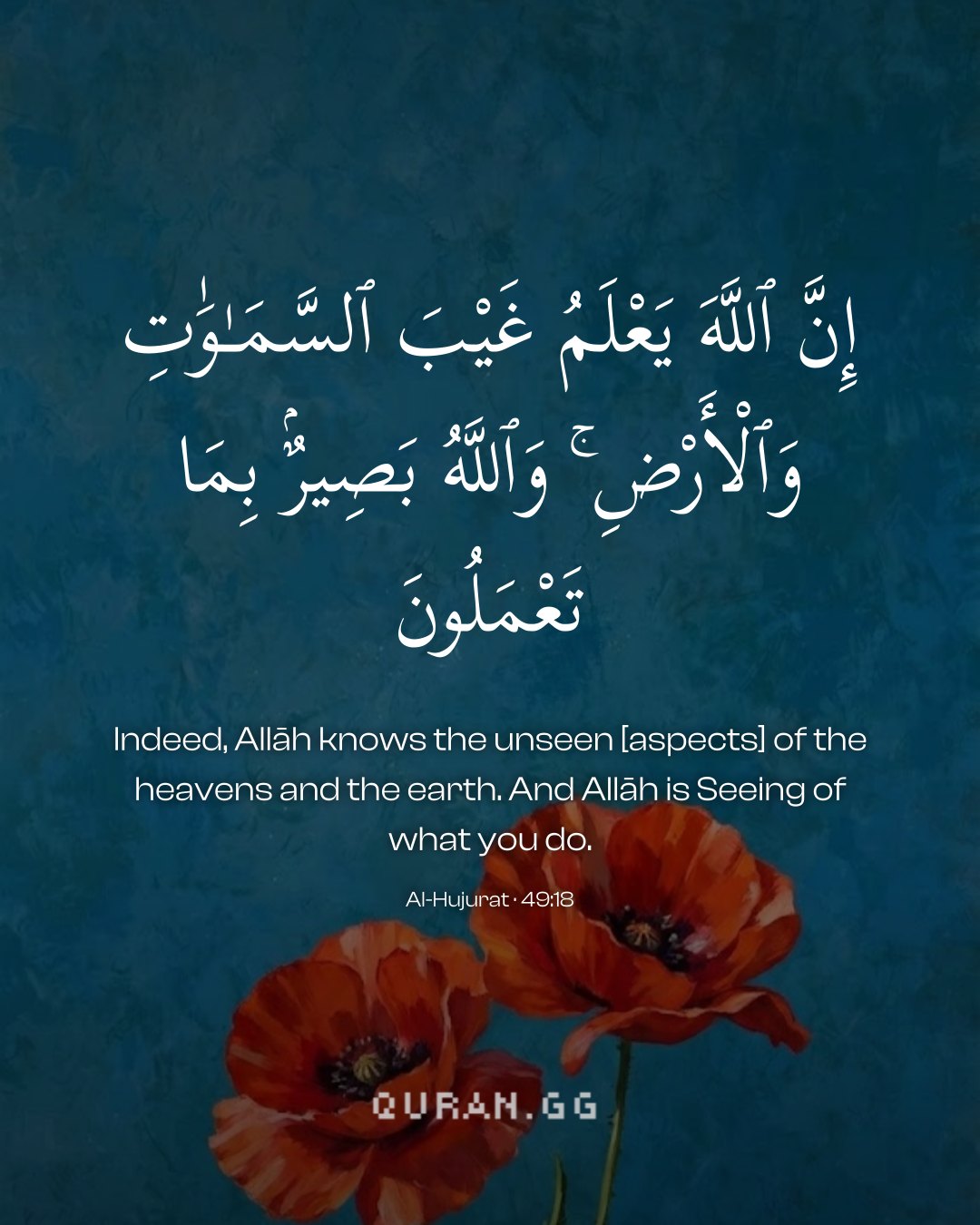
If anyone embraces Islam or some Islamic task is accomplished through him, he should realize that this has come about with the help of God. Faith and good deeds all depend on God’s directive guidance. So, whenever somebody is in a position to do something good, he should thank God for it. If, instead of so doing, the individual attempts to make his co-religionists feel obliged to him for what he has done, this would amount to his having acted not out of concern for God, but in order to figure well in the eyes of his fellow-men. God is directly aware of everything. One who performs any task for the sake of God, should firmly believe that God sees his work, and that there is no need to show it to Him.
Uthmani text of the Madinah mushaf (King Fahd Complex). Translation: Saheeh International. Tafsir via Quran.com.