It has been reported from `Ali, Ibn `Abbas, `Ubadah bin As-Samit, Abu Hurayrah, Shaddad bin Aws, Ibn `Umar, Muhammad bin `Ali bin Al-Husayn, Makhul, Bakr bin `Abdullah Al-Muzani, Bukayr bin Al-Ashaj, Malik, Ibn Abi Dhi'b, and `Abdul-`Aziz bin Abi Salamah Al-Majishun, they all said, "Ash-Shafaq is the redness (in the sky).`Abdur-Razzaq recorded from Abu Hurayrah that he said, "Ash-Shafaq is the whiteness." So Ash-Shafaq is the redness of the horizon, either before sunset, as Mujahid said or after sunset, as is well known with the scholars of the Arabic Language. Al-Khalil bin Ahmad said, "Ash-Shafaq is the redness that appears from the setting of sun until the time of the last `Isha' (when it is completely dark). When that redness goes away, it is said, `Ash-Shafaq has disappeared."' Al-Jawhari said, "Ash-Shafaq is the remaining light of the sun and its redness at the beginning of the night until it is close to actual nighttime (darkness)." `Ikrimah made a similar statement when he said, "Ash-Shafaq is that what is between Al-Maghrib and Al-`Isha'." In the Sahih of Muslim, it is recorded from `Abdullah bin `Amr that the Messenger of Allah ﷺ said,
فَلَا أُقْسِمُ بِالشَّفَقِ وَاللَّيْلِ وَمَا وَسَقَ وَالْقَمَرِ إِذَا اتَّسَقَ (So, I swear by the twilight [ after sunset ], and by the night and what it envelops, and by the moon when it develops at the full...84:16-18) In these verses Allah takes oath by four phenomena and reinforces what was asserted in:
إِنَّكَ كَادِحٌ إِلَىٰ رَبِّكَ
'you have to work hard constantly to reach your Lord'
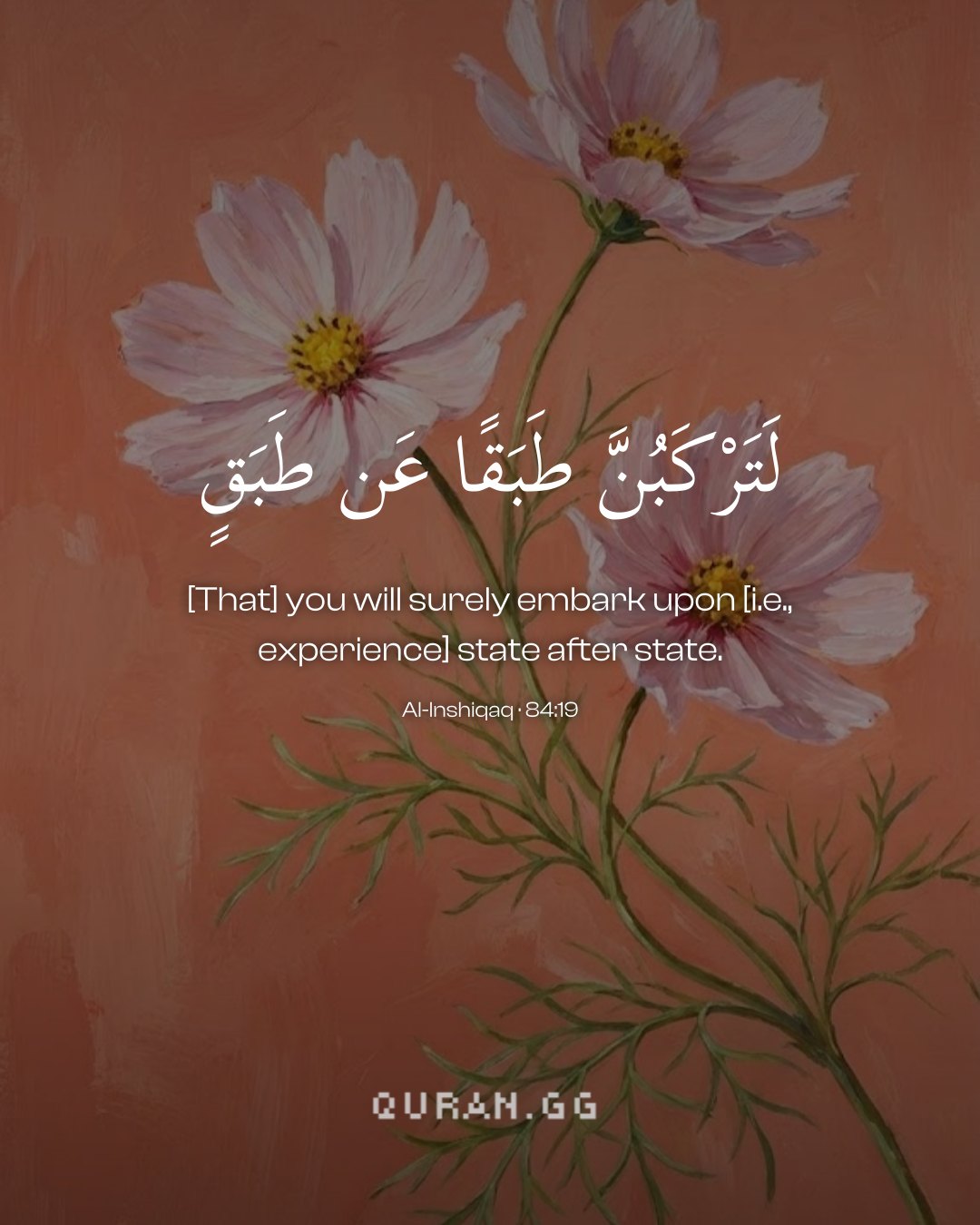
If we consider the four phenomena by which oath is taken, it bears evidence to the subject which is forthcoming in the complement of the oath, that is, the condition of man never remains the same at all times. He undergoes changes and unexpected phases all the time. The first phenomenon that brings about a change in his life is the twilight after the sunset, or the red glow that remains on the west side of the sky after the sunset in the evening. This is the beginning of the night. This is the harbinger of a massive change in human conditions, that is, the light is disappearing and a flood of darkness is setting in. The second phenomenon by which oath is taken is night itself which completes the change in his life. The third phenomenon by which oath is taken includes all things that night envelops or shrouds. The primitive sense of the word wasaqa means to 'pile, gather, heap up the thing'. If it is taken in general sense, it embraces every member of the entire universe which the darkness of night covers, such as animals, vegetation, minerals and inorganic matter, mountains and oceans. By extension, the word would comprehend all things that normally disperse in the light of day and retreat to their own places at night. Human beings return to their homes, animals to their habitats and birds to their nests. Business goods and merchandise are or piled up in one place. This massive change is related to man himself. The fourth phenomenon by which oath is taken is in the following verse: وَالْقَمَرِ إِذَا اتَّسَقَ (and by the moon when it develops at the full...84:18). The word ittisaq is also derived from wasaqa and it means 'to gather'. The 'gathering of moon' signifies that it gathered its light, and it became complete and full [ badr ] the moon of the 14th night. The phrase إِذَا اتَّسَقَ , idhat-tasaqa in relation to moon points to the phenomenon that it goes through various phases. First, it appears as a very fine semicircle. Then its light grows progressively night after night, until it becomes badr kamil [ full moon of the 14th night ]. Having taken oath by the vicissitudes of the four phenomena, the Surah asserts the subject: لَتَرْكَبُنَّ طَبَقًا عَن طَبَقٍ (you shall certainly ascend from stage to stage....84:19) The word tabaq or tabqah refers to a 'stage'. Its plural is tabaqat. The verb لَتَرْكَبُنَّ latarkabunna is derived from rukub which means 'to mount or mount up'. The verse purports to say that mankind from the inception to the end of his life will continue to mount up stage by stage, or will pass through all the conditions, gradually and in stages referred to in the preceding verses, that is, periods of light and darkness and other phenomena. He never remains in one condition all the time. He gradually goes through the vicissitudes of life.
Whatever is related here about Doomsday refers apparently to an unknown world. However, such evidence exists as points to its veracity. An example of this is the present world itself. The very existence of the world proves that another similar or different world may come into existence. Furthermore, certain extraordinary aspects of the Quran prove that it is the Book of God. (For details see The Quran: An Abiding Wonder and The Call of the Quran by the commentator).
Uthmani text of the Madinah mushaf (King Fahd Complex). Translation: Saheeh International. Tafsir via Quran.com.