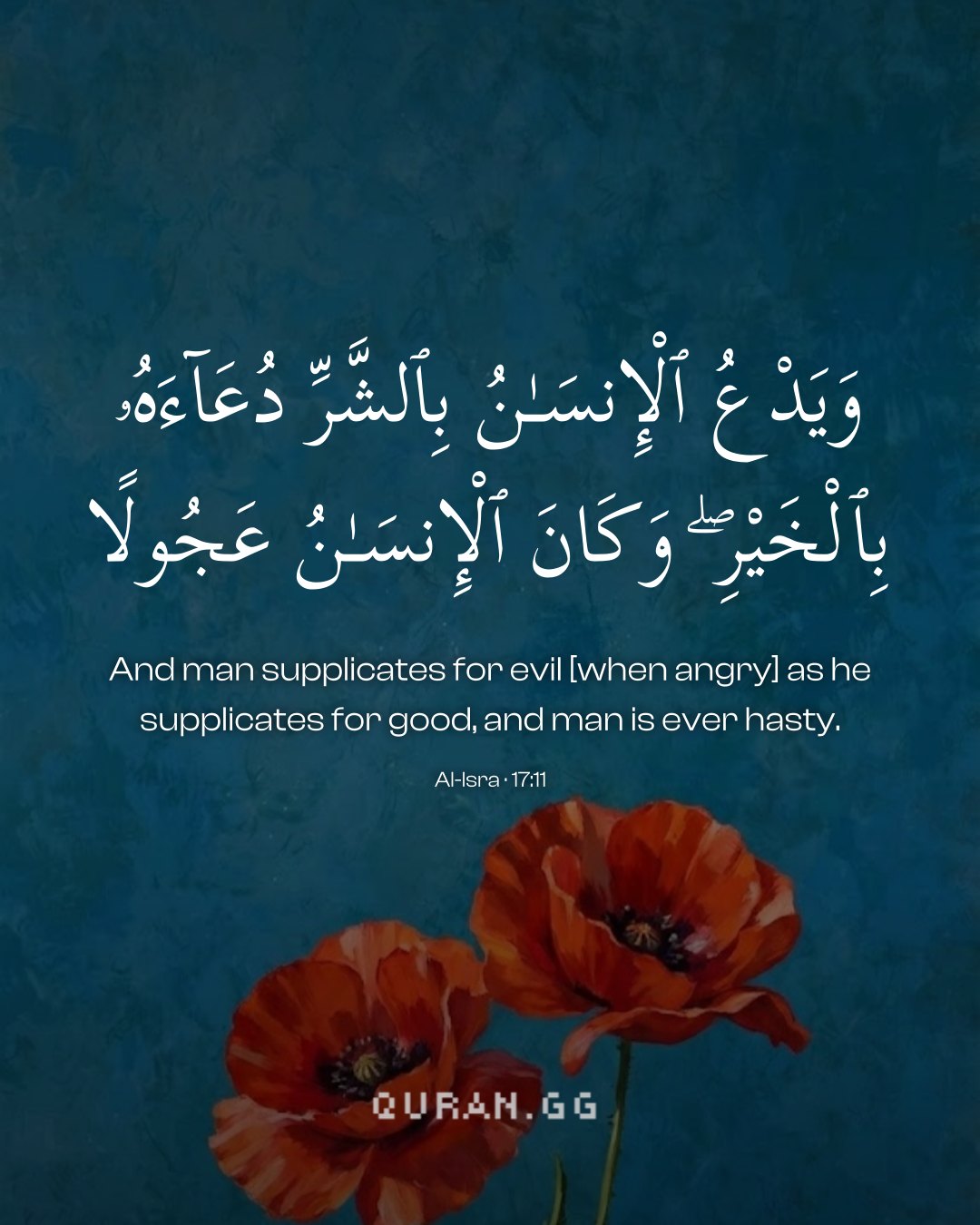
Allah tells us about man's haste and how he sometimes prays against himself or his children or his wealth, praying for something bad to happen for them, or for them to die or be destroyed, invoking curses, etc. If Allah were to answer his prayer, he would be destroyed because of it, as Allah says:
وَلَوْ يُعَجِّلُ اللَّهُ لِلنَّاسِ الشَّرَّ
(And were Allah to hasten for mankind the evil...) 10:11 This is how it was interpreted by Ibn `Abbas, Mujahid and Qatadah. We have already discussed the Hadith:
(Do not pray against yourselves or your wealth, for that might coincide with a time when Allah answers prayers.) What makes the son of Adam do that is his anxiety and haste. Allah says:
وَكَانَ الإِنْسَـنُ عَجُولاً
(And man is ever hasty.) Salman Al-Farisi and Ibn `Abbas mentioned the story of Adam, when he wanted to get up before his soul reached his feet. When his soul was breathed into him, it entered his body from his head downwards. When it reached his brain he sneezed, and said, "Al-Hamdu Lillah" (praise be to Allah), and Allah said, "May your Lord have mercy on you, O Adam." When it reached his eyes, he opened them, and when it reached his body and limbs he started to stare at them in wonder. He wanted to get up before it reached his feet, but he could not. He said, "O Lord, make it happen before night comes."
Ma'arif al-Qur'an
Mufti Muhammad Shafi
Perhaps, it is based on this congruity that it was said in verse 11 that man would, on occasions, pray for something in a haste, something that spells out destruction for him. If Allah Ta` ala were to answer such a prayer, he would be ruined. But, Allah Ta’ ala does not answer such prayers instantly until man himself comes to realize that his prayer was made in error and that it was fatal for him. Then, in the last sentence of this very verse, a natural weakness of man has been mentioned in the form of a standing rule - that man is, by nature, haste-prone. He keeps his sight trained on passing profit and loss and falls short on foresight and hindsight. He loves to go for the immediate gain and comfort, even if it happens to be only a little. He would not bat an eye to prefer it to the greater and more lasting gain and comfort. In short, this verse points out to a natural weakness of human beings in general.
And some authorities in Tafsir have taken this verse to be related to a particular event. The event they refer to concerns Nadr ibn Harith who had made a prayer in the heat of his hostility to Islam saying:
O Allah, if this [ Islam ] is the truth from You, then, rain down on us rocks from the skies or send upon us some other painful punishment.
In that case, 'al-insan' of the text would be referring to those mentioned above, or those like them.
Tazkirul Quran
Maulana Wahiduddin KhanOn ayahs 10–11
The Quran calls upon all human beings to accept the Oneness of God, or tawhid, that is, belief in the one God and surrender to His will. It can truly be said that no other matter can be more correct, more reasonable and more natural. Undoubtedly, the Oneness of God is the greatest reality and also the greatest truth. This position of the Oneness of God necessarily makes it the standard by which all human beings should be tested and the basis on which some should be treated as right and others as wrong, some as successful and others as failures. But, in the present world this standard is seemingly not upheld and the testing of human beings is not, apparently, done on this basis. But this is due only to God’s hidden way of applying His law of testing. For individuals, death, and for the general mass of the people, the Day of Judgement are the final limits of the test period. As soon as this limit is reached, human beings will be separated into two different groups: those who believed in one God in the full sense, and met all the demands of that belief, will find themselves in paradise, while those who did not, will find themselves in hell.
Uthmani text of the Madinah mushaf (King Fahd Complex). Translation: Saheeh International. Tafsir via Quran.com.