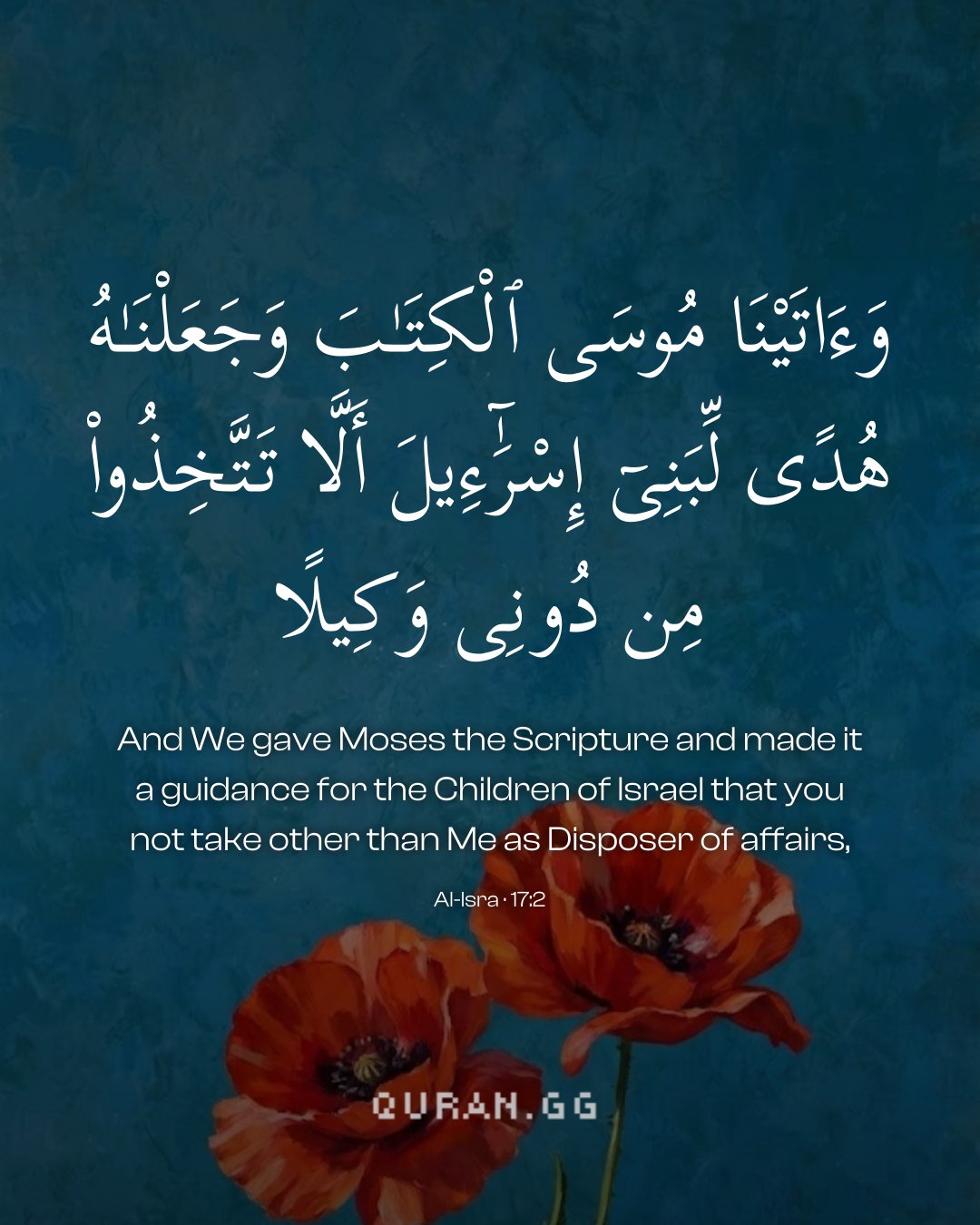
Musa and how He was given the Tawrah
When Allah mentions how He took His servant Muhammad ﷺ, on the Journey by Night, He follows it by mentioning Musa, His servant and Messenger who also spoke with Him. Allah often mentions Muhammad ﷺ and Musa (AH.) together, may the peace and blessings of Allah be upon them both, and he mentions the Tawrah and the Qur'an together. So after mentioning the Isra', He says:
وَءَاتَيْنَآ مُوسَى الْكِتَـبَ
(And We gave Musa the Scripture), meaning the Tawrah.
وَجَعَلْنَاهُ
(and made it), meaning the Scripture,
هُدًى
(a guidance), meaning a guide,
لِّبَنِى إِسْرَءِيلَ أَلاَّ تَتَّخِذُواْ
(for the Children of Israel (saying): "Take none...") means, lest they should take,
مِن دُونِى وَكِيلاً
("... other than Me as (your) Wakil") means, `you have no protector, supporter or god besides Me,' because Allah revealed to every Prophet that he should worship Him alone with no partner or associate. Then Allah says:
ذُرِّيَّةَ مَنْ حَمَلْنَا مَعَ نُوحٍ
(O offspring of those whom We carried (in the ship) with Nuh) by addressing the descendants of those who were carried in the ship with Nuh there is a reminder of the blessings, as if Allah is saying: `O descendants of those whom We saved and carried in the ship with Nuh, follow in the footsteps of your father,
إِنَّهُ كَانَ عَبْدًا شَكُورًا
(Verily, he was a grateful servant). `Remember the blessing I have granted you by sending Muhammad ﷺ.' Imam Ahmad reported that Anas bin Malik said: "The Messenger of Allah ﷺ said:
«إِنَّ اللهَ لَيَرْضَى عَنِ الْعَبْدِ أَنْ يَأْكُلَ الْأَكْلَةَ أَوْ يَشْرَبَ الشَّرْبَةَ فَيَحْمَدَ اللهَ عَلَيْهَا»
(Allah will be pleased with His servant if, when he eats something or drinks something, he praises Allah for it.)" This was also recorded by Muslim, At-Tirmidhi and An-Nasa'i. Malik said about Zayd bin Aslam: "He used to praise Allah in all circumstances." In this context, Al-Bukhari mentioned the Hadith of Abu Zar`ah narrating from Abu Hurayrah, who said that the Prophet said:
«أَنَا سَيِّدُ وَلَدِ آدَمَ يَوْمَ الْقِيَامَة»
(I will be the leader of the sons of Adam on the Day of Resurrection...) He quoted the Hadith at length, and in the Hadith, the Prophet said:
«فَيَأْتُونَ نُوحًا فَيَقُولُونَ: يَا نُوحُ إِنَّكَ أَنْتَ أَوَّلُ الرُّسُلِ إِلَى أَهْلِ الْأَرْضِ، وَقَدْ سَمَّاكَ اللهُ عَبْدًا شَكُورًا، فَاشْفَعْ لَنَا إِلَى رَبِّك»
(They will come to Nuh and will say, `O Nuh, you were the first of the Messengers sent to the people of earth, and Allah called you grateful servant, so intercede for us with your Lord.') And he quoted the Hadith in full.
Commentary
Described in this verse is the event of Mi` raj (the Ascent to the heavens, or al-'Isra', the midnight journey of the Holy Prophet ﷺ which is a signal honor and distinctive miracle of our Messenger of Allah ﷺ). The word: أَسْرَىٰ (asra) is a derivation from: اِسْرَىٰ (isra' ) which literally means to make someone travel at night. After that, the introduction of the word: لَيْلًا (lailan) also makes this sense very clear. Then, by placing this word as a common noun, the indication released was that during this event the time spent was that of a part of the night - not even that of the whole night. The journey from al-Masjid al-Haram to al-Masjid al-Aqsa mentioned in this verse is called al-'Isra' and the name of the journey from here to the seven heavens is al-Mi` raj. Isra' stands proved under the definitive textual authority of this verse and the Mi` raj finds mention in the verses of Surah an-Najm and is proved by Ahadith appearing in an uninterrupted succession. The word: بِعَبْدِهِ (bi'abdihi: His servant) used here for the Holy Prophet ﷺ is special. It shows that, in this magnificent setting of honor and welcome, when Allah Ta’ ala, on His own, elects to call someone His servant', a unique bond of love lies embedded therein and that this is the highest honor any man could ever have.
Continue reading the tafsir of ayahs 1–3 One year before the migration (hijrah) of the Prophet Muhammad to Madinah, the conditions at Makkah were extremely adverse. It looked as if the history of Islam might come to an end even before it could take any definite shape. At that very juncture, God arranged to show the Prophet a very great sign—a demonstration, in fact, that Islamic history would not only run its due course, but that certain conditions would also be created to ensure that what it brought to the world would be preserved and thus remain eternally alive. This was because it had to become the authentic source of God’s religion for all nations till the Day of Judgement. God so willed that the Prophet Muhammad be taken from Makkah to al-Masjid al-Aqsa in Palestine (Jerusalem). This was the first stage of a journey (mi‘raj), which was spiritual rather than physical, in nature. Here, at al-Masjid al-Aqsa, God had also gathered all the previous prophets. Together, they engaged in congregational prayer, with the Prophet Muhammad leading them. This instance of the Prophet Muhammad leading the prayer symbolized God’s decision that the shariah of the previous prophets were no longer an authentic source of divine guidance. Now, all the nations should have to draw upon the religion presented by the Prophet Muhammad in order to have the authentic knowledge of God’ religion. For this important happening, which came to be known as The Night Journey, or isra’, Palestine was the most suitable place, its having been the centre from which the majority of the previous prophets had issued their call of Truth. Hence God’s selection of this particular area to announce His decision.
Continue reading the tafsir of ayahs 1–2 Uthmani text of the Madinah mushaf (King Fahd Complex). Translation: Saheeh International. Tafsir via Quran.com.