The Command to maintain the Ties of Kinship and the Prohibition of Extravagance
When Allah mentions honoring one's parents, He follows this with the command to treat one's relatives well and to maintain the ties of kinship. According to the Hadith:
«أُمَّكَ وَأَبَاكَ، ثُمَّ أَدْنَاكَ أَدْنَاك»
وفي رواية
«ثُمَّ الْأَقْرَبَ فَالْأَقْرَب»
(Your mother and your father, then your closest relatives and the next closest.) According to another Hadith:
(Whoever would like to see his provision expanded and his life extended, let him maintain his ties of kinship.)
وَلاَ تُبَذِّرْ تَبْذِيرًا
(But spend not wastefully (your wealth) in the manner of a spendthrift.) When Allah commands spending, He forbids extravagance. Spending should be moderate, as stated in another Ayah:
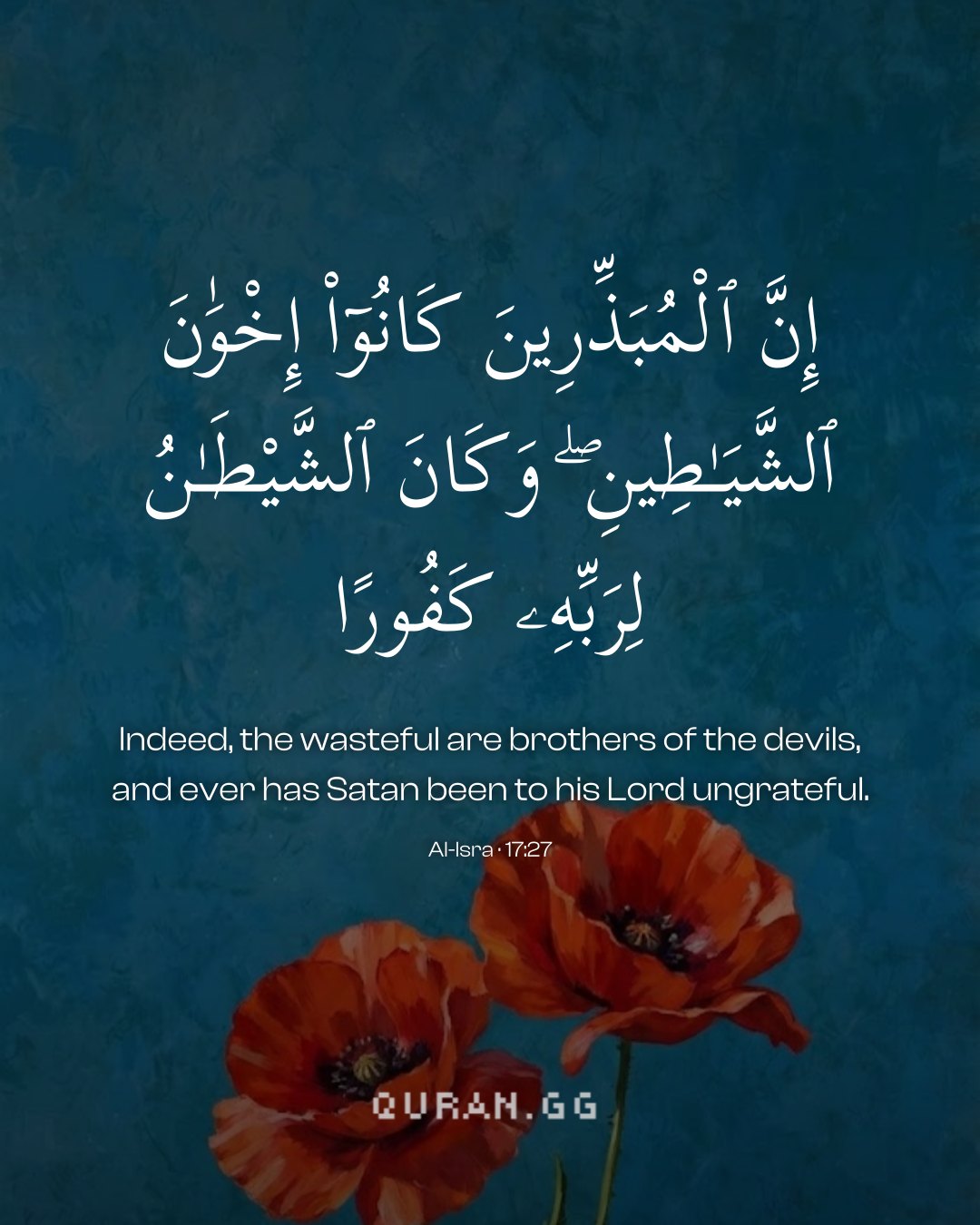
The Qur'an expresses the sense of spending wastefully through two words: (1) Tabdhir (تَبذیر), translated as 'squandering recklessly.' (2) Israf (اِسرِاف): extravagance. The prohibition of tabdhir is already clear in verse 26 here. The prohibition of israf has its proof in the verse of Surah al-A` raf: وَلَا تُسْرِفُوا (and do not be extravagant - 7:31). Some commentators say that both words are synonymous. Any spending in sin or disobedience or a wrong occasion or place is called tabdhir and israf. There are others who refine it by saying that tabdhir is spending in sin or on some totally unsuitable occasion or place, while israf is spending beyond the level of need on an occasion where it is permissible to spend. Therefore, tabdhir is emphatically worse than israf. Al-Mubadhdhirin (the squanderers) were called brothers to Shaitan and his cohorts.
Of the early Tafsir authorities, Mujahid has said: If someone spends everything he has for the sake of what is haqq, (incumbent), it is no tabdhir (squandering recklessly) - and should he spend even one mudd (1/2 kilo) for what is false (non-incumbent), then it is tabdhir. Sayyidna ` Abdullh ibn Masud ؓ said: Spending out of place in what one has not been obligated with is tabdhir. (Mazhari) Imam Malik said: Tabdhir is that one acquires wealth and property, lawfully and cleanly, as he has been obligated to do, but spends it off in ways counter to it - and this is also given the name of israf (extravagance), which is Haram (unlawful).
Imam al-Qurtubi (رح) said: As for things unlawful and impermissible, spending even one dirham for these is tabdhir. And spending limitlessly to fulfill permissible and allowed desires - which exposes one to the danger of becoming a needy beggar in the future - is also included under tabdhir. Yes, if someone keeps his real capital holdings in tact and goes on to spend its profit liberally to fulfill his permissible desires, then, that is not included under tabdhir. (AI-Qurtubi, v. 10, p. 248)
Tazkirul Quran
Maulana Wahiduddin KhanOn ayahs 25–27
For the human being God is everything. He is his Creator, Lord and Sustainer. But God remains in the unseen, He does not come before man to gain recognition. This means that when one acknowledges one’s helplessness vis-à-vis the greatness of God, one does so out of choice rather than as a result of some visible compulsion. In this respect, the case of elderly parents is somewhat similar in nature to that of God. The parents have no material power over their children. When the children treat their parents well, they do it of their own free will and not because of any material pressures. This is the real test of man in the present world. Here he has to adopt the way of truth and justice, without being forced to do so. He has to perform of his own free will and at his pleasure such deeds as he would perform if God appeared before him in all His Omnipotence. Such voluntary action poses a serious test for man. However, God has made it easy for man by his special Grace. He does not test man with the severity of a master who becomes overly exercised about petty things. If a man is basically loyal to God, He excuses his petty lapses. If a man turns over a new leaf after doing something wrong, He pardons him, regardless of how great a sin he may have committed.
Uthmani text of the Madinah mushaf (King Fahd Complex). Translation: Saheeh International. Tafsir via Quran.com.