Refutation of Those Who claim that the Angels are Daughters of Allah
Allah refutes the lying idolators who claim, may the curse of Allah be upon them, that the angels are the daughters of Allah. They made the angels, who are the servants of Ar-Rahman (the Most Beneficent), females, and called them daughters of Allah, then they worshipped them. They were gravely wrong on all three counts. Allah says, denouncing them:
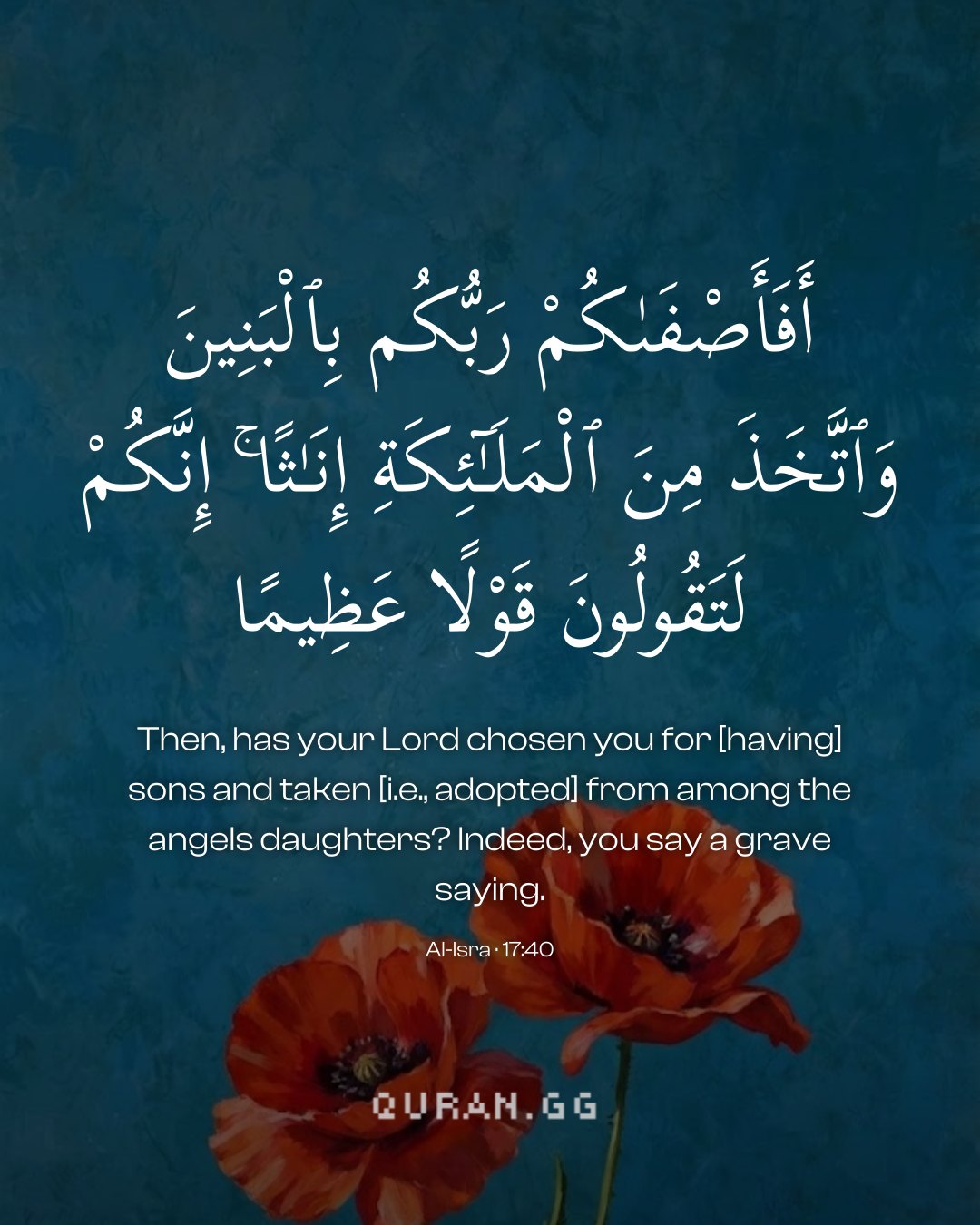
أَفَأَصْفَـكُمْ رَبُّكُم بِالْبَنِينَ
(Has then your Lord preferred for you sons,) meaning, has He given only you sons
وَاتَّخَذَ مِنَ الْمَلَـئِكَةِ إِنَاثًا
(and taken for Himself from among the angels daughters) meaning, has He chosen for Himself, as you claim, daughters Then Allah denounces them even more severely, and says:
إِنَّكُمْ لَتَقُولُونَ قَوْلاً عَظِيمًا
(Verily, you indeed utter an awful saying.) meaning, in your claim that Allah has children, then you say that His children are female, which you do not like for yourselves and may even kill them by burying them alive. That is indeed a division most unfair! Allah says:
(And they say: "The Most Beneficent (Allah) has begotten a child." Indeed you have brought forth (said) a terrible evil thing. Whereby the heavens are almost torn, and the earth split asunder, and the mountains fall in ruins. That they ascribe a son child to the Most Beneficent. But it is not suitable for (the majesty of) the Most Beneficent that he should beget a child. There is none in the heavens and the earth but comes unto the Most Beneficent as a servant. Verily, He knows each one of them, and has counted them a full counting. And every one of them will come to Him alone on the Day of Resurrection.) (19:88-95)
Ma'arif al-Qur'an
Mufti Muhammad ShafiOn ayahs 38–41
After having described details of the injunctions appearing above, it was said in the last verse: كُلُّ ذَٰلِكَ كَانَ سَيِّئُهُ عِندَ رَبِّكَ مَكْرُوهًا (That which is evil, of all these, is detestable in the sight of your Lord - 38).
As for what has been forbidden in the said injunctions, their repugnance is obvious. But, within these there are some commandments where rights of parents and relatives have been enjoined or fulfillment of promises has been made mandatory. Here too, the purpose is to avoid doing the opposite of it, like hurting parents, breaking off from relatives and going back on solemn promises. Since all these things are haram or reprehensible, therefore, it has been called 'makruh' in a general sense of 'detestable' which includes the haram and makruh both. (Bayan al-Qur an)
Note
The injunctions described in the fifteen verses cited above are, in a way, the explanation of the effort acceptable in the sight of Allah mentioned in: وَسَعَىٰ لَهَا سَعْيَهَا (and makes effort for it as due - 19). There it was said that not every effort is acceptable with Allah. Instead, the effort made in accordance with the Sunnah and teaching of the Holy Prophet ﷺ is the only one acceptable with Him. Main divisions of such acceptable effort have been mentioned in these injunctions which take up the rights of Allah first and then the rights of the servants of Allah.
A gist of Torah in fifteen verses
Sayyidna ` Abdullah ibn ` Abbas ؓ said that the commandments of the entire Torah have been reduced to fifteen verses of Surah Bani Isra'il. (Mazhari)
Tazkirul Quran
Maulana Wahiduddin KhanOn ayahs 39–43
The injunctions given in the above verses come under the heading of ‘wisdom’ (hikmah). The meaning of ‘wisdom’ here stands for the firm reality, the sound truths of life. It is on the foundations of these realities that the healthy life is built. A human society devoid of them can expect little else but annihilation both in the present and in the next life. The narration of the above-mentioned advice begins with the Oneness of God, or tawhid (verse 22) and finishes with the oneness of God (verse 39). This indicates that, for the foundation of all good deeds, man should believe in the one God. He should fear and love Him alone. The secret of a good life is concealed in the right relationship with God. If the relationship with God is not proper, no other thing can set right the affairs of human life. God is the beginning and the end of human life.
Uthmani text of the Madinah mushaf (King Fahd Complex). Translation: Saheeh International. Tafsir via Quran.com.