Refutation of Those Who do not believe in Life after Death
Allah tells us about the disbelievers who think it very unlikely that the Resurrection will happen and who say, in a tone of denial,
أَءِذَا كُنَّا عِظَـماً وَرُفَـتاً
(When we are bones and fragments.) meaning earth. This was the view of Mujahid. `Ali bin Abi Talhah reported from Ibn `Abbas that it means dust.
أَءِنَّا لَمَبْعُوثُونَ خَلْقاً جَدِيداً
(should we really be resurrected (to be) a new creation) meaning, on the Day of Resurrection after we have disintegrated and become nothing, and have been forgotten. Allah tells us about them elsewhere:
يَقُولُونَ أَءِنَّا لَمَرْدُودُونَ فِى الْحَـفِرَةِ - أَءِذَا كُنَّا عِظَـماً نَّخِرَةً - قَالُواْ تِلْكَ إِذاً كَرَّةٌ خَـسِرَةٌ
Continue reading the tafsir of ayahs 49–52Ma'arif al-Qur'an
Mufti Muhammad Shafi
Commentary
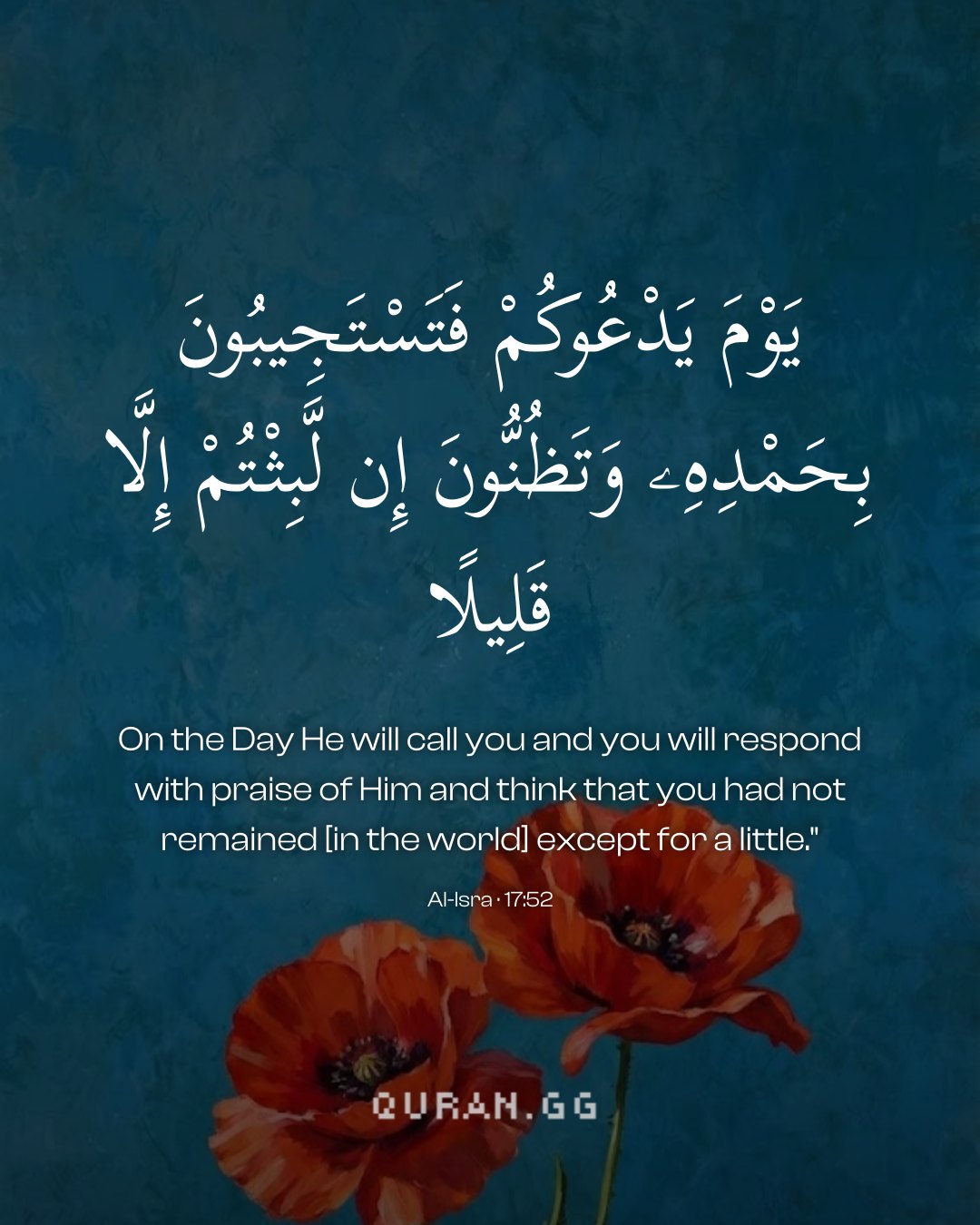
The word: يَدْعُوكُمْ (He will call you) in: يَوْمَ يَدْعُوكُمْ فَتَسْتَجِيبُونَ بِحَمْدِهِ (on a day when He will call you, and you will respond praising Him - 52) is a derivation from: دُعَاء (dua' ) which means to call out for someone by announcing it vocally. The sense is that the day when Allah Ta’ ala will call everyone to come to the plains of Resurrection, this calling will be through Angel Israfil. When he sounds the second trumpet, the dead will come alive and assemble on the plains of Resurrection. It is also possible that, once alive, a call goes through to all of them to assemble there. (Qurtubi)
In a Hadith, the Holy Prophet ﷺ said, "On the day of Qiyamah, you will be called out with your name and the name of your father, therefore, give yourself good names (avoiding the absurd ones)." (Qurtubi)
Even disbelievers will rise praising Allah on the day of Resurrection
The word: اِستِجَابَۃ (istijabah) in: فَتَسْتَجِيبُونَ بِحَمْدِهِ (and you will respond praising Him - 52) means to respond on being called by someone and be present before him. The sense is when you will be called to present your-selves on the plains of Resurrection, all of you will obey that call and assemble there. The word: بِحَمْدِهِ (bihamdihi: praising Him) is the state of the nominative pronoun in: تسْتَجِيبُونَ (tastajibun: you will respond) which releases the sense of hamidin (حَامِدِین) that is, those praising Him. Thus, the outcome is that all of them will present themselves praising Allah while coming to those fateful plains.
As outwardly obvious, the verse does seem to indicate that this will be the state of all, believers or disbelievers - they both will rise praising Allah. But, the real addressees here are the disbelievers. It is about them that it is being said they all will rise praising Allah. From among Tafsir authorities, Sayyidna Said ibn Jubayr has said that the disbelievers too will rise from their graves saying: سُبحَانَکَ وَ بِحَمدِکَ (Pure are You and to You belong all praises), but their act of praising at that hour will be of no use to them. (Qurtubi) The reason is not far to see. When these people see life after death, the words of praise for Allah will escape their mouth involuntarily. This will be no deed deserving recompense.
Some commentators have said that this state has been particularized with believers. They argue that, regarding the disbelievers, the Qur'an has only this to say: (1) When they rise, they will say, يَا وَيْلَنَا مَن بَعَثَنَا مِن مَّرْقَدِنَا (Woe be to us! Who made us rise from our resting-place? – Surah Ya Sin, 36:52). (2) And according to another verse, they will say, يَا حَسْرَتَىٰ عَلَىٰ مَا فَرَّطتُ فِي جَنبِ اللَّـهِ (0 my remorse [ is boundless ] over what I have neglected on the side of [ obedience to ] Allah! - Surah az-Zumar, 39:56).
But, the truth of the matter is that there is no likelihood of a contra-diction between these two sayings. May be, in the beginning, all rise praising. Later, when disbelievers are separated from believers as said in Surah Ya Sin: وَامْتَازُوا الْيَوْمَ أَيُّهَا الْمُجْرِمُونَ (But today, 0 criminals, you stand out distinctly apart - 36:59), they will also say what appears in the cited verses. Then, it stands proved from many explications of the Qur'an, and Sunnah that stations of Resurrection will be different with a corresponding difference in the states and conditions of people in each of these. Imam al-Qurtubi has said that rising in Resurrection will begin with the praise of Allah with everyone doing it when rising and on it will end all matters. This is as it was already said: وَقُضِيَ بَيْنَهُم بِالْحَقِّ وَقِيلَ الْحَمْدُ لِلَّـهِ رَبِّ الْعَالَمِينَ (And matters between them have been settled in accordance with the truth and it was said: All praise belongs to Allah, the Lord of the Worlds - az-Zumar, 39:75)
Tazkirul Quran
Maulana Wahiduddin Khan
Man’s first existence clearly proves the possibility of his second existence, or re-creation, on the Day of Judgement. One who believes in the first creation of man has no real argument to back up his denial of man’s second creation in the Hereafter. Furthermore, the concept of man’s second creation is not at all difficult to understand for those who regard human beings as an amalgam of material elements, for the cells in the human body keep on breaking down and being replaced by new ones. In this world known to us, man’s material existence is repeatedly terminated only to be rebuilt again and again through this continuous replacement of cells. In this way, man’s body continually renews itself. It is said that every ten years the cells in our body replace themselves and a new body comes into being. The truth is what we already believe in and comprehend before death through our knowledge of the functioning of cells, i.e. what we have time and again experienced before death. Doomsday is, in actual fact, the name of that day when the veil of the unseen is torn asunder and God in all His Power and Majesty appears before us. When this happens, the deniers will also be compelled to do what a true believer does today, namely, believe in God and life in the Hereafter. At that time all humanity will rush towards God in acknowledgement of His power and greatness.
Uthmani text of the Madinah mushaf (King Fahd Complex). Translation: Saheeh International. Tafsir via Quran.com.