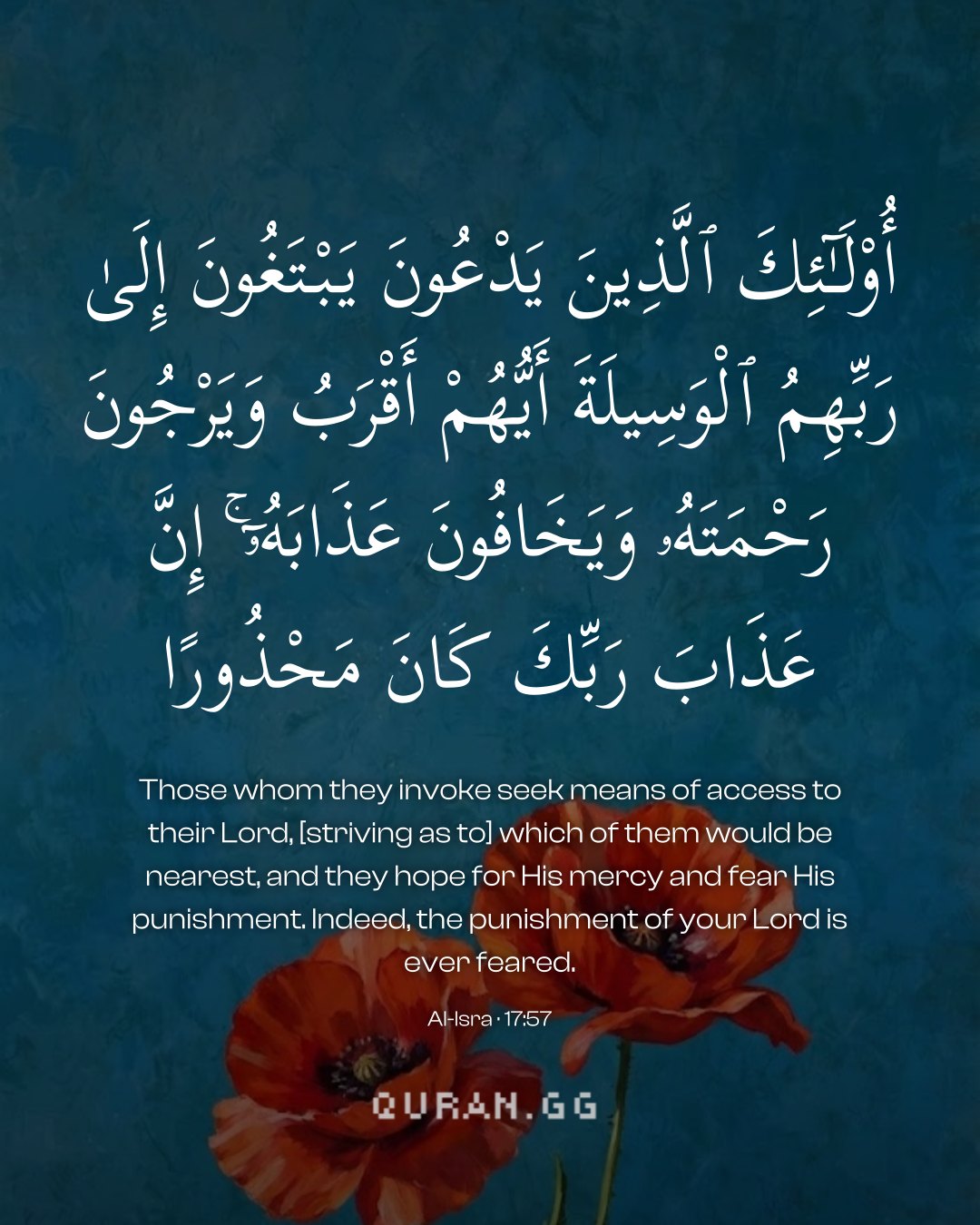
Those whom they invoke seek means of access to their Lord, [striving as to] which of them would be nearest, and they hope for His mercy and fear His punishment. Indeed, the punishment of your Lord is ever feared.
The gods of the Idolators can neither benefit nor harm; rather they themselves seek to draw close to Allah
Allah says:
قُلْ
(Say) O Muhammad to these idolators who worship things other than Allah,
ادْعُواْ الَّذِينَ زَعَمْتُم مِّن دُونِهِ
(Call upon those - besides Him whom you pretend.) such as idols and rivals of Allah. Even if you turn to them,
فَلاَ يَمْلِكُونَ كَشْفَ الضُّرِّ عَنْكُمْ
(They have neither the power to remove the adversity from you) they have no such power at all,
وَلاَ تَحْوِيلاً
(nor even to shift (it from you to another person.)) to lift the distress from you and give it to someone else. The meaning is that the only one Who is able to do that is Allah Alone, with no partner or associate, Who is the One Who creates and issues commands.
The word 'al-wasilah' in: يَبْتَغُونَ إِلَىٰ رَبِّهِمُ الْوَسِيلَةَ (seek the means of close ness to their Lord - 57) conveys the sense of that which is used as a means of reaching someone. As for reaching Allah, the wasilah or means is to always keep the pleasure of Allah in sight when learning or doing anything while adhering to the injunctions of the Shari` ah strictly. Thus, the sense of the sentence is that all of them are seeking the closeness of Allah Ta’ ala through their righteous deeds.
About the sentence which follows immediately after: يَرْجُونَ رَحْمَتَهُ وَيَخَافُونَ عَذَابَهُ (hope for His Mercy and fear His punishment - 57), Sahl ibn ` Abdullah said: Hope and Fear, that is, hoping for mercy from Allah as well as fearing Him are two different states one is in. When they stay at par, one keeps on course, correct and stable. And if any one of the two overcomes the other, one finds the equilibrium of his spiritual state subjected to disorder to the measure of that imbalance. (Qurtubi)
Tazkirul Quran
Maulana Wahiduddin KhanOn ayahs 55–57
When a preacher calls for the truth and his hearers pay no attention to him, then certainly the preacher becomes exasperated, especially when the truth is as clear as daylight. Sometimes, he is so irritated that he cannot but vent his anger on the addressees by saying that they are not going to receive God’s mercy. Such words as these do not befit a preacher. He does not have permission from God to utter such words. Conveying the message of truth is one thing and meting out the divine reward according to the response given to the call of truth, another. The first is the task of a preacher and the second, that of God. A preacher should never make the mistake of crossing the limits set for him by entering the sphere reserved for God. Similarly, it happens sometimes that the preacher and the addressees engage in arguments regarding which of their respective prophets is the superior one. The energies of each side are then spent on proving that their own prophet enjoys a higher status with God, with the result that the discussion, which should have been focused on the principles of the prophet’s message, is instead focused on personalities. This awakens in them feelings of prejudice and, as a result, places further obstacles in the path of the acceptance of the truth. Hence the explanation given in these verses that it is a matter pertaining to God as to what status He grants to His servants. What preachers have to do is avoid such heated discussions on irrelevant topics and convey the real message of truth to the people.
Uthmani text of the Madinah mushaf (King Fahd Complex). Translation: Saheeh International. Tafsir via Quran.com.