Tafsir Ibn Kathir (abridged)
Ismail ibn Kathir
Does not the Punishment of Allah come on Land too
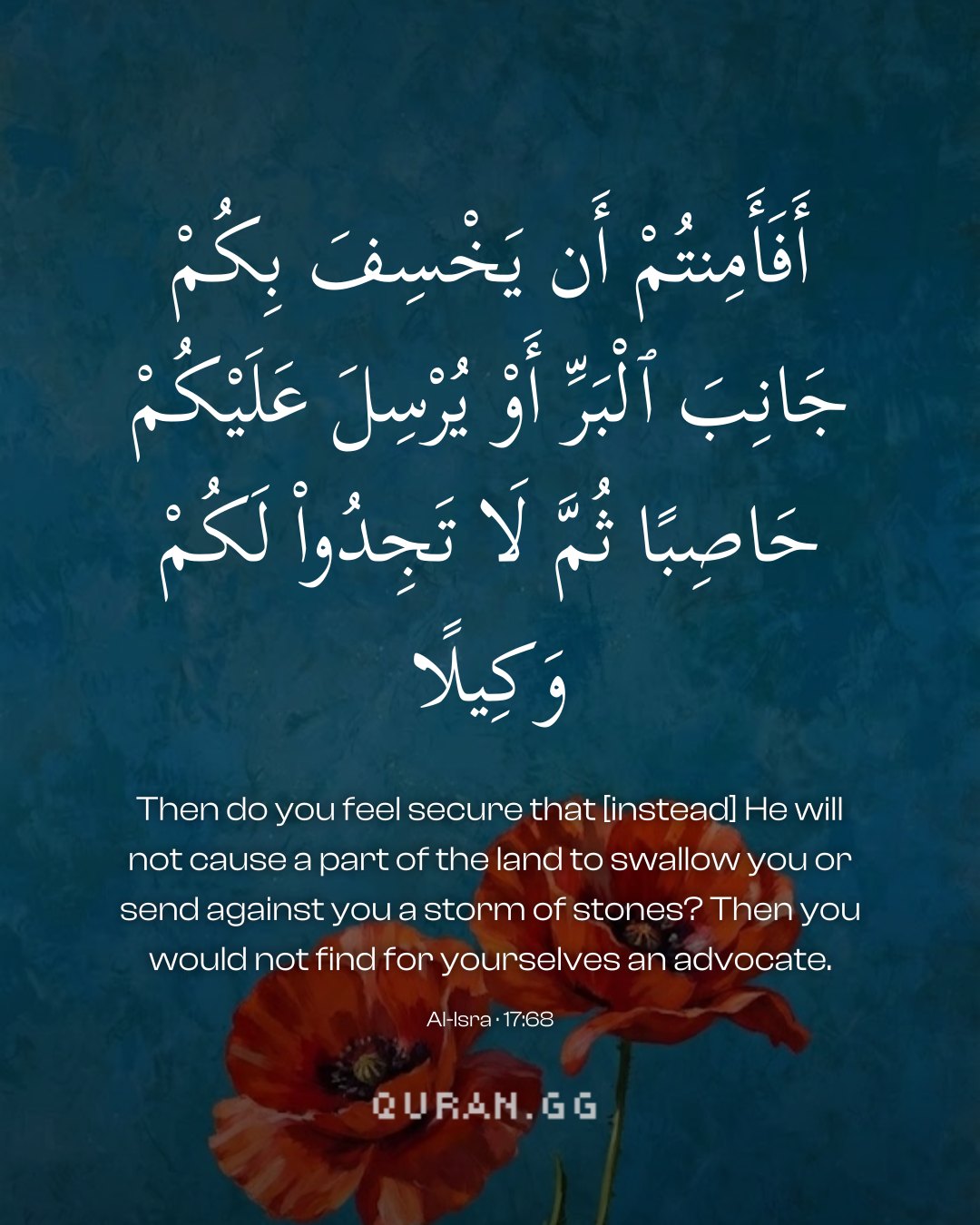
Allah says, do you think that by emerging onto dry land you will be safe from His vengeance and punishment, that a side of the land will not swallow you up or He will not send against you a Hasib - which is a kind of rain that carries stones This was the view of Mujahid and others. As Allah says:
إِنَّآ أَرْسَلْنَا عَلَيْهِمْ حَـصِباً إِلاَّ آلَ لُوطٍ نَّجَّيْنَـهُم بِسَحَرٍ نِّعْمَةً مِّنْ عِندِنَا
(Verily, We sent against them, except the family of Lut, them We saved in the last hour of the night, As a favor from Us.) (54:34-35) Elsewhere, Allah says:
وَأَمْطَرْنَا عَلَيْهَا حِجَارَةً مِّن سِجِّيلٍ مَّنْضُودٍ
(and We rained on them stones of Sijjil, in a well-arranged manner one after another)
أَءَمِنتُمْ مَّن فِى السَّمَآءِ أَن يَخْسِفَ بِكُمُ الاٌّرْضَ فَإِذَا هِىَ تَمُورُ - أَمْ أَمِنتُمْ مِّن فِى السَّمَآءِ أَن يُرْسِلَ عَلَيْكُمْ حَـصِباً فَسَتَعْلَمُونَ كَيْفَ نَذِيرِ
(Do you feel secure that He, Who is over the heaven (Allah), will not cause the earth to sink with you, and then it should quake Or do you feel secure that He, Who is over the heaven (Allah), will not send against you a Hasib Then you shall know how (terrible) has been My warning) (67: 16-17)
ثُمَّ لاَ تَجِدُواْ لَكُمْ وَكِيلاً
(Then, you shall find no guardian.) no helper to turn the punishment away from you and save you.
(2) Secondly, he had said if he was given respite till the day of Qiyamah, he will mislead the entire progeny of 'Adam, except a few of them. That Allah Ta’ ala has elected to answer in the later verses. He said that the Shaitan will have no control over His sincere servants even if he were to rally his entire forces against them and as for the insincere who fall into his trap, they will meet the same fate as his, all consigned to Hell. When this verse (64) mentions the horsemen and footmen of the Shaitanic army, it does not necessarily mean that the Shaitan actually has combat support in that formation. In fact, this is a manner of referring to the full force and power of the Shaitan. And if the Shaitan does have horsemen and footmen actually, even that too cannot be denied. Sayyidna ` Abdullah ibn ` Abbas ؓ said: Those who come out in support of disbelief and sin, horsemen or footmen, they are nothing but the army of the Shaitan. Now remains the question as to how the Shaitan came to know that he would succeed in enticing and misleading the progeny of 'Adam (علیہ السلام) ، the basis on which he claimed that he will subdue them. There are two possibilities. Perhaps, by looking at the ingredients that went into the making of man, he had gathered that man would be desire-prone and it would not be difficult to entice him successfully. And then, it is also not far out to believe that his very claim was nothing but a bland lie.
Continue reading the tafsir of ayahs 64–69 God has imposed certain laws upon our world. This is what enables man to navigate the seas and fly in the air. All these dispositions were made so that he might realize God’s mercies and become a thankful servant of God. But man thinks totally differently. He takes everything for granted, thinking that everything is happening as a matter of cause and effect. That is why he fails to receive any divine inspiration from life’s events. The concept of God is ingrained in human nature to the utmost extent. One demonstration of this is that when man is faced with a calamity, such as being on the point of being ship-wrecked, all artificial barriers are removed at that moment, and finding himself helpless, he starts calling out to the one and only God. He is made to experience such adversity so that he may mould his conduct accordingly. This temporary recognition of God’s godhead should become a permanent feature in his life. But, unfortunately, that same man who remembers God in the tempest forgets God as soon as he safely reaches the shore. Accepting the godhead of God is monotheism (tawhid), while acceptance of beings and things other than God as the godhead is polytheism (shirk). What God desires from man is nothing other than acknowledgement. But man is so insolent that he is not willing to bow to God’s will, even to this minimum extent.
Uthmani text of the Madinah mushaf (King Fahd Complex). Translation: Saheeh International. Tafsir via Quran.com.