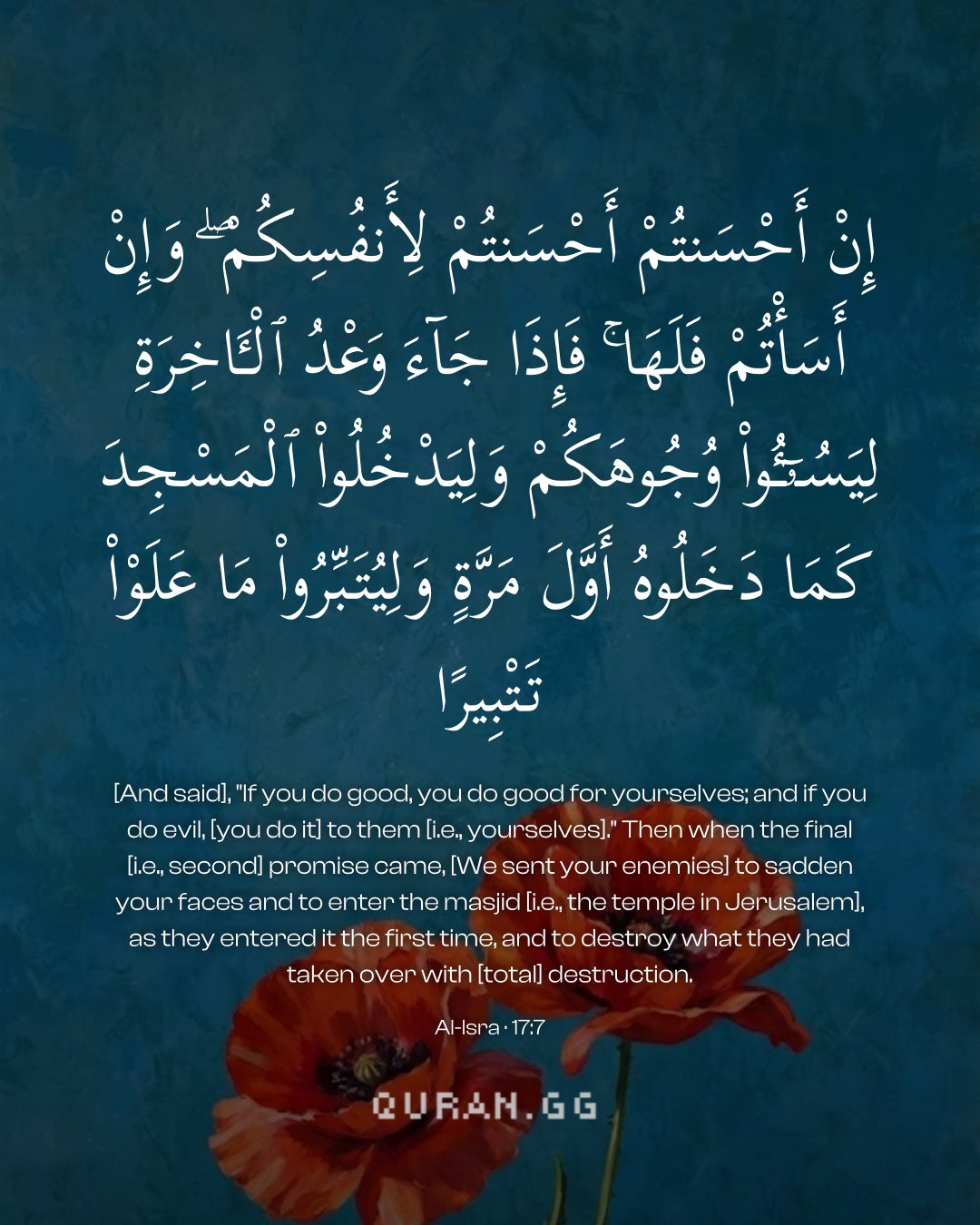
[And said], "If you do good, you do good for yourselves; and if you do evil, [you do it] to them [i.e., yourselves]." Then when the final [i.e., second] promise came, [We sent your enemies] to sadden your faces and to enter the masjid [i.e., the temple in Jerusalem], as they entered it the first time, and to destroy what they had taken over with [total] destruction.
It was mentioned in the Tawrah that the Jews would spread Mischief twice
Allah tells us that He made a declaration to the Children of Israel in the Scripture, meaning that He had already told them in the Book which He revealed to them, that they would cause mischief on the earth twice, and would become tyrants and extremely arrogant, meaning they would become shameless oppressors of people, Allah says:
(And We made known this decree to him, that the root of those (sinners) was to be cut off in the early morning.)(15:66), meaning, We already told him about that and informed him of it.
Verses 2 and 3 featuring the statement: (We made it guidance for the children of Bani Isra'il) exhorted the Bani Isra'il to follow and obey the Divine Law. The verses that follow warn and admonish them on their disobedience. These verses mention two events relating to the Bani Isra'il so that they serve as a lesson. Tuned to sin and disobedience, first they increased the tempo of their hostility. Allah Ta` ala set their enemies upon them. They shook them up. The Jews got the message, cut down on their mischief and gave the impression of having been corrected. But, soon after, the same lust for mischief and misdeeds overtook them. So then, Allah Ta’ ala had them punished at the hands of their enemies. The Qur'an mentions two events while history carries six like these:
The ‘corruption’, or fasad, referred to here occurred among the Children of Israel after the advent of Moses. This happened in two stages. The details of the first instance of corruption are found in the Old Testament books of Psalms, Isaiah, Jeremiah and Ezekiel. The details of the second instance of corruption are found in the words of Jesus in the New Testament in the Gospels of Matthew and Luke. The Prophet Muhammad was taken from Makkah to al-Masjid al-Aqsa in Jerusalem, in order to be shown ‘the sign of God.’ One of these signs is also the history associated with al-Masjid al-Aqsa. The above verse just means a place of worship situated at a distance. It is called the farthest place of worship, because it was situated at a distance of 765 miles from Makkah. Al-Masjid al-Aqsa, in this context, refers to the Jewish place of worship, that is, the Haykal Synagogue. This Jewish synagogue, built by Solomon in 957 BC, was razed to the ground in 586 BC by the king of Babylonia, Nebuchadnezzar II. After a long period of time, the Jews rebuilt their place of worship. This was gain reduced to ruins in AD 70 by the Romans. This history is a manifestation of God’s Law which lays down that if a community entrusted with the Holy Scriptures discharges the obligations attached to them, then it is given a high status in this world, as well as success in the Hereafter. If it fails to do so, it is made subject to oppressive communities, which make it a victim of their tyranny and exploitation. The manifestation of this law has occurred again and again in the case of former bearers of the scriptures. Two important events of direct relevance have been referred to here, so that a lesson may be taken from them. In the beginning God blessed the Children of Israel and delivered them from the Pharaoh’s tyranny and permitted them to occupy Palestine and establish their rule there. But then, corruption set in among the Jews. They started engaging in polytheistic practices, became the victims of differences and schisms, and separated into different groups. As a result of this repeated disobedience to God, the Children of Israel had to submit to Nebuchadnezzar, the King of Babylon, who established his dominion over Palestine. Thereafter, he chose a member of the royal family of the Jews and appointed him as his representative to rule over them. But, the Jews, considering this subordinate state damaging to their national pride, rebelled against it. This was despite being advised against rebellion by one of their prophets, Jeremiah. The King of Babylon became so incensed that once again, in 486 B.C., he attacked Palestine with all his military might. The Jews were not only totally defeated, but their temple in Jerusalem, which was the last sign of their glory, was also completely demolished.