Surah Al-Isra Ayah 72 (17:72) — Meaning & Tafsir | Quran.GG

Surah Al-Isra, Ayah 72

17:72 · Meaning and tafsir

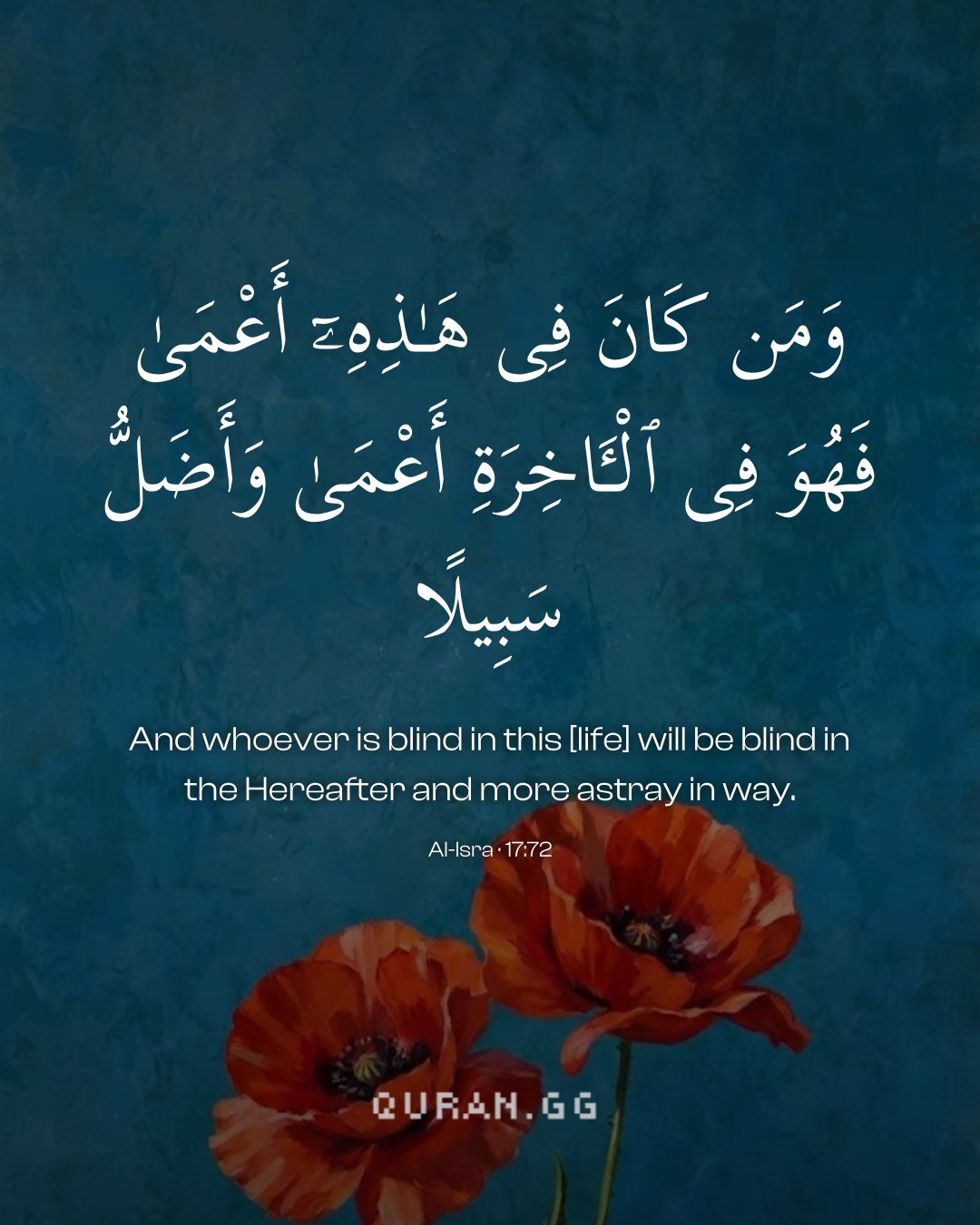
وَمَن كَانَ فِى هَـٰذِهِۦٓ أَعْمَىٰ فَهُوَ فِى ٱلْـَٔاخِرَةِ أَعْمَىٰ وَأَضَلُّ سَبِيلًا ٧٢

And whoever is blind in this [life] will be blind in the Hereafter and more astray in way.

Surah Al-Isra 17:72 in Arabic with its translation: “And whoever is blind in this [life] will be blind in the Hereafter and more astray in way.”

Make something with this ayah

Turn it into a video for Stories, Reels or TikTok, recited by the reciter you pick, or an image on a background you choose. Free, in your browser.

Download this image

Tafsir Ibn Kathir (abridged)

Everyone will be called by his Imam on the Day of Resurrection

Allah tells us that on the Day of Resurrection, he will call each people to account by its Imam. The scholars differed as to the meaning of this (i.e. Imam. Mujahid and Qatadah said that it meant each nation would be called to account by its Prophet. Some of the Salaf said this is the greatest honor for the people of Hadith, because their leader is the Prophet . Ibn Zayd said it means they would be called to account by their Book which was revealed to their Prophet with its laws. This was also the view favored by Ibn Jarir. Ibn Abi Najih narrated that Mujahid said, "With their Books." It may be that what is meant here is what Al-`Awfi narrated from Ibn `Abbas concerning this Ayah,

Continue reading the tafsir of ayahs 71–72

Ma'arif al-Qur'an

Commentary

The word: اِمَام (Imam) in the first sentence of verse يَوْمَ نَدْعُو كُلَّ أُنَاسٍ بِإِمَامِهِمْ translated as ' (Think of) the Day We will call every people with their book of deeds' appears here in the sense of 'book' as in Surah Ya Sin: وَكُلَّ شَيْءٍ أَحْصَيْنَاهُ فِي إِمَامٍ مُّبِينٍ (and We have enumerated everything in a clear book - 36:12). Here, إِمَامٍ مُّبِينٍ means a clear book. Then, 'kitab' is called 'imam' for the reason that, in the event of some error or difference, one turns to the book very much like turning to a religious leader who is followed. (Qurtubi)

And it also appears from a Hadith of Tirmidhi as narrated by Sayyidna Abu Hurairah ؓ (Tirmidhi calls it Hasan Gharib) that, 'imam' in this verse means 'kitab.' The words of the Hadith are given below:

Continue reading the tafsir of ayahs 71–72

Tazkirul Quran

In this world all human groups have their leaders. Similarly, in the Hereafter all groups will be rated along with their respective leaders—good people with their good leaders and evil people with their evil leaders. Subsequently, everyone will be given a full record of his deeds in the world he left behind. The record of good people will be placed in their right hands while the record of bad people will be placed in their left hands. This will serve as a tangible sign that the first group is God’s favoured group and the second is the disfavoured group. The division between bad and good in the Hereafter will be on the basis of who lead his life in this world like a deaf and blind man and who lead his life in this world like one possessed of sight. Since God does not converse with man directly in this world, His messages have to be learned through the silent signs of this universe and through the words of God’s messengers. Those who apprehend this indirect communication of the divine message will be regarded as possessing sight in this world. And those who do not understand this ‘indirect language’ and wait for the day when God Himself will appear and speak, are the ones who are blind in the eyes of God. Ultimately, the direct words of God will be of no avail to them. They will remain as far from the reality of truth at that time as they are today.

Uthmani text of the Madinah mushaf (King Fahd Complex). Translation: Saheeh International. Tafsir via Quran.com.