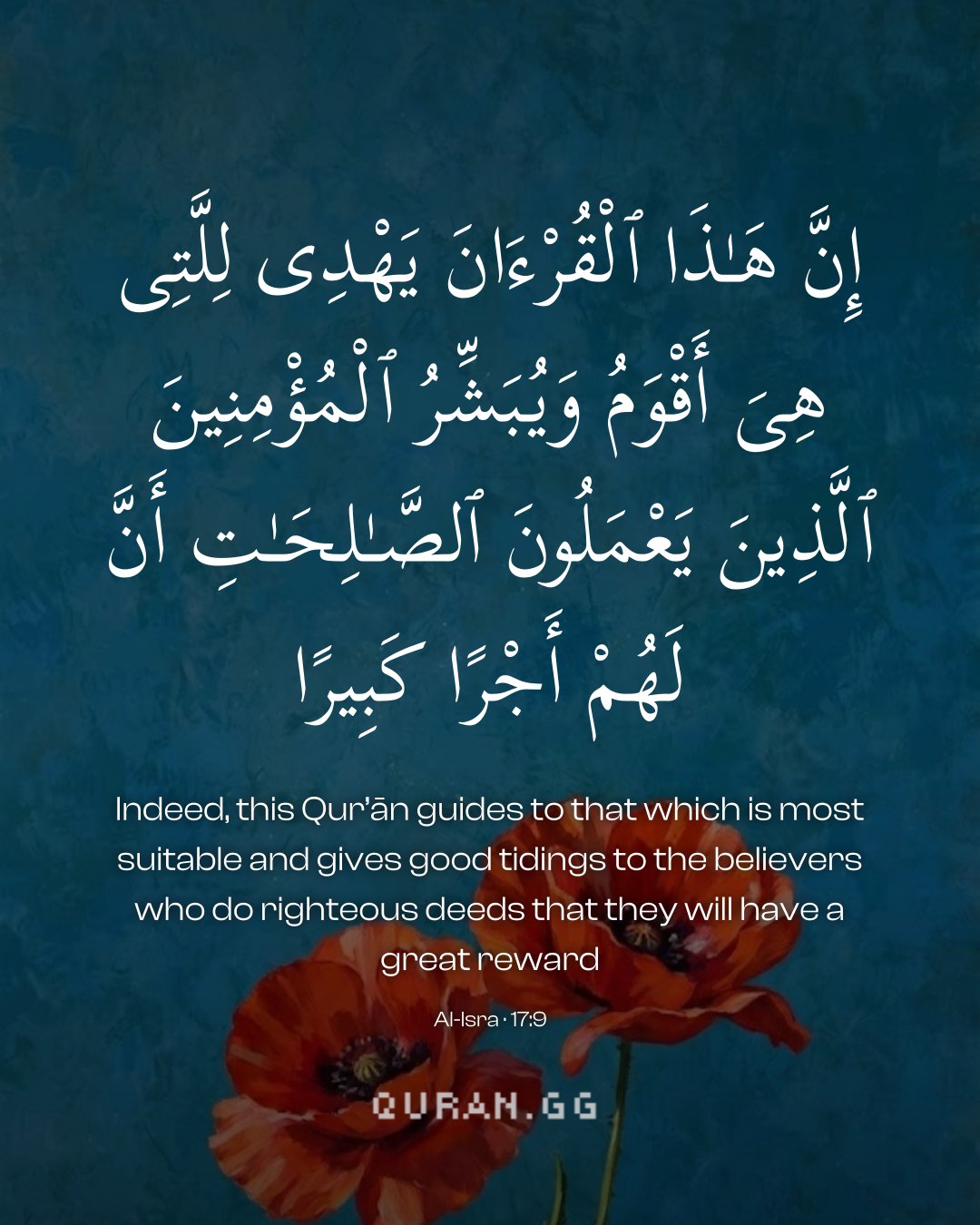
Indeed, this Qur’ān guides to that which is most suitable and gives good tidings to the believers who do righteous deeds that they will have a great reward
Allah praises His noble Book, the Qur'an, which He revealed to His Messenger Muhammad ﷺ. It directs people to the best and clearest of ways.
وَيُبَشِّرُ الْمُؤْمِنِينَ
(gives good news to those who believe,) in it a
الَّذِينَ يَعْمَلُونَ الصَّـلِحَاتِ
(those who do righteous deeds,) in accordance with it, telling them
أَنَّ لَهُمْ أَجْرًا كَبِيرًا
(that they will have a great reward,) i.e., on the Day of Resurrection. And He tells
وأَنَّ الَّذِينَ لاَ يُؤْمِنُونَ بِالاٌّخِرَةِ
(those who do not believe in the Hereafter,) that
لَهُمْ عَذَاباً أَلِيماً
(for them is a painful torment,) i.e. on the Day of Resurrection. As Allah says:
فَبَشِّرْهُمْ بِعَذَابٍ أَلِيمٍ
(... then announce to them a painful torment.) 84:24
Ma'arif al-Qur'an
Mufti Muhammad ShafiOn ayahs 9–10
Sequence
At the beginning of the Sarah, the majesty of the prophet-hood of the Messenger of Allah was described through the miracle of al-Mi` raj. The present verses cite the miracle of Qur'an as its confirmation.
Commentary
The most upright way
The way to which the Qur'an guides has been called 'aqwam,' the most upright. 'Aqwam' can be explained by saying that it is a way that is closer to the destination, is easy and free of dangers at the same time. (Qurtubi) This tells us that the rules set for human life by the Holy Qur'an are a combination of all three features mentioned above. However, it is a different matter that man may start taking this way to be difficult or dangerous on occasions because of his own lack of comprehension. But, the Lord of all the worlds has the most comprehensive knowledge of every single particle in the entire universe. Before Him, the past and the future are the same. It is He who can have the knowledge of the reality as to the function and form most beneficial for human beings. And since man is unaware of things as they are in a comprehensive setting, he can-not identify even his own good or bad fully and decisively.
Tazkirul Quran
Maulana Wahiduddin KhanOn ayahs 8–9
Various calamities inclined the Children of Israel to turn back to God once again. They were then given divine assistance through the agency of Cyrus, the King of Iran, who attacked and captured Babylon in 539 B.C., having defeated its ruler. Cyrus showed his favour to the Jews by allowing them to leave Babylon and return to their native place, Palestine. There, after a long time, they constructed their temple once again. However, the corruption, which had prevailed in the previous generation of the Jews, began to set in in the new generation also. In the meantime, they faced many vicissitudes. Their own prophets, John the Baptist and Jesus, who rose from among them, criticized their behaviour, revealing the irreligiousness they indulged in in the name of religion. This enraged the Jews. They went so far as to kill John the Baptist and were prepared to crucify Jesus. Then the wrath of God descended upon them once again. In the year 70 A.C., the Roman King, Titus, attacked Jerusalem and destroyed it completely. The Jews recognize these events as a part of their history, but when they mention these historical facts, they attribute them to the oppression of tyrants. The Quran, however, very clearly attributes them to the behaviour of the People of the Book themselves. This shows that political conditions are always subject to moral conditions. No tyrant oppresses any community unless the corruption of the religious and moral conditions of that community gives him the opportunity to do so, i.e. it allows him to make them his victims.
Uthmani text of the Madinah mushaf (King Fahd Complex). Translation: Saheeh International. Tafsir via Quran.com.